FORCETALLY
Loading the evidence…
Preparing your view.


Preparing your view.
Radar & sensorsIn service
active electronically scanned array counter-battery radar
SLC-2 Radar is a active electronically scanned array counter-battery radar originating in China.
 China
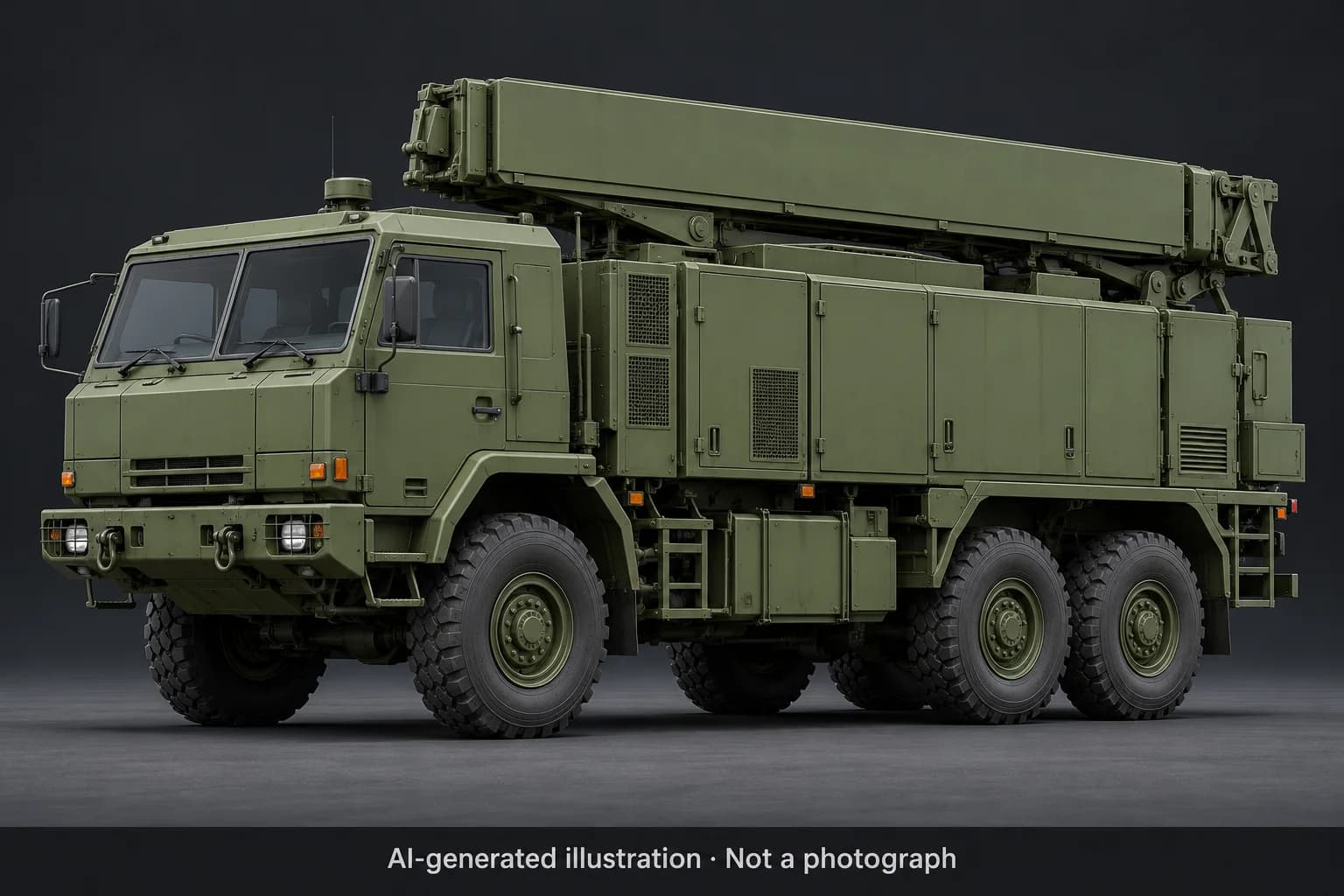
AI-generated illustration · Not a photograph. Representative SLC-2 radar carrier in transport configuration; details are illustrative and do not establish specifications.
ForceTally · AI-generated illustration · Not a photograph · AI-generated · OpenAI output terms · Source ↗ · ModifiedThe SLC-2 Radar is a Chinese active electronically scanned array counter-battery radar designed to locate hostile artillery, rocket and ground-to-ground missile launchers immediately after firing, and to support friendly artillery by guiding counter-battery fire.
is a Chinese active electronically scanned array counter-battery radar
designed to locate hostile artillery, rocket and ground-to-ground missile launchers immediately after firing
SLC-2 systems have sometimes been mounted on a Dongfeng EQ2102 3.5 ton truck
Specifications S - band
For artillery—35 km
For rockets—50 km
Peak power: 45 kW
Active phased array antenna with electronic scanning both in azimuth and elevation
SLC-2 systems have sometimes been mounted on a Dongfeng EQ2102 3.5 ton truck .
Four AN/TPQ-37 Firefinder radars were sold to China, and these became the foundation of the SLC-2 radar development. Aside from political reasons, the US$10 million plus unit price tag of the TPQ-37 (including after sale logistic support) was simply too costly for the Chinese. The decision was made to develop a domestic equivalent after mastering the technologies of the TPQ-37. After the initial test of the TPQ-37 in Tangshan (汤山) Range near Nanjing in 1988, and in Xuanhua District in October of the same year, several shortcomings of the TPQ-37 were discovered, and further intensive tests were conducted and completed in 1994.
One of the shortcomings of TPQ-37 revealed in tests was in its multi-targeting capability. When enemy artillery batteries located more than two hundred meters apart fired simultaneously, the TPQ-37 could provide accurate coordinate for distance, but coordinates for positions were less accurate. This would not be a problem for most users because TPQ-37 can be used in pairs in conjunction, provide accurate coordinates for locations. However, these costly radars could not be purchased in large numbers and China thus developed the capability for SLC-2 to provide accurate coordinates for both distance and position. Myanmar Army currently operating as many as 27 SLC-2 radars for artillery force. Bangladesh Bought two in 2012. Pakistan also operates significant number of SLC-2 Radar
Detection range: (for 80% detection probability against 81-mm mortar rounds sized target) For artillery—35 km For rockets—50 km
Accuracy: 0.35% of range (for range more than 10 km) 35 m (for range less than 10 km)
Peak power: 45 kW
China Electronics Technology Group Corporation
frequency: S band
instrumented range : 50 km
frequency: S band
peak power : 45 kW
instrumented range : 50 km
accuracy : 0.35% or 35 m
SLC-2 radar is an S band counter-battery radar designed to locate hostile artillery, rocket and ground-to-ground missile launchers immediately after firing, and to support friendly artillery by guiding counter-battery fire. It is a fully solid-state, highly digitized radar that adopts a planar active electronically scanned array . In addition it is equipped with optical infrared system and sound measuring systems that enable to discover enemy’s stealth attack.
Reference text from Wikipedia contributors, used under CC BY-SA 4.0.
Two SLC-2 radars are delivered to Bangladesh in 2012.
SLC-2 Radar equipment records. Variants, orders and quantities are shown as reported in each inventory source; coverage is incomplete.
 Bangladesh
Reported count for SLC-2. Service scope: Bangladesh Army; does not replace a national total. 1 distinct count cell(s) from the same source list; shared rowspan cells counted once. Retired, wholly reserve and on-order rows are excluded; the reported count retains any explicitly mixed stock scope in the quoted row. Count column(s): quantity: 10. Origin: China. The listed variants/roles are the scope, not an immediately deployable count. The components do not establish one inventory census date; the stored date is the retrieved source snapshot.
 Pakistan
 Thailand
Keep exploring
mobile active electronically scanned array counter-battery radar system
 United States
Passive electronically scanned array
transportable passive electronically scanned array air search 3D radar
United StatesCaptor-M : Solid-state Mechanically Scanned Array (MSA) Captor-E : Active Electronically Scanned Array (AESA)
solid state L band medium range tactical 3D radar with active electronically scanned array (AESA) in elevation
 Israel
Counter-battery radar
 Russia