FORCETALLY
Loading the evidence…
Preparing your view.


Preparing your view.
Radar & sensorsIn service
transportable passive electronically scanned array air search 3D radar
AN/TPS-75 is a transportable passive electronically scanned array air search 3D radar originating in United States. It was built by Westinghouse Defense and Electronic Division. Reported operators include United States Air Force.
 United States
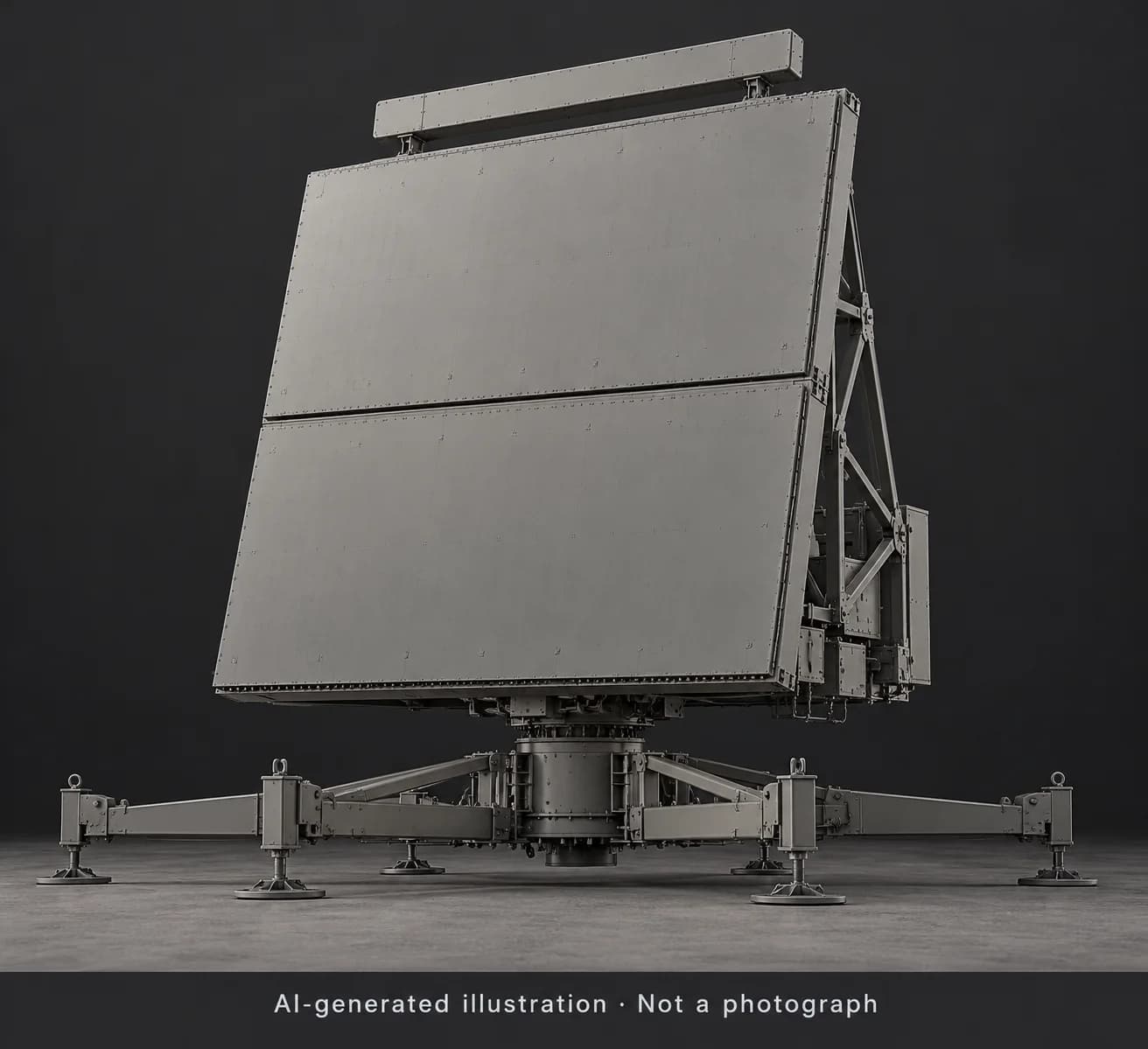
AI-generated illustration · Not a photograph. Representative AN/TPS-75 radar with deployed Ultra-Low Sidelobe Antenna; details are illustrative and do not establish specifications.
ForceTally · AI-generated illustration · Not a photograph · AI-generated · OpenAI output terms · Source ↗ · ModifiedTechnical data
AN/TPS-75 is a transportable passive electronically scanned array air search 3D radar
3D radar produced in the United States
originally by Westinghouse Defense and Electronic Division
radar used by the United States Air Force
capable of transmitting 5-Megawatts of power
realistically it is approx 2.8 Megawatts
packed onto two M939 trucks for road transport and mobile air transport by planes such as the C-130 Hercules or bigger
The AN/TPS-75 is a transportable passive electronically scanned array air search 3D radar produced in the United States.
The AN/TPS-75 is the primary transportable Aerospace Control And Warning (AC&W) radar used by the United States Air Force . The TPS-75 is capable of transmitting 5-Megawatts of power. (Although 5-Megawatts is almost never achieved; realistically it is approx 2.8 Megawatts)
The entire system can be broken down and packed onto two M939 trucks for road transport and mobile air transport by planes such as the C-130 Hercules or bigger. The entire radar system can be "torn down" and be ready for transport in just a few hours. This varies greatly with the number of personnel, their level of training, and method of transport. A typical convoy package would consist of one 5-ton truck pulling the radar van with the radar antenna in the bed of the truck and a support 5-ton pulling an AN/MJQ-1632 400 Hz power plant. The support truck would hold some spare parts, fuel tank(s), camouflage netting, and other logistical items as needed. The heat exchanger and -18 environmental control unit (ECU) are normally loaded into and transported within the radar van.
frequency: 2.9 … 3.1 GHz
instrumented range : 240 NM
frequency: 2.9 … 3.1 GHz
pulse repetition frequency (PRF) : 235 … 275 Hz
pulsewidth ( τ ): 6.8 ±0.25 µs
peak power : 2.8 MW
average power : 4.7 kW
instrumented range : 240 NM
beamwidth : 1.1°
Reference text from Wikipedia contributors, used under CC BY-SA 4.0.
antenna rotation : 6.5 r.p.m.
MTBCF : > 1 500 h
The AN/TPS-75 is a land-based tactical air defense radar operating in S band (IEEE designation) or in the E/F band (NATO designation). This system is an upgrade of the AN/TPS-43/70 family of radars with significantly better electronic protection measures, increased performance, and enhanced reliability and maintainability. It employs the Ultra-Low Sidelobe Antenna ( ULSA ) which decreases sidelobe emission by more than 50 per cent and considerably reduces vulnerability to anti-radiation missiles . The radar uses Barker Phase Coded pulses to increase range accuracy and resolution . Pulse-to-pulse frequency diversity is used to decrease vulnerability to jamming (JATS).
This TPS-43E upgrade is one of three projects in the USAF Seek Screen programme which will provide the USAF with viable surveillance and command, control and communications capability well into the 21st century.
AN/TPS-75 equipment records. Variants, orders and quantities are shown as reported in each inventory source; coverage is incomplete.
 Switzerland
Reported count for AN/TPS-75 (FLORES). Service scope: Swiss Army; does not replace a national total. 1 distinct count cell(s) from the same source list; shared rowspan cells counted once. Retired, wholly reserve and on-order rows are excluded; the reported count retains any explicitly mixed stock scope in the quoted row. Count column(s): quantity (2024): 4. Origin: United States France. The listed variants/roles are the scope, not an immediately deployable count. The components do not establish one inventory census date; the stored date is the retrieved source snapshot.
 Taiwan
Keep exploring
Passive electronically scanned array
transportable air search 3D radar
United Statesnaval medium to long-range air and surface surveillance multibeam passive electronically scanned array 3D radar
 Netherlands
active electronically scanned array counter-battery radar
 China
mobile active electronically scanned array counter-battery radar system
United Statestransportable 2-dimensional air search radar
United States