FORCETALLY
Loading the evidence…
Preparing your view.


Preparing your view.
Radar & sensorsIn service
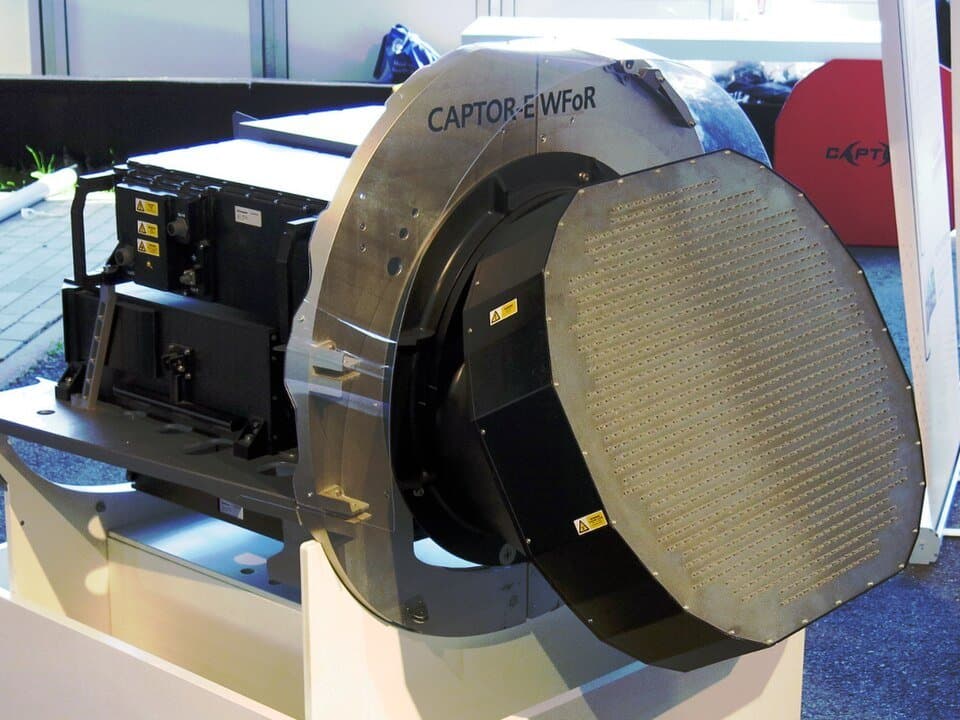
Captor-M : Solid-state Mechanically Scanned Array (MSA) Captor-E : Active Electronically Scanned Array (AESA)
Euroradar CAPTOR is a captor-M : Solid-state Mechanically Scanned Array (MSA) Captor-E : Active Electronically Scanned Array (AESA) originating in Germany , Italy , Spain , United Kingdom. It was built by Selex ES (Now Leonardo ) Airbus Defence & Space Indra Sistemas.
 Germany /
 Italy /
 Spain /
 United Kingdom
Germany , Italy , Spain , United Kingdom
Selex ES (Now Leonardo ) Airbus Defence & Space Indra Sistemas
Captor-M : Solid-state Mechanically Scanned Array (MSA) Captor-E : Active Electronically Scanned Array (AESA)
X-band
operates in the X-band from 8 to 12 gigahertz (GHz)
entire system weighs 193 kilograms (425 lb)
Eurofighter Typhoon
carbon fibre-reinforced plastic with a diameter of 0.7 metres (2 ft 4 in)
The Euroradar Captor is a next-generation mechanical multi-mode Pulse Doppler Radar designed for the Eurofighter Typhoon .
The antenna drive was based on the Blue Vixen and PS-05 of the Saab 39, and corrected pitch and roll movements with 0.5 hp samarium-cobalt motors.
Compared to the APG-65, the antenna was to be enlarged from 68 cm to 75 cm and the radiation power doubled.
In early 1990, GEC-Ferranti was finally declared the winner of the EFA radar competition and awarded a £300m contract.
Captor-E ECRS Mk.0 : Interface and integration of the radar to the aircraft is done by BAE Systems . The AESA antenna and T/R modules are made with GaAs HEMT HPA . It has a field of regard exceeding 180 degrees and uses a mechanical repostioner featuring two coupled swashplates to change the radars elevation from -30° to +30°.
Captor-E ECRS Mk.1 : Interface and integration of the radar to the aircraft is done by Airbus Germany. The AESA antenna and the T/R modules are made with GaN HEMT HPA . It has a field of regard exceeding 180 degrees. It is installed on a pivot. In June 2026 Hensoldt and Indra began live testing of the first ECRS Mk1 Step 1 radars, which add electronic-attack and wideband capability beyond the Mk1 Step 0, with delivery to the German and Spanish air forces targeted for 2027.
Captor-E ECRS Mk.2 : Interface and integration of the radar to the aircraft is done by BAE Systems . The AESA antenna and the T/R modules are made with GaAs and GaN HEMT HPA . This enables efficient multi-tasking of radar tracking use and electronic warfare simultaneously. It has a field of regard exceeding 180 degrees. It is installed on a pivot derived from the one used on the Gripen E with the Selex ES-05 Raven radar. A new radome was needed for the wider bandwidth of this radar.
The radar consists of a mechanically controlled antenna made of carbon fibre-reinforced plastic with a diameter of 0.7 metres (2 ft 4 in). The antenna can be swivelled by ±60° in elevation and +-70° azimuth . Four high-precision samarium-cobalt servomotors with high torque are used to control the antenna in order to achieve high scanning speeds. The motors can only move the planar antenna in elevation and azimuth angles while roll angles are compensated electronically by combined control in order to reduce weight. Due to the very high scanning speed for a mechanically swivelled antenna, the radar can also interleave different radar modes, which would only otherwise be possible with phased array antennas, albeit much faster. For example, air-to-air and air-to-ground modes can be combined in one scan pass. The accuracy is less than one milliradian in alignment and less than 10 metres (33 ft) in distance.
The entire system weighs 193 kilograms (425 lb) and the computers are cooled with both liquid and air.
In general, a bandwidth of 400 MHz and a large number of measurements are considered necessary to identify airborne targets.
If an aerial target is lost in TWS mode, the suspected target area no longer has to be swivelled in a time-consuming manner with a signal lobe: The Combat Search mode generates multiple signal lobes that cover the target area in a chessboard-like manner within an angle range of 20° × 20°.
Alcance efectivo 175 km
Alcance máximo 370 km
Reference text from Wikipedia contributors, used under CC BY-SA 4.0.
Points represent sourced observations, including revisions. Revisions on the same effective date are not separate inventory events. Ranges appear in the table and are not plotted as exact points.
| Observation / report period | Value | Source | Claim state |
|---|---|---|---|
| 1 Oct 2026 | 8–12 GHz | Wikipedia contributors | approved |
Euroradar CAPTOR equipment records. Variants, orders and quantities are shown as reported in each inventory source; coverage is incomplete.
GermanyReported count for Euroradar CAPTOR · CAPTOR ECRS Mk1 - Step 1 / Euroradar CAPTOR · CAPTOR ECRS Mk1 Step 2. Service scope: equipment of the German Air Force; does not replace a national total. 3 distinct quantity component(s) from the same source list; shared rowspan cells counted once. Explicit source inventory scope: ordered; no other stock status or total inferred. Count column(s): quantity ordered: 110 / quantity ordered: 38 / quantity ordered: 20. Origin: Germany Spain. The listed variants/roles are the scope, not an immediately deployable count. The components do not establish one inventory census date; the stored date is the retrieved source snapshot.
Keep exploring
solid state L band medium range tactical 3D radar with active electronically scanned array (AESA) in elevation
 Israel
Passive electronically scanned array
active electronically scanned array counter-battery radar
 China
mobile active electronically scanned array counter-battery radar system
 United States
transportable passive electronically scanned array air search 3D radar
United StatesTransportable multimode solid state active phased array radar.
Israel