FORCETALLY
Loading the evidence…
Preparing your view.


Preparing your view.
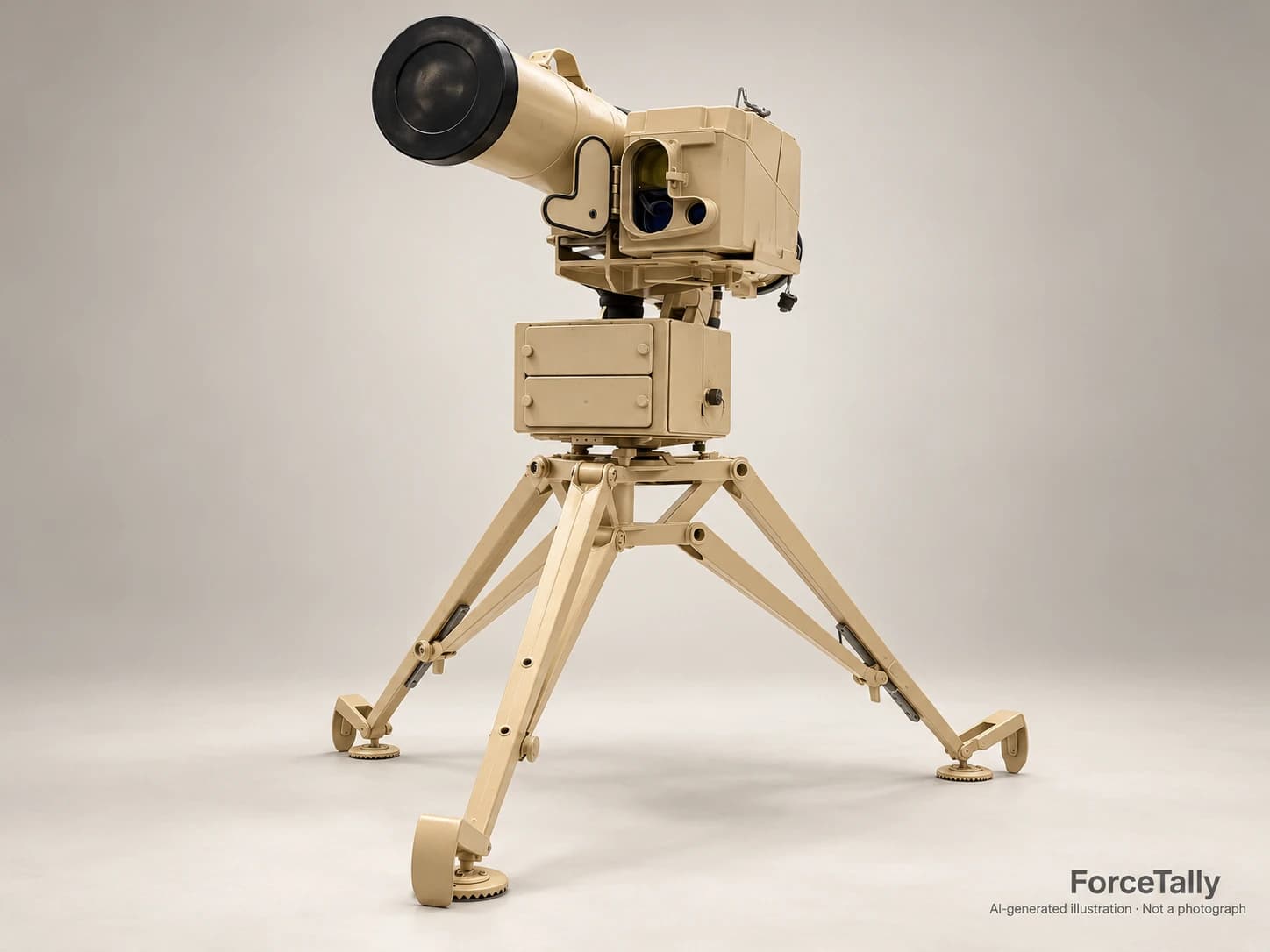
Anti-tank weaponsIn service
ATGM
Skif (anti-tank guided missile) is a aTGM originating in Ukraine. Reported operators include Azerbaijan, Algeria, Saudi Arabia, Myanmar, Georgia, Ukraine, Morocco, Qatar, Egypt, Jordan.
 Ukraine
AI-generated illustration · Not a photograph · Skif / Stugna-P · illustrated source-pictured tripod-mounted launcher assembly; separate tube and terminal omitted. Exterior details are illustrative, not specification evidence.
ForceTally · AI-generated illustration · Not a photograph · Adapted from VoidWanderer · CC BY-SA 4.0 · CC BY-SA 4.0 · Source ↗ · ModifiedATGM
Ukraine
2011–present
See Users
War in Donbas Russian invasion of Ukraine
Kyiv Design Bureau "Luch" , OJSC Peleng
See Variants
97 kg (214 lb); full system including missile 104 kg (229 lb)
130 mm, 152 mm
Impact fuze
Day: 5/5.5 km Night: 3 km
Laser beam riding with target tracking in TV or thermal imaging channels in manual or auto mode
Manual or automatic
Tripod , vehicle mount on remote weapon station (RWS)
Azerbaijan
Algeria
Saudi Arabia
Myanmar
Georgia
Ukraine
Morocco
Qatar
Egypt
Jordan
The initial guidance device PN-S (ПН-С) of the Skif was developed and manufactured by Belarusian design bureau Peleng based in Minsk .
The Skif , also known as the Stugna-P or Stuhna-P ,
The Skif , also known as the Stugna-P or Stuhna-P ,
The Skif , also known as the Stugna-P or Stuhna-P , is a Ukrainian anti-tank guided missile (ATGM) system developed in the early 2010s by the Luch Design Bureau , a unit of UkrOboronProm .
The Skif is designed to destroy modern armored targets with combined carried or monolithic armor, including explosive reactive armor (ERA). The Skif can attack both stationary and moving targets. It can be used to attack from both long range (up to 5 kilometres [3.1 mi] in the daytime) and close range (100 metres; 330 ft). It can attack point targets such as weapon emplacements, lightly armored objects, and hovering helicopters. The Skif has two targeting modes: manually steered, and automated fire-and-forget that uses no manual tracking of a target. In 2018, an upgraded export variant of the Skif was tested by the Ukrainian military .
The Skif ATGM system should not be confused with the Stugna 100-mm gun-launched anti-tank missile.
The Skif consists of a tripod , PDU-215 remote control panel, guidance device, and thermographic camera (thermal imager). Each round of ammunition comes in its own canister of either 130 or 152 mm diameter.
The PDU-215 control panel is a briefcase-like laptop computer with a control panel, holding a small joystick and a flat-panel display , that is connected to the firing unit by a cable, allowing it be used at distances up to 50 metres (160 ft) away. Two firing modes are available: manual, and fire-and-forget. Fire-and-forget provides automatic control of the missile flight using a targeting laser beam.
A three to four-person team is optimal for deploying the Skif. Operators require specially-made backpacks. Once the missile is fired, the operator controls the Skif and corrects the aim when needed, by using the joystick on the remote control. The Skif's system has a shelf life of 15 years. The missiles have a 10-year shelf life.
The system comes complete with 130 mm and 152 mm caliber missiles in transport and launching containers. Tandem charge high-explosive anti-tank (HEAT) RK-2S warheads might be able to counter medium weight main battle tanks such as the T-90 A with penetration of 800 millimetres (31 in) behind ERA . RK-2M-K warheads might be able to counter heavy main battle tanks such as M1A2 Abrams with their penetration of 1,100 millimetres (43 in) behind ERA. The system also includes high explosive (HE) fragmentation RK-2OF and RK-2М-OF warheads to attack infantry positions and light armored vehicles. The system can use all four types of missiles with no modification. The system's thermal imager can be used during night operations . According to a 2014 article, SLX-Hawk thermal imaging camera produced by Selex ES can be installed for use at night and in poor visibility conditions. The Ukrainian military only uses the 130 mm caliber missiles, as the 152 mm versions were made to compete against the Russian Kornet-EM on the export market.
System configuration with 130 mm missiles using RK-2S and RK-2OF warheads.
Missile caliber: 130 mm
Firing range (day): 100–5,000 metres (110–5,470 yd)
Firing range (night): 100–3,000 metres (110–3,280 yd)
Full system weight: 97 kilograms (214 lb)
Missile in container weight: 30 kilograms (66 lb)
Warhead penetration: RK-2S tandem-charge HEAT : Not less than 1,000 millimetres (39 in) RHA behind ERA RK-2OF HE-fragmentation : Not less than 60 millimetres (2.4 in) RHA with at least 600 fragments
Container length: 1,360 millimetres (54 in)
System configuration with 152 mm missiles using RK-2M-K and RK-2М-OF warheads:
Missile caliber: 152 mm
Firing range (day): 100–5,500 metres (110–6,010 yd)
Full system weight: 104 kilograms (229 lb)
Missile in container weight: 37 kilograms (82 lb)
Warhead penetration: RK-2M-K tandem-charge HEAT : Not less than 1,200 millimetres (47 in) RHA behind ERA RK-2М-OF HE- fragmentation : Not less than 120 millimetres (4.7 in) RHA with at least 1000 fragments
SERDAR is a stabilized remote controlled weapon station (RCWS). The system was developed jointly by the Luch Design Bureau, Turkish company Aselsan , and SpetsTechnoExport, part of Ukraine's Ukroboronprom enterprise. The system carries two (in some versions four) 130 mm or 152 mm missiles with RK-2S or RK-2M-K tandem-charge HEAT warheads. The system is also equipped with 12.7 mm and 7.62 mm caliber machine guns. A joint company for the production of Skif missiles was established in Turkey and production began in early 2020.
Shershen is a Belarusian ATGM based on Skif. It also has different types of 130 mm and 152 mm missiles.
As the war has moved to the Donbas and fighting has changed from wooded areas to open plains, the missile has been fitted to light vehicles to make it mobile. The Skif is being used in the same way US forces used the TOW missile system in the 1980s and the Gulf War Desert Patrol Vehicle . On 25 April, near Izyum, during one engagement four tanks were destroyed or damaged in 4 minutes by the same Skif operator.
According to Ukrainian soldiers, one missile has hit a Russian tank at 5,300 meters (300 m beyond the nominal maximum range of 5 km).
The initial guidance device PN-S (ПН-С) of the Skif was developed and manufactured by Belarusian design bureau Peleng based in Minsk .
Länge RK-2S: 1,36 m RK-2M: 1,45 m
Reference text from Wikipedia contributors, used under CC BY-SA 4.0.
True scale
Sourced dimensions beside a 1.75 m human reference.
Points represent sourced observations, including revisions. Revisions on the same effective date are not separate inventory events. Ranges appear in the table and are not plotted as exact points.
| Observation / report period | Value | Source | Claim state |
|---|---|---|---|
| 28 Sept 2026 | 0.13 m | Wikipedia contributors | superseded |
| 28 Sept 2026 | 0.13 m | Wikipedia contributors | superseded |
| 28 Sept 2026 | 0.13 m | Wikipedia contributors | superseded |
| 28 Sept 2026 | 0.13 m | Wikipedia contributors | superseded |
| 28 Sept 2026 | 0.13 m | Wikipedia contributors | superseded |
| 28 Sept 2026 | 0.13 m | Wikipedia contributors | approved |
Skif (anti-tank guided missile) equipment records. Variants, orders and quantities are shown as reported in each inventory source; coverage is incomplete.
Azerbaijan, Algeria, Saudi Arabia, Myanmar, Georgia, Ukraine, Morocco, Qatar, Egypt, Jordan
Equipment reference ↗ Algeria
 Azerbaijan
 Egypt
 Georgia
 Jordan
 Morocco
 Myanmar
 Qatar
 Saudi Arabia
 Israel
 Brazil