FORCETALLY
Loading the evidence…
Preparing your view.


Preparing your view.
Anti-tank weaponsIn service
ATGM
9M119 Svir/Refleks is a aTGM originating in Soviet Union. It was built by Degtyarev plant. Reported operators include Soviet Union Russia China India Serbia South Korea.
ATGM
Soviet Union
1985–present
Soviet Union Russia China India Serbia South Korea
First Chechen War Russo-Ukrainian War
Tula Machinery Design Bureau (Tula KBP)
1980s
Degtyarev plant
$37,500 (2012)
1980s–present
9M119M
16.5 / 17.2 kg
125 mm
Tandem hollow-charge
4.5 kg
4,000 / 5,000 m
Supersonic
Laser beam riding
125 mm smoothbore guns
China
Cyprus
Georgia
Iran
Iraq
India
Morocco
Pakistan
Russia
Serbia
Syria
Ukraine
Vietnam
Soviet Union - Passed on to Russia.
South Korea - Retired in early 2019, with the T-80U Main battle tanks.
The 9K120 Svir , 9K119 Refleks , 9K119M Refleks-M ( NATO reporting name AT-11 Sniper ) are laser beam riding , guided anti-tank missile systems developed in the Soviet Union . Both are designed to be fired from smoothbore 125 mm tank and anti-tank guns ( 2A45 , 2A46 and 2A46M). The name Svir comes from the River Svir , while Refleks means reflex .
The first guided anti-tank missile system fired from smoothbore 125 mm tank guns, the 9K112 Kobra , appeared on Soviet T-64B tanks in 1976. However, they were incompatible with the autoloader of the T-72 tanks (while the T-64 also had an autoloader, it was very different from the one in T-72), so the new missile system was developed for T-72.
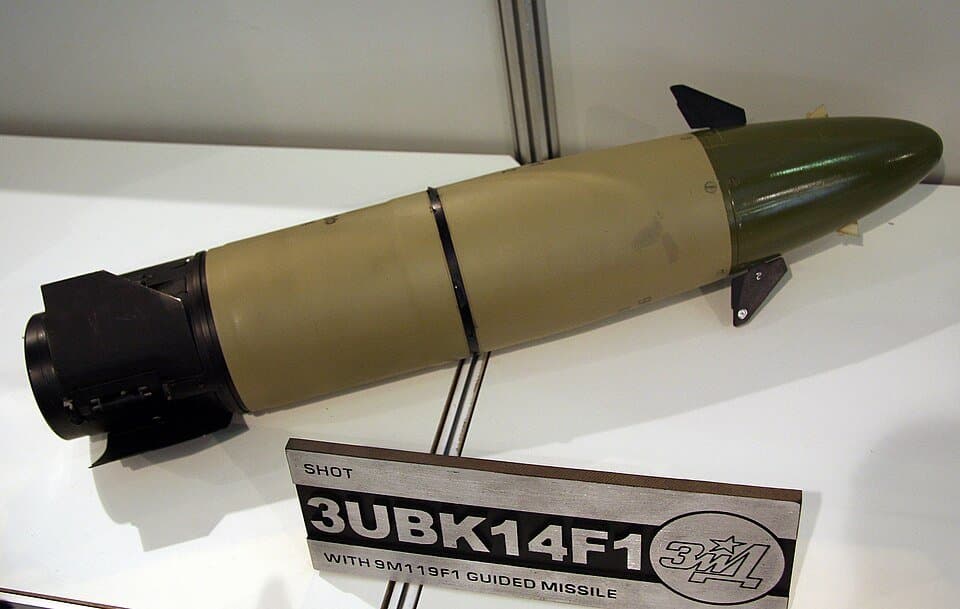
9M119M "Refleks-M" missiles ( GRAU designation: 3UBK20) can be fired from the T-72B, T-80U, and T-90S through the use of a 1K13-49 sight, are ejected using the 9Kh949 ejecting mechanism, and the rocket motor ignites as soon as the missile exits the barrel. Ram air collected by the air intakes in the nose is used to provide power to move the control fins. The 17.2 kg (37.8 pound) missile is 690 mm (27.1 inches) long and has pop-out fins (with a 250 mm/69 girth span) that aid in guidance. The missile is guided by the modulated laser beam steered by the tank gunner. The missile has a maximum range of 5,000 meters at a speed of 350 meters per second (17.69 seconds max flight time). The Svir/Reflex enables the tank to hit targets at twice the range of the 125mm shells. The tandem warhead can penetrate up to 900 mm of armor (35.4 inches). 9M119M "Refleks-M" was put into service in 1992, and the modernized variant 9M119M1 in the second half of the 1990s. There are also high explosive versions produced named 9M119F and 9M119F1 which are intended to defeat enemy personnel.
Russia: 9K112 Kobra (AT-8 Songster) is also fired through 125-mm smoothbore gun tubes.
India: SAMHO fired from 120mm main gun of Arjun MBT.
Israel: LAHAT , used with their 105 and 120-mm gun tubes.
France: ACRA 142mm anti-tank missile, tested on a version of the AMX-30 MBT.
Ukraine : Kombat tandem-warhead ATGM with a 5,000-m effective range, fired from 125-mm smoothbore guns. 950 mm penetration.
Iran : Reversed engineered version of the Svir with max range of 4,000 meters named Tondar.
Range: Svir: 75 to 4,000 m Refleks: 75 to 5,000 m
Weight (complete round): Svir: 28 kg Refleks: 24.3 kg
Missile Weight: Svir: 16.5 kg Refleks: 17.2 kg
Penetration: 700–900 mm of RHA
Time of flight to 4,000 m: 11.7 s
Time of flight to 5,000 m: 17.6 s
9M119M "Refleks-M" missiles ( GRAU designation: 3UBK20) can be fired from the T-72B, T-80U, and T-90S through the use of a 1K13-49 sight, are ejected using the 9Kh949 ejecting mechanism, and the rocket motor ignites as soon as the missile exits the barrel. Ram air collected by the air intakes in the nose is used to provide power to move the control fins. The 17.2 kg (37.8 pound) missile is 690 mm (27.1 inches) long and has pop-out fins (with a 250 mm/69 girth span) that aid in guidance. The missile is guided by the modulated laser beam steered by the tank gunner. The missile has a maximum range of 5,000 meters at a speed of 350 meters per second (17.69 seconds max flight time). The Svir/Reflex enables the tank to hit targets at twice the range of the 125mm shells. The tandem warhead can penetrate up to 900 mm of armor (35.4 inches). 9M119M "Refleks-M" was put into service in 1992, and the modernized variant 9M119M1 in the second half of the 1990s. There are also high explosive versions produced named 9M119F and 9M119F1 which are intended to defeat enemy personnel.
Reference text from Wikipedia contributors, used under CC BY-SA 4.0.
True scale
Sourced dimensions beside a 1.75 m human reference.
See it in your room. Scan with your phone to open this model in 3D, then place it in your space.
Points represent sourced observations, including revisions. Revisions on the same effective date are not separate inventory events. Ranges appear in the table and are not plotted as exact points.
| Observation / report period | Value | Source | Claim state |
|---|---|---|---|
| 28 Sept 2026 | 0.125 m | Wikipedia contributors | superseded |
| 28 Sept 2026 | 0.125 m | Wikipedia contributors | superseded |
| 28 Sept 2026 | 0.125 m | Wikipedia contributors | superseded |
| 28 Sept 2026 | 0.125 m | Wikipedia contributors | superseded |
| 28 Sept 2026 | 0.125 m | Wikipedia contributors | superseded |
| 28 Sept 2026 | 0.125 m | Wikipedia contributors | approved |
9M119 Svir/Refleks equipment records. Variants, orders and quantities are shown as reported in each inventory source; coverage is incomplete.
 China
 Cyprus
 Georgia
 India
Reported count for 9M119 Svir (AT-11 Sniper). Service scope: Indian Army; does not replace a national total. 1 distinct count cell(s) from the same source list; shared rowspan cells counted once. Excludes retired/reserve/on-order rows. Count column(s): quantity: 25,000. Origin: India Russia. The listed variants/roles are the scope, not an immediately deployable count. The components do not establish one inventory census date; the stored date is the retrieved source snapshot.
 Iran
 Iraq
 Morocco
 Pakistan
 Russia
 Serbia
 Syria
 Ukraine
 Vietnam
Soviet Union Russia China India Serbia South Korea
Equipment reference ↗ Israel
 Brazil