FORCETALLY
Loading the evidence…
Preparing your view.


Preparing your view.
Anti-tank weaponsIn service
ATGM
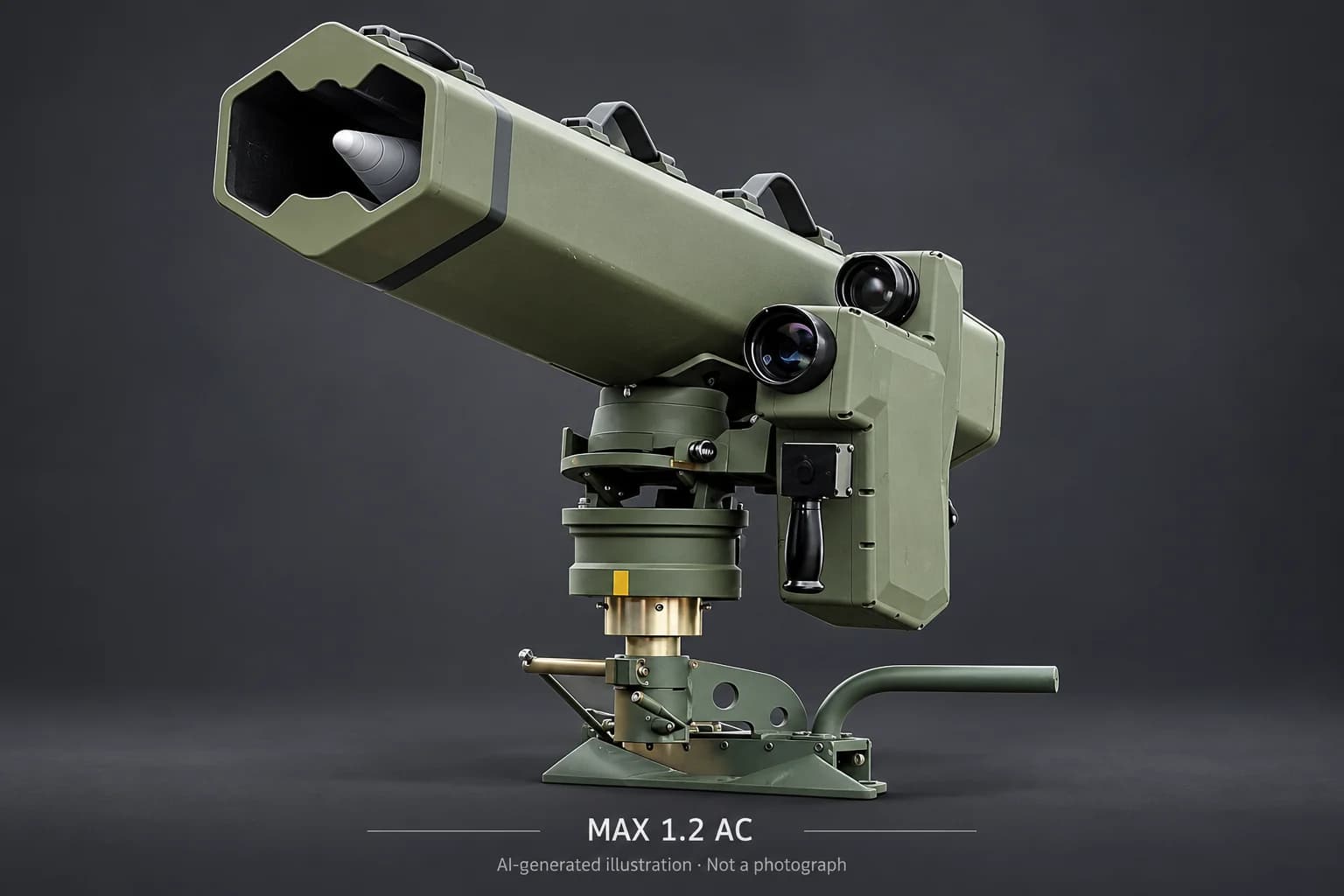
MAX 1.2 AC is a aTGM originating in Brazil. It was built by SIATT. Reported operators include Brazilian Armed Forces.

AI-generated illustration · Not a photograph — Representative MAX 1.2 AC launcher and sight assembly exterior, adapted from a licensed reference. Geometry is illustrative; not evidence for specifications.
ForceTally · Adapted from “Vehicle-mounted MAX 1.2 ATGM” by Unknown author Unknown author · CC BY-SA 2.0 · AI-generated illustration · Not a photograph · CC BY-SA 2.0 · AI-generated illustration · Source ↗ · ModifiedATGM
Brazil
Brazilian Armed Forces
1980s
SIATT
15 or 15.2 kg (missile) 24 kg (missile + launch tube) 28 kg (firing unit) 52 kg (total)
1.38 or 1.52 m
HMX in a non-tandem shaped charge HEAT warhead (at least 500 mm RHAe penetration, see #Penetration )
Two-stage engine
Two-stage solid propellant
At least 2,000 m, see #Range
274 m/s
Laser-guided semi-automatic command to line of sight
Two-person infantry crew or vehicle-mounted
The MAX 1.2 AC (previously MSS 1.2 AC ) is a Brazilian anti-tank guided missile (ATGM).
As of 2021 the Brazilian Army's anti-tank weapons, the Carl Gustaf 84 mm recoilless rifle and AT-4 launcher, are outranged by tank guns used in other South American countries: 300 meters for the AT-4 and 600-700 meters for the Carl Gustaf, on one hand, and 2,500 meters for the Tanque Argentino Mediano and 4,000 meters for the Leopard 2A4 , on the other. An anti-tank missile has greater range and lethality than such weapons. The Brazilian Army has tested missiles with ranges of up to 2,500 meters, and countries such as Chile , Colombia , Ecuador and Peru use missiles with ranges above 4,000 meters, such as the SPIKE LR and TOW 2B . The Argentine Army 's TOW2B missiles outrange the Brazilian Army's 105 millimeter Leopard 1 tank guns.
The MSS 1.2's main role is anti-tank, and it may also be used against casemates , small buildings and hovering helicopters . It consists of two systems, the Support Mode, composed of a simulator and testing equipment, and Employment Mode, composed of the launch tube, missile and firing unit, which is operated by two men, the gunner and loader. The missile and launch tube weigh 24 kg, with the firing unit contributing another 28 kg, for a total of 52 kg. In comparison, the MILAN ADT-ER has a total weight of 34 kg, the Javelin , 22,3 kg, and the TOW-2A, 21,6 kg. The launch tube is reloadable.
The guidance system uses a semi-automatic command to line of sight (SACLOS) method. The operator points the target with a laser beam on which the missile will ride . The missile detects the laser with a sensor in its tail and centers itself on the beam through electrically activated wings. Tail fins stabilize movement. The missile can handle maneuvers with accelerations of up to 5 g. The firing unit has an infrared -sensitive night vision camera.
The MAF had a minimum range of 70 m and a maximum range of 2,000 m, using an all-weather thermal imager, or 3,000 m with an optical sight in favorable conditions. The MSS 1.2 has a 500 m minimum range. Sources diverge on its maximum range, which is cited as two miles (3,220 m), about 3,000 m, or 2,000 m but reaching 3,000 m in good weather. The Army Technological Center's official page lists a 2,000 m range. Army tests deemed the missile acceptable for targets at a distance of up to 2,000 m, but the range reaches 3,000 m. Mectron representatives stated in 2007 that the Army's requirement was for a 2,000 m range, but targets 3,500 m to 4,000 m away had been hit in tests. As of October 2024, SIATT claims a range "above 2,000 meters".
Compared to alternatives in the market, the 2,000 m range is comparable to the FGM-148 Javelin's (2,000 m) and inferior to the MILAN ADT-ER's (3,000 m) and BGM-71 TOW's (3,750 m). A range extension to 4,000 m was already considered in 2013, and in September 2023 SIATT received funding from Finep for a "beam riding guidance, navigation and control link for a surface-to-surface missile with a range above 4 km".
The planned MSS 1.3 aims for a range of three kilometers, and its successor would have four kilometers as well as fire and forget guidance.
Ammunition is of the high-explosive anti-tank type inside a shaped charge warhead. Measured in Rolled Homogeneous Armor equivalency, it penetrates, depending on the source, up to 500, 530, 580 or 800 millimeters. The Army Technological Center's official number is 530 mm. This penetration is small. Although superior to the MILAN ADT-ER's, it is inferior to that of the Javelin (750 mm), Spike ER (800 mm) and TOW (900 mm). These missiles use tandem charges , allowing them to face reactive armor .
In 2021, a paper at the Officer Improvement School (Portuguese: Escola de Aperfeiçoamento de Oficiais , EsAO) compared the MSS 1.2 to other armament options for a hypothetical Anti-tank Squadron in a Mechanized Cavalry Brigade. The Brazilian system was considered inappropriate in its role, although useful for Anti-tank Sections in Mechanized Cavalry Regiments and equivalent units. The producer's experience, caliber (over 105 mm), night vision capacity, two-man crew, adaptability to vehicles, independence from auxiliary material, adaptability to Army doctrine, political convenience and cost were favorable variables within the study's criteria. Penetration in RHAe was deemed neutral as it was in the 400 to 600 mm range. Maximum range, lack of diversity in ammunition, guidance system (which isn't 4th or 5th generation) and absence of service experience were the unfavorable variables to its use.
Future versions planned as of 2024 would raise penetration beyond 1,000 millimeters and improve the missile's effectiveness against reactive armor, according to SIATT.
Calibre 130 mm
Tripulação 2
Reference text from Wikipedia contributors, used under CC BY-SA 4.0.
True scale
Sourced dimensions beside a 1.75 m human reference.
Points represent sourced observations, including revisions. Revisions on the same effective date are not separate inventory events. Ranges appear in the table and are not plotted as exact points.
| Observation / report period | Value | Source | Claim state |
|---|---|---|---|
| 14 Oct 2026 | 130 mm | Wikipedia contributors | approved |
MAX 1.2 AC equipment records. Variants, orders and quantities are shown as reported in each inventory source; coverage is incomplete.
 Ukraine
 Israel