FORCETALLY
Loading the evidence…
Preparing your view.


Preparing your view.
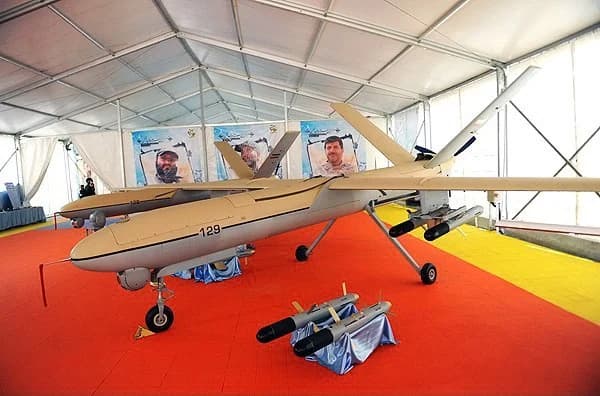
Drones & UAVsIn service
Combat / Intelligence / Surveillance / Reconnaissance (CISR)
Shahed 129 is a combat / Intelligence / Surveillance / Reconnaissance (CISR) originating in Iran. It was built by Iran Aircraft Manufacturing Industries Corporation (HESA). Reported operators include Iran.
 Iran
Technical data
Combat / Intelligence / Surveillance / Reconnaissance (CISR)
Iran
Iran Aircraft Manufacturing Industries Corporation (HESA)
Shahed Aviation Industries Research Center
In service, in production
Iran
+42
2012–present
September 2013
Spring 2012
Shahed 123
Shahed 149 Gaza
none
400 kg payload
8 m (26 ft 3 in)
True scale
Sourced dimensions beside a 1.75 m human reference.
Points represent sourced observations, including revisions. Revisions on the same effective date are not separate inventory events. Ranges appear in the table and are not plotted as exact points.
| Observation / report period | Value | Source | Claim state |
|---|---|---|---|
| 28 Sept 2026 | 1,700 km | Wikipedia contributors | superseded |
| 28 Sept 2026 | 1,700 km | Wikipedia contributors | superseded |
| 28 Sept 2026 | 1,700 km | Wikipedia contributors | superseded |
| 28 Sept 2026 | 1,700 km | Wikipedia contributors | superseded |
| 28 Sept 2026 | 1,700 km | Wikipedia contributors | superseded |
| 28 Sept 2026 | 1,700 km | Wikipedia contributors | superseded |
| 28 Sept 2026 | 1,700 km | Wikipedia contributors | superseded |
| 28 Sept 2026 | 1,700 km | Wikipedia contributors | approved |
16 m (52 ft 6 in)
3.1 m (10 ft 2 in)
1 × Rotax 914 four cylinder, four stroke aircraft engine 75 kW (100 shp)
150 km/h (93 mph, 81 kn)
1,700 km (1,100 mi, 920 nmi)
3,400 km (2,100 mi, 1,800 nmi)
24h
7,300 m (24,000 ft)
3-bladed
4 × Sadid-345 PGM
The Shahed 129 ( Persian : شاهد ۱۲۹ , English: "witness" ; sometimes S129 ) is an Iranian single-engine medium-altitude long-endurance unmanned combat aerial vehicle (UCAV) designed by Shahed Aviation Industries for the Islamic Revolutionary Guard Corps (IRGC).
The Shahed 129 ( Persian : شاهد ۱۲۹ , English: "witness" ; sometimes S129 ) is an Iranian single-engine medium-altitude long-endurance unmanned combat aerial vehicle (UCAV) designed by Shahed Aviation Industries for the Islamic Revolutionary Guard Corps (IRGC). The Shahed 129 is capable of combat and reconnaissance missions and has an endurance of 24 hours; it is similar in size, shape and role to the American MQ-1 Predator and is widely considered as one of the most capable drones in Iranian service.
The Shahed 129 is a large single-engine propeller-driven UAV with V-tail vertical stabilizers, high-mounted straight wings, and a pusher configuration , generally similar to the MQ-1 Predator . It has a long, narrow cylindrical fuselage approximately 65–75 cm in diameter, and is fabricated from large panels of composite material with an aluminum alloy superstructure. It has a chin-mounted gimbal electro-optic/infrared sensor for day/night missions, retractable landing gear, and a real-time video data link. There is also a payload bay under the drone's body, at the center of gravity. The Shahed 129 is powered by one Rotax 914 aircraft engine and has two twin hardpoints, for a total of up to four munitions.
It has a long, narrow cylindrical fuselage approximately 65–75 cm in diameter, and is fabricated from large panels of composite material with an aluminum alloy superstructure.
Though the Shahed 129 airframe is likely capable of its claimed 1700 km combat range, it relies on a ground control station, which Iranian state media say is limited to a 200 km datalink. Independent analysts are more positive, saying the effective range is likely 300–400 km, but are clear that the drone's reliance on a ground station severely circumscribes its effective range. Other experts say the Shahed 129's datalink could likely not reach even 200 km. The drone can use an autopilot system, similar to that used on the Karrar UAV, to follow predefined way-points beyond its control station's communication range. The Shahed is claimed to have a 24-hour endurance, which is considered plausible but has not been independently verified.
Two Shahed 129s were transferred to Iran's border with Pakistan in 2015, and were later supplemented by two more. Iranian military officials say that Shahed 129 UAV can increase Iran's surveillance capabilities in border areas such as the Persian Gulf and the Sea of Oman. Mohammad Ali Jafari described the UAV as "smart, accurate and inexpensive." Shahed 129s have been broadly dispersed and are not operated from any central airbase. As of 2017, two Shahed 129s were based in Damascus , Syria, three in Tactical Air Base 10 near Konarak , four in Bandar-Abbas , two on Abu Musa , and one in Urmia . Some number are also stationed in Semnan , and two are based in Kashan Air Base for training. In Syria, satellite imagery placed Shahed 129s at Hama Air Base and T4 airbase . In general, Iran has said little about the Shahed-129's use in Syria.
On the same day, on 20 June 2017, a Pakistani JF-17 shot down a Shahed 129 after it entered Pakistani airspace near Panjgur. It flew about 3–4 km into Pakistani airspace.
On 3 February 2026, a Shahed 129 was shot down by a United States Navy F-35C as it approached the aircraft carrier USS Abraham Lincoln . The ship was located about 500 miles off the coast of Iran, no US personnel were harmed.
A new Shahed 129 variant distinguishable by a bulging nose was developed by Shahed Aviation Industries in 2015 and revealed in February 2016. Iranian sources say this variant is equipped with satellite navigation, which will extend the range of the UAV. On the other hand, sources hostile to Iran say that as Iran has no satellites, the bulbous nose is unrelated to satellite guidance. Iran has not commented on the purpose of the redesigned nose, and Jane's speculates it could house a Ku-band beyond-line-of-sight satellite link or synthetic aperture radar . In addition, the payload is increased by 100 kg and the range is increased to 3000 km, according to Iran. A naval version called Simorgh was presented in December 2019. A variant with a possible external synthetic aperture radar was observed in 2023.
Used by IRGC-ASF with 26–28 delivered, 3 shot down, leaving 23–25 in service (2018). 40 ordered. A different source reports possibly 50 produced.
Capacity: 400 kg payload
Length: 8 m (26 ft 3 in)
Wingspan: 16 m (52 ft 6 in)
Height: 3.1 m (10 ft 2 in)
Powerplant: 1 × Rotax 914 four cylinder, four stroke aircraft engine 75 kW (100 shp)
Cruise speed: 150 km/h (93 mph, 81 kn)
Combat range: 1,700 km (1,100 mi, 920 nmi)
Ferry range: 3,400 km (2,100 mi, 1,800 nmi)
Endurance: 24h
Service ceiling: 7,300 m (24,000 ft)
Original design on which the model-129 is based on.
Base Series Designation.
Shahed-129, S129
Medium-Altitude Long Endurance (MALE) Unmanned Aerial Vehicle (UAV)
HESA
2012-Present
Ground Attack; Intelligence-Surveillance-Reconnaissance (ISR), Scout; Unmanned Capability
Relies on a ground control station, the drone's reliance on a ground station severely circumscribes its effective range.
Though the Shahed-129 airframe is likely capable of its claimed 1700 km combat range, it relies on a ground control station, which Iranian state media say is limited to a 200 km datalink. Independent analysts are more positive, saying the effective range is likely 300–400 km, but are clear that the drone's reliance on a ground station severely circumscribes its effective range. Other experts say the Shahed-129's datalink could likely not reach even 200 km.
Yes, a chin-mounted gimbal electro-optic/infrared sensor
Yes
300-400 km
Yes
Two twin hardpoints, for a total of up to four munitions
No
V-tail vertical stabilizers
Yes
400 kg
24 hours
Runway
Runway
Retractable
Similar to the MQ-1 Predator
8.0
16.0
3.1
65–75 cm in diameter, and is fabricated from large panels of composite material with an aluminum alloy superstructure
990
400 kg
1 × Rotax 914
Four cylinder, four stroke aircraft engine
100 hp
3-bladed
Though the Shahed-129 airframe is likely capable of its claimed 1700 km combat range, it relies on a ground control station, which Iranian state media say is limited to a 200 km datalink. Independent analysts are more positive, saying the effective range is likely 300–400 km, but are clear that the drone's reliance on a ground station severely circumscribes its effective range. Other experts say the Shahed-129's datalink could likely not reach even 200 km.
175 km/h
150 km/h
5,485 m - 7,300 m
24 hours
Sadid-345
Precision-guided glide bomb with a fragmentation warhead.
1,690
1,520
34
Yes
glide bomb with a fragmentation
four fixed fins on the body for lift and stability and four deflectable fins on the tail for trajectory control
6
30
Impact fuse
Available
2.5
4
INA
INA
INA
INA
Yes
INA
Real-time video data link
Yes
Oghab-6 electro-optical/infrared sensor
Yes
INA
INA
INA
INA
INA
INA
INA
Iran
Propulsion 1 x Conventional engine driving three-bladed propeller in pusher configuration.
Maximum Speed 109 mph (175 kph | 94 kts)
Service Ceiling 17,995 ft (5,485 m | 3 miles)
Operational Range 186 miles (300 km | 162 nm)
Crew 0 (UNMANNED)
Length 19.7 ft (6.00 m)
Width 34.4 ft (10.50 m)
MTOW 2,183 lb (990 kg)
Reference text from Wikipedia contributors, used under CC BY-SA 4.0.
Shahed 129 equipment records. Variants, orders and quantities are shown as reported in each inventory source; coverage is incomplete.
IranLower-bound count for Shahed 129. Service scope: Iranian Army; does not replace a national total. 1 distinct count cell(s) from the same source list; shared rowspan cells counted once. Excludes retired/reserve/on-order rows. Count column(s): quantity: 42+. Origin: Iran. The listed variants/roles are the scope, not an immediately deployable count. The components do not establish one inventory census date; the stored date is the retrieved source snapshot.
Keep exploring
Light/medium intelligence, surveillance, and reconnaissance (ISR)
IranCompare with Shahed 129 Reconnaissance / Surveillance
 Slovenia
Surveillance and Reconnaissance
 Greece
Unmanned surveillance and reconnaissance aerial vehicle and Unmanned combat aerial vehicle (armed variant)
IranCompare with Shahed 129 Unmanned surveillance and reconnaissance aerial vehicle (reconnaissance variant) and unmanned combat aerial vehicle (armed variant)
 RussiaCompare with Shahed 129
Unmanned surveillance and reconnaissance aerial vehicle and unmanned combat air vehicle (armed variant)
 Israel