FORCETALLY
Loading the evidence…
Preparing your view.


Preparing your view.
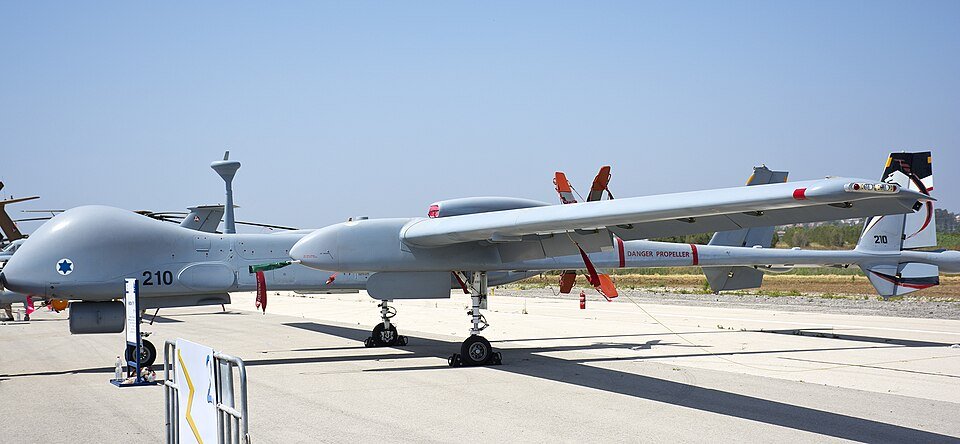
Drones & UAVsActive, In production
Unmanned surveillance and reconnaissance aerial vehicle and unmanned combat air vehicle (armed variant)
IAI Eitan is a unmanned surveillance and reconnaissance aerial vehicle and unmanned combat air vehicle (armed variant) originating in Israel. It was built by IAI.

Unmanned surveillance and reconnaissance aerial vehicle and unmanned combat air vehicle (armed variant)
Israel
IAI
Active, In production
ca. 2004
IAI Heron
2,700kg payload
5,400kg
14m
26m
1 × Pratt & Whitney Canada PT6 -67A , 900 kW (1,200 hp)
407 km/h (253 mph, 220 kn)
7,400 km (4,600 mi, 4,000 nmi)
30+ hours
14,000 m (46,000 ft)
Reference text from Wikipedia contributors, used under CC BY-SA 4.0.
True scale
Sourced dimensions beside a 1.75 m human reference.
Points represent sourced observations, including revisions. Revisions on the same effective date are not separate inventory events. Ranges appear in the table and are not plotted as exact points.
| Observation / report period | Value | Source | Claim state |
|---|---|---|---|
| 28 Sept 2026 | 14 m | Wikipedia contributors | superseded |
| 28 Sept 2026 | 14 m | Wikipedia contributors | superseded |
| 28 Sept 2026 | 14 m | Wikipedia contributors | approved |
IAI Eitan equipment records. Variants, orders and quantities are shown as reported in each inventory source; coverage is incomplete.
 Germany
German Heron TP aircraft in the leased fleet, not owned aircraft or ground stations. Includes the reported lease arrangement across locations; additional purchases are excluded. Specialist-reported holdings; not an independently audited readiness count.
 Greece
Reported count for IAI Eitan - Heron TP · Heron 1. Service scope: Hellenic Air Force; does not replace a national total. 1 distinct count cell(s) from the same source list; shared rowspan cells counted once. Excludes retired/reserve/on-order rows. Count column(s): in service: 3. Origin: Israel. The listed variants/roles are the scope, not an immediately deployable count. The components do not establish one inventory census date; the stored date is the retrieved source snapshot.
Israel