FORCETALLY
Loading the evidence…
Preparing your view.


Preparing your view.
Drones & UAVsIn service
Surveillance and Reconnaissance
HAI Pegasus is a surveillance and Reconnaissance originating in Greece. It was built by Hellenic Aerospace Industry. Reported operators include Hellenic Air Force.
 Greece
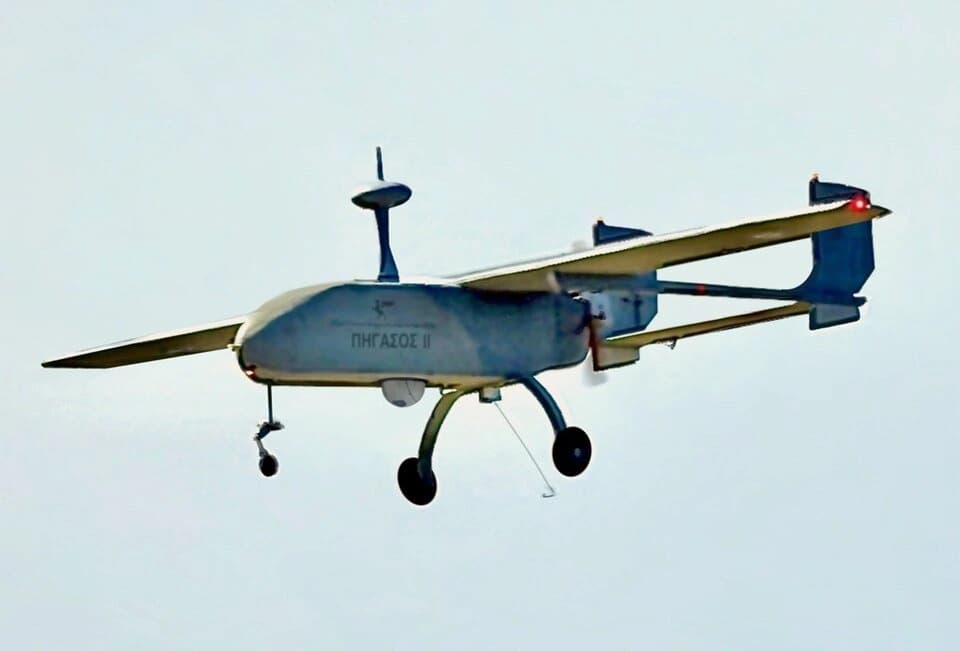
HAI Pegasus in the exact reference-pictured configuration
AegeanHawk · CC BY-SA 4.0 · Resized; original frame retained · CC BY-SA 4.0 · Source ↗ · ModifiedSurveillance and Reconnaissance
Greece
Hellenic Aerospace Industry
Air Force Research and Development Center (KETA)
4 aircraft in active service
Hellenic Air Force
16 (Est.)
1992 - 2007
1992 - Pegasus 2005 - Pegasus II
1982
The HAI Ε1-79 Pegasus ( Greek : ΕΑΒ Ε1-79 Πήγασος ) is a Greek indigenous medium-altitude long-endurance Unmanned Aerial Vehicle (MALE - UAV) produced by the Hellenic Aerospace Industry (HAI/EAB).
The first generation Pegasus had a length of 2.1 meters (6.9 feet), wingspan of 5 meters (16.4 feet), maximum speed 160 km/h (100 miles-per-hour), minimum speed 75 km/h, takeoff load of 130 kilograms and autonomy of 3.5 hours. Ten units including the ground station infrastructure were produced by Hellenic Aerospace, and a number of them by KEA to facilitate its performance optimization. It became operational by 1992.
The upgraded MALE design named Pegasus II (Block I), was introduced in 2005. It featured advanced electronics, an increased fuselage length of 4.3 meters (14.1 feet), increased wingspan 6.2 meters (20.34 feet), takeoff load of 250 kg (551 lb) and increased autonomy of 15 hours. From the 16 units initially produced by the State Aircraft Factory (KEA) and HAI between 2005 and 2007, four units remain operational including the ground stations and equipment. Pegasus II can carry a maximum payload weight of 50 kg and thanks to the wide use of composite materials for its construction, it represents a substantial improvement from the initial design. Its technical features make it suitable for ISR-OB missions and it is evaluated as an ELINT payload carrier. Expectations for its use as a weapons carrier were limited, as the relatively small payload capacity makes it less suitable for these types of missions.
The Pegasus is conventional by Unmanned Aerial System (UAS) standards, incorporating a twin-boom, pusher-prop engine along with a slab-sided fuselage and high-mounted wings. The twin booms emanate from the trailing edge of each mainplane and are capped at the rear by vertical tailplanes, joined together by a shared horizontal plane. The undercarriage is of a tricycle non-retractable type and the aircraft is wheeled for take-off. Over the fuselage is a protruding component, seating a disc-shaped telecommunications antenna. A trainable turret is seen under the fuselage housing sensors and camera equipment.
The upgraded MALE design named Pegasus II (Block I), was introduced in 2005. It featured advanced electronics, an increased fuselage length of 4.3 meters (14.1 feet), increased wingspan 6.2 meters (20.34 feet), takeoff load of 250 kg (551 lb) and increased autonomy of 15 hours. From the 16 units initially produced by the State Aircraft Factory (KEA) and HAI between 2005 and 2007, four units remain operational including the ground stations and equipment. Pegasus II can carry a maximum payload weight of 50 kg and thanks to the wide use of composite materials for its construction, it represents a substantial improvement from the initial design. Its technical features make it suitable for ISR-OB missions and it is evaluated as an ELINT payload carrier. Expectations for its use as a weapons carrier were limited, as the relatively small payload capacity makes it less suitable for these types of missions.
The upgraded MALE design named Pegasus II (Block I), was introduced in 2005. It featured advanced electronics, an increased fuselage length of 4.3 meters (14.1 feet), increased wingspan 6.2 meters (20.34 feet), takeoff load of 250 kg (551 lb) and increased autonomy of 15 hours. From the 16 units initially produced by the State Aircraft Factory (KEA) and HAI between 2005 and 2007, four units remain operational including the ground stations and equipment. Pegasus II can carry a maximum payload weight of 50 kg and thanks to the wide use of composite materials for its construction, it represents a substantial improvement from the initial design. Its technical features make it suitable for ISR-OB missions and it is evaluated as an ELINT payload carrier. Expectations for its use as a weapons carrier were limited, as the relatively small payload capacity makes it less suitable for these types of missions.
The upgraded MALE design named Pegasus II (Block I), was introduced in 2005. It featured advanced electronics, an increased fuselage length of 4.3 meters (14.1 feet), increased wingspan 6.2 meters (20.34 feet), takeoff load of 250 kg (551 lb) and increased autonomy of 15 hours. From the 16 units initially produced by the State Aircraft Factory (KEA) and HAI between 2005 and 2007, four units remain operational including the ground stations and equipment. Pegasus II can carry a maximum payload weight of 50 kg and thanks to the wide use of composite materials for its construction, it represents a substantial improvement from the initial design. Its technical features make it suitable for ISR-OB missions and it is evaluated as an ELINT payload carrier. Expectations for its use as a weapons carrier were limited, as the relatively small payload capacity makes it less suitable for these types of missions.
The first generation Pegasus had a length of 2.1 meters (6.9 feet), wingspan of 5 meters (16.4 feet), maximum speed 160 km/h (100 miles-per-hour), minimum speed 75 km/h, takeoff load of 130 kilograms and autonomy of 3.5 hours. Ten units including the ground station infrastructure were produced by Hellenic Aerospace, and a number of them by KEA to facilitate its performance optimization. It became operational by 1992.
Pegasus II Block I Hellenic Aero- space Industry II Fw 160 250 6.2 4.3
Pegasus II Block I Hellenic Aero- space Industry II Fw 160 250 6.2 4.3
Pegasus II Block I Hellenic Aero- space Industry II Fw 160 250 6.2 4.3
Pegasus II Block I Hellenic Aero- space Industry II Fw 160 250 6.2 4.3
Pegasus II Block I Hellenic Aero- space Industry II Fw 160 250 6.2 4.3
Pegasus II Block I Hellenic Aero- space Industry II Fw 160 250 6.2 4.3
Pegasus II Block I Hellenic Aero- space Industry II Fw 160 250 6.2 4.3
Class Type Endurance Range Mx Speed MTOW Payload Wingspan Length I, II, III Fixed-Wing, Rotary-Wing Hours Kilometers Kilometers per hour Kilograms Kilograms Meters Meters
Reference text from Wikipedia contributors, used under CC BY-SA 4.0.
HAI Pegasus equipment records. Variants, orders and quantities are shown as reported in each inventory source; coverage is incomplete.
Keep exploring
Reconnaissance / Surveillance
 Slovenia
Unmanned surveillance and reconnaissance aerial vehicle
 Israel
Unmanned surveillance and reconnaissance aerial vehicle
 South Korea
Unmanned surveillance and reconnaissance aerial vehicle
Unmanned surveillance and reconnaissance aerial vehicle
 Ukraine
Unmanned surveillance and reconnaissance aerial vehicle