FORCETALLY
Loading the evidence…
Preparing your view.


Preparing your view.
Drones & UAVsIn service
Unmanned surveillance and reconnaissance aerial vehicle
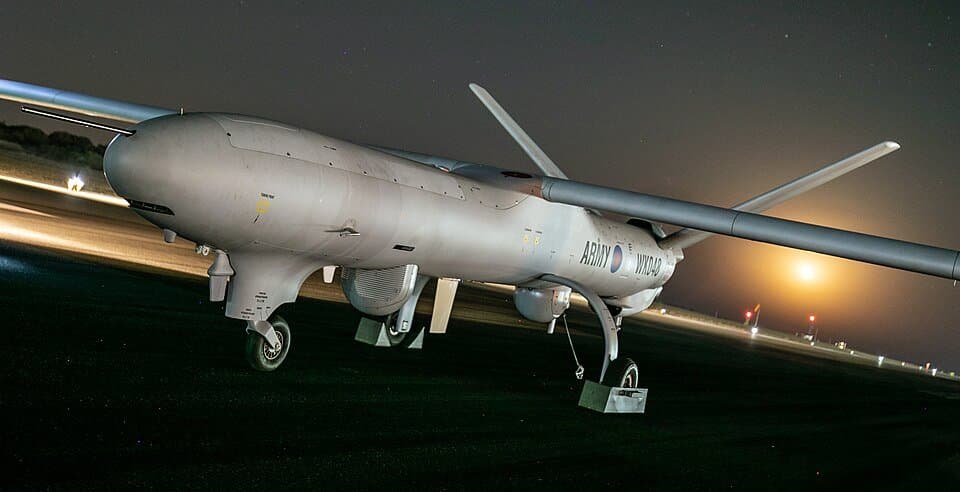
Thales Watchkeeper WK450 is a unmanned surveillance and reconnaissance aerial vehicle originating in United Kingdom Israel. It was built by Thales Group & Elbit Systems. Reported operators include British Army.
 United Kingdom /
 Israel
Technical data
Unmanned surveillance and reconnaissance aerial vehicle
United Kingdom Israel
Thales Group & Elbit Systems
In Service
British Army
54
30 November 2018 (full operational capability)
14 April 2010
Elbit Hermes 450
Watchkeeper X
The Thales Watchkeeper is an unmanned aerial vehicle (UAV) for intelligence, surveillance, target acquisition, and reconnaissance (ISTAR) used by the British Army .
The Watchkeeper WK450 is based on the Elbit Hermes 450 UAV and is built in the UK by a joint venture company, UAV Tactical Systems (U-TacS), set up by the Israeli company Elbit Systems (51% ownership) and the Thales group. The Watchkeeper is 6.5m long, with a 10.9m wingspan. Its cruising speed is 77 knots (143 km/h), and it can operate at an altitude of 16,000 feet (4,900 m). It has a takeoff weight of 485 kg, a typical endurance of 14 hours, a payload capacity of 150 kg and uses a rotary Wankel engine provided by UAV Engines Ltd, a wholly owned subsidiary of Elbit Systems, and target acquisition camera by another subsidiary, Instro. It can operate up to 150 km from the Ground Control Station; multiple stations can be linked to extend the range. It was originally intended to enter service in June 2010, but years of delays, technical issues, hardware modifications, difficulties in training sufficient pilots and incidents means that it was not expected to be fully operational until late 2018.
True scale
Sourced dimensions beside a 1.75 m human reference.
On 15 July 2007, the UK MoD revealed that 54 Watchkeepers would be delivered to the British Army at a cost of £800m. This figure includes construction of new basing facilities at Boscombe Down airfield, ground training facilities and simulators at the School of Artillery, ground control stations, development and testing of extensive aircraft modifications including automatic take-off and landing and the integration and provision of new sensors including radars.
In June 2023, Defence minister James Cartlidge stated that the Watchkeeper program had cost £1.35 billion to date, including necessary airfield upgrades at Aberporth and Boscombe Down . By 2023, one in seven Watchkeepers had been lost, giving concerns about the cost-effectiveness of the Watchkeeper compared to smaller more modern UAVs.
On 10 November 2022, a Watchkeeper WK036 crashed on an exercise in New Mexico , the eighth loss since 2014.
On 29 September 2014, the MoD revealed that an undisclosed number of Watchkeepers had become fully operational and sent to Afghanistan. The aircraft were stationed at Camp Bastion to provide force protection for British troops and worked alongside Hermes 450s that it is derived from. Watchkeeper proved its use by successfully supporting a detachment of U.S. Marines using its Thales I-Master radar. It cued a Hermes 450 onto a target for continued tracking, which then passed the information on to a Royal Air Force MQ-9 Reaper to conduct an airstrike. Some 140 flights were conducted for 8 hours a day until operations ceased in mid-October 2014.
In September 2020, in support of the UK Border Force under Operation Deveran, the British Army used Watchkeeper to patrol the English Channel for potential illegal entrants into the UK. The operation was criticised as being of little practical value. Just 15 sorties, totalling 43 hours and 52 minutes, were flown in September 2020, and six sorties for 23 hours and 54 minutes were flown the following month. Chris Cole, director of Drone Wars UK, said "the use of military-grade drones at borders is the beginning of the use of drones that blur the boundaries between military and domestic policing".
The Watchkeeper is 6.5m long, with a 10.9m wingspan. Its cruising speed is 77 knots (143 km/h), and it can operate at an altitude of 16,000 feet (4,900 m). It has a takeoff weight of 485 kg, a typical endurance of 14 hours, a payload capacity of 150 kg and uses a rotary Wankel engine provided by UAV Engines Ltd, a wholly owned subsidiary of Elbit Systems, and target acquisition camera by another subsidiary, Instro. It can operate up to 150 km from the Ground Control Station; multiple stations can be linked to extend the range.
The Watchkeeper is 6.5m long, with a 10.9m wingspan. Its cruising speed is 77 knots (143 km/h), and it can operate at an altitude of 16,000 feet (4,900 m). It has a takeoff weight of 485 kg, a typical endurance of 14 hours, a payload capacity of 150 kg and uses a rotary Wankel engine provided by UAV Engines Ltd, a wholly owned subsidiary of Elbit Systems, and target acquisition camera by another subsidiary, Instro. It can operate up to 150 km from the Ground Control Station; multiple stations can be linked to extend the range.
The Watchkeeper is 6.5m long, with a 10.9m wingspan. Its cruising speed is 77 knots (143 km/h), and it can operate at an altitude of 16,000 feet (4,900 m). It has a takeoff weight of 485 kg, a typical endurance of 14 hours, a payload capacity of 150 kg and uses a rotary Wankel engine provided by UAV Engines Ltd, a wholly owned subsidiary of Elbit Systems, and target acquisition camera by another subsidiary, Instro. It can operate up to 150 km from the Ground Control Station; multiple stations can be linked to extend the range.
The Watchkeeper is 6.5m long, with a 10.9m wingspan. Its cruising speed is 77 knots (143 km/h), and it can operate at an altitude of 16,000 feet (4,900 m). It has a takeoff weight of 485 kg, a typical endurance of 14 hours, a payload capacity of 150 kg and uses a rotary Wankel engine provided by UAV Engines Ltd, a wholly owned subsidiary of Elbit Systems, and target acquisition camera by another subsidiary, Instro. It can operate up to 150 km from the Ground Control Station; multiple stations can be linked to extend the range.
The Watchkeeper is 6.5m long, with a 10.9m wingspan. Its cruising speed is 77 knots (143 km/h), and it can operate at an altitude of 16,000 feet (4,900 m). It has a takeoff weight of 485 kg, a typical endurance of 14 hours, a payload capacity of 150 kg and uses a rotary Wankel engine provided by UAV Engines Ltd, a wholly owned subsidiary of Elbit Systems, and target acquisition camera by another subsidiary, Instro. It can operate up to 150 km from the Ground Control Station; multiple stations can be linked to extend the range.
The Watchkeeper is 6.5m long, with a 10.9m wingspan. Its cruising speed is 77 knots (143 km/h), and it can operate at an altitude of 16,000 feet (4,900 m). It has a takeoff weight of 485 kg, a typical endurance of 14 hours, a payload capacity of 150 kg and uses a rotary Wankel engine provided by UAV Engines Ltd, a wholly owned subsidiary of Elbit Systems, and target acquisition camera by another subsidiary, Instro. It can operate up to 150 km from the Ground Control Station; multiple stations can be linked to extend the range.
The Watchkeeper is 6.5m long, with a 10.9m wingspan. Its cruising speed is 77 knots (143 km/h), and it can operate at an altitude of 16,000 feet (4,900 m). It has a takeoff weight of 485 kg, a typical endurance of 14 hours, a payload capacity of 150 kg and uses a rotary Wankel engine provided by UAV Engines Ltd, a wholly owned subsidiary of Elbit Systems, and target acquisition camera by another subsidiary, Instro. It can operate up to 150 km from the Ground Control Station; multiple stations can be linked to extend the range.
The Watchkeeper is 6.5m long, with a 10.9m wingspan. Its cruising speed is 77 knots (143 km/h), and it can operate at an altitude of 16,000 feet (4,900 m). It has a takeoff weight of 485 kg, a typical endurance of 14 hours, a payload capacity of 150 kg and uses a rotary Wankel engine provided by UAV Engines Ltd, a wholly owned subsidiary of Elbit Systems, and target acquisition camera by another subsidiary, Instro. It can operate up to 150 km from the Ground Control Station; multiple stations can be linked to extend the range.
The Watchkeeper is 6.5m long, with a 10.9m wingspan. Its cruising speed is 77 knots (143 km/h), and it can operate at an altitude of 16,000 feet (4,900 m). It has a takeoff weight of 485 kg, a typical endurance of 14 hours, a payload capacity of 150 kg and uses a rotary Wankel engine provided by UAV Engines Ltd, a wholly owned subsidiary of Elbit Systems, and target acquisition camera by another subsidiary, Instro. It can operate up to 150 km from the Ground Control Station; multiple stations can be linked to extend the range.
The UA has a length of 6.50m, a wingspan of 1 0.95m and an overall height of 2.18m and a maximum all up mass of 500kg.
The UA has a length of 6.50m, a wingspan of 1 0.95m and an overall height of 2.18m and a maximum all up mass of 500kg.
The UA has a length of 6.50m, a wingspan of 1 0.95m and an overall height of 2.18m and a maximum all up mass of 500kg.
The UA has a length of 6.50m, a wingspan of 1 0.95m and an overall height of 2.18m and a maximum all up mass of 500kg.
Reference text from Wikipedia contributors, used under CC BY-SA 4.0.
Thales Watchkeeper WK450 equipment records. Variants, orders and quantities are shown as reported in each inventory source; coverage is incomplete.
United KingdomReported count for Thales Watchkeeper WK450. Service scope: British Army; does not replace a national total. 1 distinct quantity component(s) from the same source list; shared rowspan cells counted once. Explicit source inventory scope: active; no other stock status or total inferred. Count column(s): in service: 13. Origin: United Kingdom. The listed variants/roles are the scope, not an immediately deployable count. The components do not establish one inventory census date; the stored date is the retrieved source snapshot.
Keep exploring
Unmanned surveillance and reconnaissance aerial vehicle
 Ukraine
Unmanned surveillance and reconnaissance aerial vehicle
Unmanned surveillance and reconnaissance aerial vehicle
 United States
Unmanned surveillance and reconnaissance aerial vehicle
Unmanned surveillance and reconnaissance aerial vehicle
IsraelUnmanned surveillance and reconnaissance aerial vehicle
Israel