FORCETALLY
Loading the evidence…
Preparing your view.


Preparing your view.
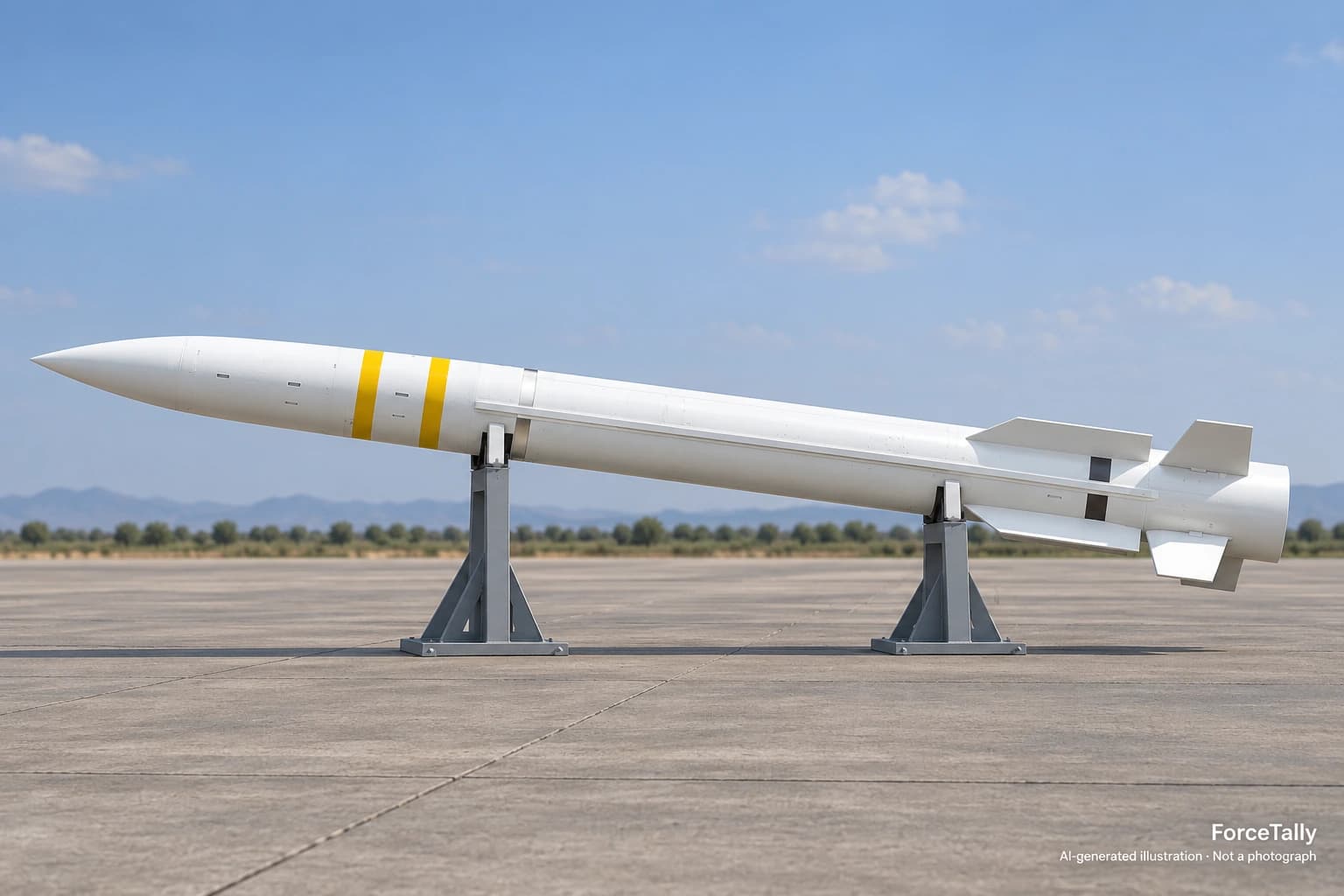
Air defenceIn service
Mobile long range surface-to-air missile with anti-ballistic missile capability
Sayyad (missile) is a mobile long range surface-to-air missile with anti-ballistic missile capability originating in Iran. It was built by Iran. Reported operators include Iran.

AI-generated illustration · Not a photograph — Sayyad-4 missile, representative of the Sayyad family, adapted from the photograph by Hossein Mersadi / Fars Media Corporation. Source-visible body, yellow bands and rear fins are illustrated; fine details and display supports are unverified.
ForceTally · AI-generated illustration · Not a photograph · Adapted from 2019 Sacred Defence Week parade (148).jpg by Hossein Mersadi / Fars Media Corporation, CC BY 4.0 (https://creativecommons.org/licenses/by/4.0/), https://commons.wikimedia.org/wiki/File:2019_Sacred_Defence_Week_parade_(148).jpg. Changes: Ceremony background, portraits, people, flags, trailer decoration and lettering removed; neutral supports, clean scene and disclosure added. Source-visible missile silhouette and surfaces retained approximately; fine details are illustrative. This adaptation is licensed CC BY 4.0. · CC BY 4.0 · Source ↗ · ModifiedTechnical data
Mobile long range surface-to-air missile with anti-ballistic missile capability
Iran
2015–present
Iran
2011 or earlier
Frag-HE
Solid fuel
Sayyad-2: 40–45 km Sayyad-2C: up to 75 km Sayyad-3: 120-150 km Sayyad-3G: 150 km Sayyad-4: 210 km Sayyad-4B: 400 km
Sayyad-2: up to 27 km Sayyad-2C: up to 30 km Sayyad-3: 27-30 km Sayyad-4: 30-40 km
Sayyad-2: Mach 3.6-4 Sayyad-2C: Mach 4.5+ Sayyad-3: Mach 4.5-5.1 Sayyad-3F: Mach 5 Sayyad-3G: Mach 7
Sayyad ( Persian : صیاد , Hunter) is a series of solid fuel surface-to-air missiles (SAM) manufactured by Iran .
Sayyad ( Persian : صیاد , Hunter) is a series of solid fuel surface-to-air missiles (SAM) manufactured by Iran .
Sayyad ( Persian : صیاد , Hunter) is a series of solid fuel surface-to-air missiles (SAM) manufactured by Iran .
Sayyad-2 is a canister-launched, reverse engineered version of the RIM-66 Standard Missile (SM-1) naval surface-to-air missile that Iran obtained from the United States before the 1979 revolution . It is an upgraded version of the Sayyad-1 system with higher precision, range and defensive power. The range of the Sayyad-2 missile is not known. Different sources claim various numbers, from 60 km to 120 km.
Sayyad-3 is a similar missile, but with a long-range capability. It has a similar diameter as Sayyad-2 but a longer body with different wings and control surfaces. Based on current estimates Sayyad-3 has a range of about 150–200 km. Iranian Defence Minister Hossein Dehghan stated the maximum range is about 120 km. This missile will be added to SAM systems via the TALASH-3 system . Iran claims that the system can also detect stealth targets from a distance of 85 kilometres (53 miles) and can intercept and destroy them within a range of 45 kilometres (28 miles), although there is no evidence that this is the case.
Sayyad-3G was revealed on 21 February 2026.
Sayyad-3G was made to help the Islamic Republic of Iran improve its naval air defense. The missile is intended to provide regional air defense coverage for Shahid Soleimani-class vessels. Shahid Soleimani-class ships, such as the Shahid Sayyad Shirazi, are fast catamarans outfitted with defense and anti-ship missile systems, and they are equipped with the Sayyad-3G.
The Sayyad-4 missile has a length of 7.5 meters, a diameter of 515 mm, a total weight of 2,050 kilograms, and carries a 180-kilogram warhead. It uses inertial mid-course guidance updated via datalink and employs either semi-active or active radar homing in the terminal phase.
Sayyad-4 belongs to the Sayyad missile family but is larger than the previous generations and has undergone continuous upgrades. Due to its larger size, it uses a vertical launching system and a hot-launch method . The missile uses composite solid fuel and is equipped with proximity and direct-impact detonation mechanisms. It has a flight ceiling of 27 kilometres (89,000 ft) and a speed of Mach 6 to Mach 8.
The missile uses hybrid solid fuel and successfully engaged a target at a distance of over 300 kilometers during testing. Earlier engagement capability had been reported at 200 kilometers.
With the introduction of Sayyad-4B, the Bavar-373 radar detection range increased from 350 to 450 kilometers, and the tracking range improved from 260 to approximately 405 kilometers. The engagement altitude increased from 27 to 32 kilometers. During testing, a target drone was destroyed at an altitude of 40,000 feet (12 km).
The Sayyad-4 missile has a length of 7.5 meters, a diameter of 515 mm, a total weight of 2,050 kilograms, and carries a 180-kilogram warhead. It uses inertial mid-course guidance updated via datalink and employs either semi-active or active radar homing in the terminal phase.
After the unveiling ceremony in November 2013, it became clear that the Sayyad-2 missile looked similar to the SM-2 Standard SAM missile but its control fins were similar to the Iranian medium-range TAER-2 SAM missile . It was also announced that it will have cooperation with the S-200 system via TALASH-2 interface system. It was planned that the Sayyad-2 missile will be added to Iranian Moudge-class frigates . Iranian defense minister announced that Sayyad-2 covered the medium range and high altitudes and had a combined guidance system.
Reference text from Wikipedia contributors, used under CC BY-SA 4.0.
Points represent sourced observations, including revisions. Revisions on the same effective date are not separate inventory events. Ranges appear in the table and are not plotted as exact points.
| Observation / report period | Value | Source | Claim state |
|---|---|---|---|
| 29 Sept 2026 | 400 km | Wikipedia contributors | superseded |
| 29 Sept 2026 | 400 km | Wikipedia contributors | approved |
Sayyad (missile) equipment records. Variants, orders and quantities are shown as reported in each inventory source; coverage is incomplete.
Keep exploring
Long-range, mobile surface-to-air missile / anti-ballistic missile system
 South Korea
Medium to long range surface-to-air / anti-ballistic missile
Long-range surface-to-air and anti-ballistic missile system
Medium-range surface-to-air missile with anti-ship capability
 United States
Long-range surface-to-air missile Anti-satellite weapon Anti-ballistic missile
 China
Extended range surface-to-air missile with anti-ship capability
United States