FORCETALLY
Loading the evidence…
Preparing your view.


Preparing your view.
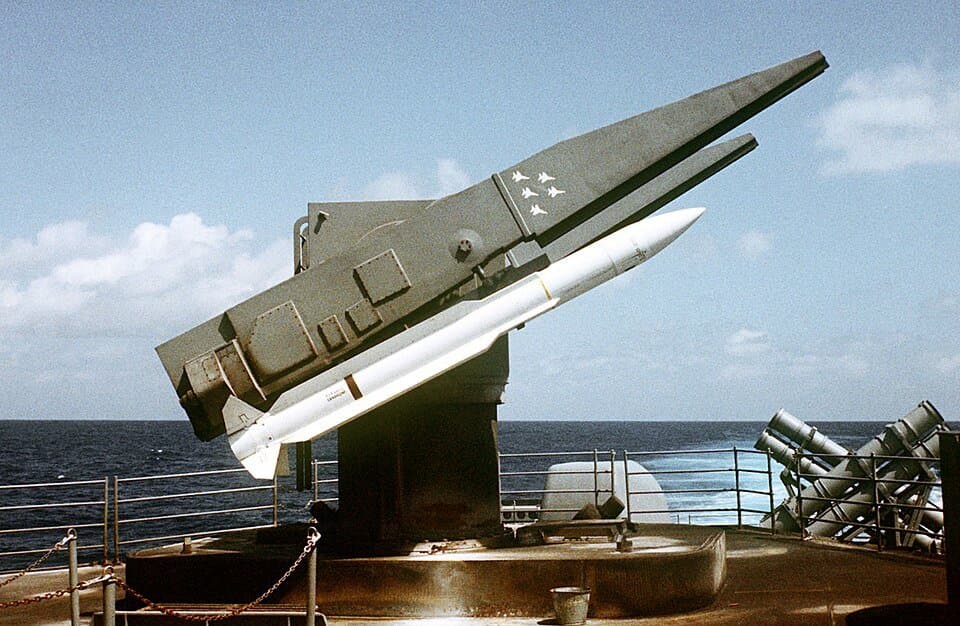
Air defenceIn service
Medium-range surface-to-air missile with anti-ship capability
RIM-66 Standard is a medium-range surface-to-air missile with anti-ship capability originating in United States.
 United States
Medium-range surface-to-air missile with anti-ship capability
United States
1967 (RIM-66A SM-1MR Block I) 1979 (RIM-66C SM-2MR)
See list of Operators
1967 onwards
Over 5,000
SM-2 – 1,558 lb (707 kg)
15 ft 6 in (4.72 m)
13.5 in (34.3 cm)
3 ft 6 in (1.07 m)
Blast fragmentation warhead
Radar and contact fuze
Dual thrust, solid-fuel rocket
40 to 92 nmi (74 to 170 km)
> 25,000 m (82,000 ft)
Mach 3.5 (4,290 km/h ; 2,660 mph ; 1.19 km/s )
SM-2MR Block IIIA Command and Inertial midcourse guidance with monopulse semi-active radar homing in the terminal phase of the interception. SM-2MR Block IIIB missiles have dual infrared homing /semi-active terminal homing. SM-1MR Block VI missiles have monopulse semi-active radar homing without command and inertial mid-course guidance.
Surface ship
The RIM-66 Standard MR (SM-1MR/SM-2MR) is a medium-range surface-to-air missile (SAM), with a secondary role as an anti-ship missile , developed for the United States Navy (USN).
The RIM-66A is the medium range version of the Standard missile and was initially developed as a replacement for the earlier RIM-24C as part of the Mk74 "Tartar" Guided Missile Fire Control System . It used the same fuselage as the earlier Tartar missile, for easier use with existing launchers and magazines for that system. The RIM-66A/B while looking like the earlier RIM-24C on the exterior is a different missile internally with redesigned electronics and a more reliable homing system and fuze that make it more capable than its predecessor. The RIM-66A/B Standard MR, (SM-1MR Block I to V) was used during the Vietnam War . The only remaining version of the Standard missile 1 in service is the RIM-66E (SM-1MR Block VI). While no longer in service with the USN, the RIM-66E is still in service with many navies globally and was expected to remain in service until 2020.
On 9 October 2016, the Arleigh Burke -class destroyer USS Mason fired two SM-2s, as well as one Evolved Sea Sparrow Missile , at two incoming Houthi anti-ship missiles off the coast of Yemen, one of which struck the water on its own. It is unknown if the SM-2s were responsible for intercepting the second cruise missile. On 12 October, Mason again came under attack by an anti-ship missile, and an SM-2 she fired was confirmed to have intercepted it at a range of 8 miles. This marked the first time in history a warship successfully defended itself with SAMs launched from vertical launch cells against an anti-ship missile. The ship experienced yet a third attack on 15 October, this time with 5 AShMs. She fired SM-2s, destroying four of the missiles.
The Block II missile was introduced in 1983 with a new rocket motor for longer range and a new warhead. The RIM-66G is for the Aegis combat system and the Mk26 missile launcher. The RIM-66H is for Aegis and the Mk41 vertical launcher. The RIM-66J is the version for the New Threat Upgrade. Block II missiles are no longer manufactured, and have been withdrawn from service. The remainder have either been put in storage, scrapped for spare parts, or remanufactured into later models.
The RIM-66M is the version of the Standard missile two medium-range (SM-2MR) currently in service with the USN aboard Ticonderoga -class cruisers and Arleigh Burke -class destroyers .
The Dutch and German Navies have added it to the Anti-Air Warfare system, which uses the Thales Group Active Phased Array Radar S-1850M and Smart-L radar.
The SM-2 Block IIIC is a modified version of the Block III/IIIA/IIIB missile that features a dual mode semi-active and active missile seeker based on the SM-6 Block I . Additionally, the missile has a new dorsal fin design and a thrust vectoring jet tab assembly to control trajectory as the missile egresses the launcher. In 2018, the U.S. Navy awarded Raytheon Missile Systems a $149.4 million contract for engineering, manufacturing, and development of the Block IIIC. In July 2021, the U.S. Navy awarded Raytheon Missile Systems a $45 million contract for the low-rate initial production of the Block IIIC. In July 2022, the U.S. Navy fired Block IIIC missiles against four targets during testing on USS Frank E. Petersen Jr. (DDG-121) . The U.S. Navy expects to field the Block IIIC in 2QFY24 . U.S. Navy Arleigh Burke -class destroyers and Constellation -class frigates will be armed with the Block IIIC.
RIM-66 Standard United States Raytheon Medium Range N/A 74 km – 170 km In service Installed on Oliver Hazard Perry class .
RIM-66 Standard United States Raytheon Medium Range N/A 74 km – 170 km In service Installed on Oliver Hazard Perry class .
Reference text from Wikipedia contributors, used under CC BY-SA 4.0.
True scale
Sourced dimensions beside a 1.75 m human reference.
See it in your room. Scan with your phone to open this model in 3D, then place it in your space.
Points represent sourced observations, including revisions. Revisions on the same effective date are not separate inventory events. Ranges appear in the table and are not plotted as exact points.
| Observation / report period | Value | Source | Claim state |
|---|---|---|---|
| 28 Sept 2026 | 0.343 m | Wikipedia contributors | superseded |
| 28 Sept 2026 | 0.343 m | Wikipedia contributors | superseded |
| 28 Sept 2026 | 0.343 m | Wikipedia contributors | approved |
RIM-66 Standard equipment records. Variants, orders and quantities are shown as reported in each inventory source; coverage is incomplete.
Keep exploring
Extended range surface-to-air missile with anti-ship capability
United StatesMobile long range surface-to-air missile with anti-ballistic missile capability
 Iran
Medium range surface-to-air missile
 China
Medium-range surface-to-air missile Surface-to-surface missile
United StatesShort to medium range surface-to-air missile
Medium to long-range surface-to-air missile
 Germany
 Pakistan
 Taiwan
 Türkiye