FORCETALLY
Loading the evidence…
Preparing your view.


Preparing your view.
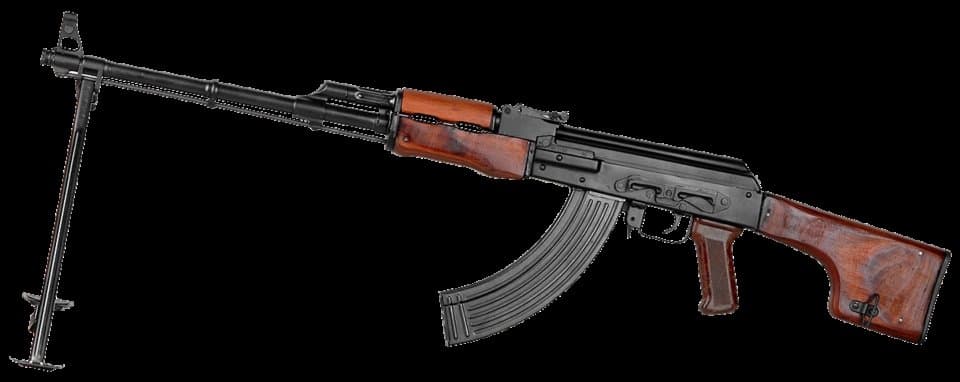
Small armsIn service
Light machine gun Squad automatic weapon
RPK is a light machine gun Squad automatic weapon originating in Soviet Union. It was built by Vyatskiye Polyany Machine-Building Plant. Reported operators include Albania, Armenia, Bulgaria, Burundi, Cambodia, Cape Verde, Central African Republic, Chad, Comoros, Congo-Brazzaville, Cuba, Djibouti, Equatorial Guinea, Ethiopia, Fiji, Georgia, Guinea-Bissau, Hungary, Iran, Iraq, Kazakhstan, Latvia, Lesotho, Libya, Malaysia, Mali, Malta, Mozambique, Namibia, Nicaragua, Nigeria, North Korea, Poland, Romania, Seychelles, Serbia, Somalia, Sudan, Syria, Tajikistan, Tanzania, Transnistria, Uganda, Ukraine, Iraq War, Uzbekistan, Vietnam, Yemen, Zimbabwe.
Technical data
Light machine gun Squad automatic weapon
Soviet Union
1961–present
See Users
See Conflicts
Mikhail Kalashnikov
1959-61
Vyatskiye Polyany Machine-Building Plant
1961–1978
See Variants
4.8 kg (10.6 lb)
1,040 mm (40.9 in) (stock extended)
590 mm (23.2 in)
7.62×39mm M43
Gas-operated , rotating bolt ; closed bolt
600 rounds/min
True scale
Sourced dimensions beside a 1.75 m human reference.
See it in your room. Scan with your phone to open this model in 3D, then place it in your space.
Points represent sourced observations, including revisions. Revisions on the same effective date are not separate inventory events. Ranges appear in the table and are not plotted as exact points.
| Observation / report period | Value | Source | Claim state |
|---|---|---|---|
| 28 Sept 2026 | 0.59 m | Wikipedia contributors | superseded |
745 m/s (2,444 ft/s)
100–1,000 m sight adjustments, Windage adjustable at the rear sight
30-, 40-round box magazine, 75-round drum magazine
Iron sights : semi-shrouded front post and rear sliding tangent with an adjustable notch
Albania : Uses both Soviet RPKs and locally produced ASh-78 Tip-2 s.
Armenia : RPK-47.
Bulgaria : Produced by Arsenal as the LMG in three different calibers, 7.62×39mm, 5.45×39mm and 5.56×45mm NATO . Uniquely had milled receivers. A folding stock variant is known as the LMG-F .
Burundi
Cambodia
Cape Verde
Central African Republic
Chad
Comoros
Congo-Brazzaville
Cuba
Djibouti
Equatorial Guinea
Ethiopia
Fiji : Russia donated RPK-201s amongst other military equipments.
Georgia : RPK-74 variant is still in use by the Georgian Army and special forces.
Guinea-Bissau
Hungary
Iran : Locally known as "BB-Kalash".
Iraq Also manufactured locally as Al Quds .
Kazakhstan : RPK-74.
Latvia : Used by Latvian National Guard .
Lesotho
Libya
Malaysia : RPK-74 variant is used by the Grup Gerak Khas (GGK) of the Malaysian Army .
Mali : Armed and Security Forces of Mali .
Malta
Mozambique
Namibia
Nicaragua
Nigeria
North Korea : Type 64.
Poland
Romania : Built by Fabrica de Arme Cugir SA as the Puşcă Mitralieră model 1964 ("model 1964 light machine gun") and later, a 5.45mm version based on the PA md. 86 —the Mitralieră md. 1993 ("model 1993 light machine gun").
Seychelles
Serbia : Manufactured locally as the Zastava M72 .
Somalia
Sudan
Syria : Used by both pro-Assad and rebel groups.
Tajikistan
Tanzania
Transnistria
Uganda
Ukraine : RPK-74 and RPK, also used by separatists .
United States: Used during the Iraq War .
Uzbekistan
Vietnam
Yemen
Zimbabwe
Afghanistan
Artsakh : RPK-203.
Chechen Republic of Ichkeria - Used by Chechen forces during the First Chechen War
East Germany : Manufactured locally as the LMGK ( Leichtes Maschinengewehr Kalashnikov) .
Rhodesia
Soviet Union
Yugoslavia : Manufactured locally as the Zastava M72 .
The RPK ( Russian : РПК; Ручной пулемёт Калашникова , romanized : Ruchnoy Pulemyot Kalashnikova , lit. ' Kalashnikov's hand-held machine gun ' ) is a Soviet 7.62×39mm light machine gun / squad automatic weapon that was developed by Mikhail Kalashnikov in the early 1960s, in parallel with the AKM assault rifle . The RPK was created to standardize the small arms inventory of the Soviet Army , where it replaced the 7.62×39mm RPD machine gun .
The RPK is chambered in 7.62×39mm intermediate cartridge . It uses a standard AKM pistol grip and can also use standard AKM detachable box magazines , but it is most commonly used with a 40-round box magazine or a 75-round drum magazine . The U-shaped receiver is stamped from a smooth 1.5 mm (0.06 in) sheet of steel, compared with the 1 mm (0.039 in) sheet metal receiver used on the standard AKM. It features a thick laminated wood foregrip and a fixed laminated wood "club-foot" buttstock similar to the stock used on the RPD, which is designed to allow the user to fire from the prone position more comfortably. Interchangeability of parts between the RPK and AKM are moderate.
The RPK's iron sights leaf is elevation adjustable, and graduated for ranges of 100 to 1,000 meters in 100 m increments. The rear sight leaf also features a windage adjustment knob unique to the RPK series of rifles.
The RPK light machine gun, chambered in the 7.62×39mm cartridge, is essentially a Russian equivalent to a squad automatic weapon . It was adopted by the former Soviet Union, and was issued mainly to motorized units . It was later adopted by several military agencies around the world.
The RPK-74 ( Russian : РПК-74 ) was introduced in 1974 together with the AK-74 assault rifle , both chambered in the 5.45×39mm intermediate cartridge . The RPK-74 was a light machine gun / squad automatic weapon based on the AK-74, with modifications that mirror those made to the AKM.
The RPK-74 uses a longer and heavier chrome-plated barrel, which has a new gas block with a gas channel at a 90° angle to the bore axis, and a ring for the cleaning rod. It is also equipped with a folding bipod and a different front sight tower. The muzzle is threaded for a flash suppressor or blank-firing device.
The RPK-74 feeds from a 45-round steel or polymer box magazine, interchangeable with magazines from the AK-74, and is designed to be charged from stripper clips . Drum magazines similar to those used on the previous RPK models were tested during its development phase, but were discontinued in favour of the 45-round box magazine. However, recently the production of a 97-round drum has started. This drum was designed to be used with the AK-107 but can also be used in any 5.45×39mm AK-74 and RPK-74 magazine compatible variants. Kalashnikov also tested with experimental conventional drums, a prototype 100-round belt fed drum magazine was also created. It attaches into the regular magazine well, but the cartridges are stored on a 100-round belt inside a box. A feed system removes them from the belt and puts them in a position where they can be loaded through the regular magazine well. This system is actuated by a lever from the magazine that clips around the charging handle. It is unknown if this ever went into service.
The RPK-74M ( Modernizirovannij "Modernized") is a modernised variant of the RPK-74 developed during the mid-'90s. In line with the AK-74M assault rifle variant, the RPK-74M lower handguard, gas tube cover, pistol grip, and new synthetic stock are made from a black, glass-filled polyamide . The stock is shaped like the RPK-74 fixed stock, but also side-folds like the RPKS-74. The stock additionally has an easier to use release mechanism, replacing the bullet press release from the RPKS and RPKS-74. Each RPK-74M is fitted standard with a side-rail bracket for mounting optics. It also includes most of the 74M economic changes, such as the dimpled on barrel hardware, omission of lightening cuts from the front sight block and piston and stamped gas tube release lever. Updated magazines were produced by Molot with horizontal ribs going up the sides of the magazines.
An export variant chambered in 5.56×45mm NATO was also introduced, designated as the RPK-201 . A modernised export variant of the RPK was also developed, designated as the RPK-203 . Both the RPK-201 and RPK-203 uses the same polymer construction as the RPK-74M.
The RPK-16 (the number 16 indicates the year 2016, when the development first started) is Kalashnikov's response to the "Tokar-2" program, where it competed against Degtyaryov's submission. In 2018, the Ministry of Defence of the Russian Federation have signed a contract concerning the procurement of the RPK-16, and is expected to take over the role of the RPK-74 in the Russian Armed Forces.
It is chambered in 5.45×39mm and features the traditional Kalashnikov gas-operated long-stroke piston system, and shares several novel technical and ergonomic features derived from the AK-12 program.
Other features of the RPK-16 include an ergonomic pistol grip, a folding buttstock, and two main barrel lengths: a 550 mm (21.7 in) long barrel (when it is applied or configured for the light machine gun role) and a 370 mm (14.6 in) short barrel (when it is applied or configured for the assault rifle role).
It has a combat weight of 6 kg (13.23 lb), a full-length of 1,076 mm (42.4 in), a cyclic rate of fire of 700 rounds per minute, and an accuracy range of 800 m (870 yd).
After receiving feedback on the performance of the RPK-16, Kalashnikov Concern began development on the RPL-20 (the number 20 indicating the year 2020) belt-fed light machine gun , chambered in 5.45×39mm cartridge. It features rate of fire of 800 rounds per minute, an empty weight of 5.5 kg (12.1 lb), an open-bolt design and quick-change barrels to enhance sustained fire. Kalashnikov Concern has so far created at least one functional prototype. The RPL-20 has become the first light machine gun to be used by Russian forces since the RPD machine gun that isn't magazine-fed or of the standard Kalashnikov pattern.
The RPK is produced by Arsenal as the LMG in three different calibers, 7.62×39mm, 5.45×39mm and 5.56×45mm NATO .
Later, a 5.45mm RPK-74 version based on the PA md. 86 , the Mitralieră md. 1993 ( lit. ' Model 1993 light machine gun ' ), was also developed.
Russia: RPK, RPK-74, RPK-74M and RPK-16.
Reference text from Wikipedia contributors, used under CC BY-SA 4.0.
RPK equipment records. Variants, orders and quantities are shown as reported in each inventory source; coverage is incomplete.
 Afghanistan
 Albania
 Algeria
 Armenia
 Belarus
 Bulgaria
 Burundi
 Cambodia
 Cape Verde
 Central African Republic
 Chad
 Comoros
 Cuba
 Djibouti
 Egypt
 Equatorial Guinea
 Ethiopia
 Fiji
 Georgia
 Ghana
 Guinea-Bissau
 Hungary
 Iran
 Iraq
 Kazakhstan
 Kyrgyzstan
 Latvia
 Lesotho
 Libya
 Malaysia
 Mali
 Malta
 Moldova
 Mozambique
 Namibia
 Nicaragua
 Nigeria
 North Korea
 Peru
 Poland
 Republic of the Congo
 Romania
 Russia
 Serbia
 Seychelles
 Somalia
 Sudan
 Syria
 Tajikistan
 Tanzania
 Turkmenistan
 Uganda
 Ukraine
 Uzbekistan
 Vietnam
 Yemen
 Zambia
 Zimbabwe
Albania, Armenia, Bulgaria, Burundi, Cambodia, Cape Verde, Central African Republic, Chad, Comoros, Congo-Brazzaville, Cuba, Djibouti, Equatorial Guinea, Ethiopia, Fiji, Georgia, Guinea-Bissau, Hungary, Iran, Iraq, Kazakhstan, Latvia, Lesotho, Libya, Malaysia, Mali, Malta, Mozambique, Namibia, Nicaragua, Nigeria, North Korea, Poland, Romania, Seychelles, Serbia, Somalia, Sudan, Syria, Tajikistan, Tanzania, Transnistria, Uganda, Ukraine, Iraq War, Uzbekistan, Vietnam, Yemen, Zimbabwe
Equipment reference ↗Keep exploring
Light machine gun Squad automatic weapon
 United States
Light machine gun Squad automatic weapon
 Belgium
Light machine gun Squad automatic weapon
Light machine gun / Squad automatic weapon
Light machine gun , Squad automatic weapon
 Singapore
Light machine gun Automatic rifle
United States