FORCETALLY
Loading the evidence…
Preparing your view.


Preparing your view.
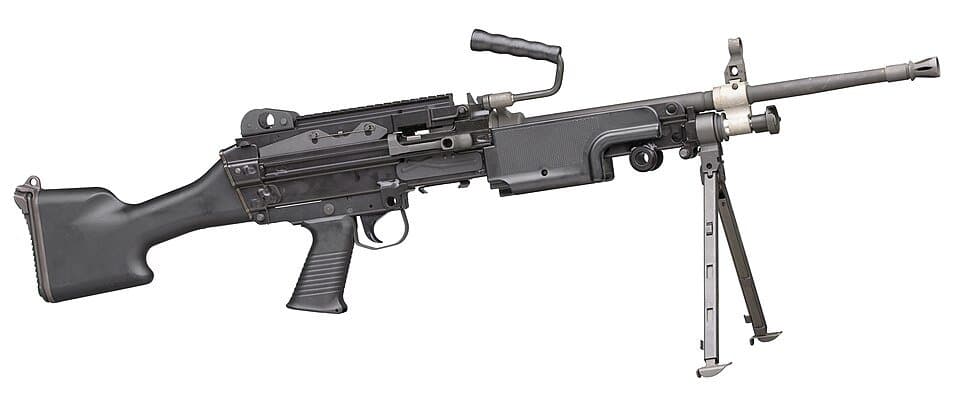
Small armsIn service
Light machine gun Squad automatic weapon
FN Minimi is a light machine gun Squad automatic weapon originating in Belgium. It was built by FN Herstal FN USA Thales Australia Beretta Bofors Carl Gustav Caracal International Pindad Sumitomo Heavy Industries. Reported operators include Argentina, Australia, Azerbaijan, Belgium, Brazil, Burundi, Canada, Chile, China, Colombia, Croatia, Cyprus, Czech Republic, Denmark, East Timor, France, Greece, Hungary, Indonesia, Iraq, Ireland, Italy, Japan, Kuwait, Latvia, Lebanon, Libya, Lithuania, Luxembourg, Malaysia, Mexico, Nepal, Netherlands, New Zealand, Norway, Pakistan, Papua New Guinea, Peru, Philippines, Poland, Portugal, Serbia, Senegal, Slovenia, Spain, Sri Lanka, Syria, Sweden, Switzerland, Taiwan, Thailand, Tunisia, Türkiye, Ukraine, United Arab Emirates, United Kingdom, United States Armed Forces, Yemen.
 Belgium
Technical data
Light machine gun Squad automatic weapon
Belgium
1980–present
See Users
United States invasion of Panama Tuareg rebellion (1990–1995) Gulf War Burundian Civil War Kosovo War War in Afghanistan (2001–2021) Moro conflict Iraq War Mexican drug war Communist rebellion in the Philippines Militias-Comando Vermelho conflict Second Ivorian Civil War Libyan Civil War Syrian Civil War Northern Mali Conflict War in Iraq (2013–2017) ISIL insurgency in Tunisia Yemeni Civil War (2014–present) Saudi Arabian-led intervention in Yemen Russo-Ukrainian War Russian invasion of Ukraine
Ernest Vervier
Early 1970s
FN Herstal FN USA Thales Australia Beretta Bofors Carl Gustav Caracal International Pindad Sumitomo Heavy Industries
1977–present
See Variants
7.1 kg (15.7 lb)
1,040 mm (40.9 in)
True scale
Sourced dimensions beside a 1.75 m human reference.
See it in your room. Scan with your phone to open this model in 3D, then place it in your space.
Points represent sourced observations, including revisions. Revisions on the same effective date are not separate inventory events. Ranges appear in the table and are not plotted as exact points.
| Observation / report period | Value | Source | Claim state |
|---|---|---|---|
| 28 Sept 2026 | 0.465 m | Wikipedia contributors | superseded |
465 mm (18.3 in)
110 mm (4.3 in)
5.56×45mm NATO / 7.62×51mm NATO
Gas-actuated , open bolt
700–1,150 rounds/min
925 m/s (3,035 ft/s)
300–1,000 m (980–3,280 ft) sight adjustments
100 or 200-round belt contained in a 100-round or 200-round soft pouch, or 200-round box or 30-round M16 -type STANAG magazine to 60-round STANAG casket magazine
Rear aperture, front post
Argentina : M249 variant in use.
Australia : Designated F89 in Australian service. It is manufactured by Lithgow Arms . The Maximi was issued in 2011 after being trialled in Afghanistan and is in limited service.
Azerbaijan :
Belgium : Standard infantry support weapon of the Belgian Army . Uses both the standard (called the Minimi Mk2) and Para (Minimi Mk3) models.
Brazil : Used by the Batalhão de Operações Policiais Especiais (BOPE) from Military Police of Rio de Janeiro , Coordenadoria de Recursos Especiais from the Civil Police of Rio de Janeiro, Federal police GPI, as well by the Brazilian Army , Marine Corps (399 by 17 military organization , with 13 adopting the Minimi 5,56 Standard and 4 adopting the Minimi 5,56 Para) and Brazilian Air Force . The Army Special Forces uses 38 Minimi 5,56 Special Purpose Weapon (SPW).
Burundi : Burundian rebels.
Canada : The C9 LMG was adopted in the 1980s.
Chile : Used by Chilean Army .
China : Locally-made clones are used by Chinese police.
Colombia : Used by Colombian military (M249 and MK3).
Croatia :
Cyprus : Used by the Cypriot National Guard .
Czech Republic : 7.62×51mm NATO Minimi adopted as the standard machine-gun for the Czech Army replacing the Uk vz. 59 . 317 delivered as of January 2016. The 601st Special Forces Group uses the Mk 48 Mod 0 . 5.56mm M249 variant were also in use.
Denmark : Used by the Jægerkorps .
East Timor : Timor Leste Defence Force
France : The Para version is widely used by the French Army . Fielded alongside the FN MAG GPMG.
Greece : Used by the Hellenic Army .
Hungary : M249 SAW is used by the Hungarian Special Force.
Indonesia : Standard light machine gun of Indonesian Armed Forces . The SM3 was used from 2007.
Iraq
Ireland : Para in use with the Army Ranger Wing (ARW) special forces.
Italy : The Minimi is made under license by Beretta , which has a partnership with FN, and is employed by the Italian Armed Forces, replacing the MG 42/59 (a variant of the WWII MG 42 , which still sees widespread mounted use) in the squad automatic weapon role. The Minimi is being widely employed by Italian forces in all the most recent and current international theaters of operation.
Japan : Partially replaced the NTK-62 with the Japanese Ground Self-Defense Forces . It is manufactured under license by Sumitomo Heavy Industries . The JGSDF is making plans to replace them, but SHI has confirmed that it will not be involved in a potential LMG tender. In January 2023, the FN-made Minimi MK3 was selected and designed as MINIMI(B). Around 3,100 Mk3s are set to be imported.
Kuwait
Latvia : Standard light machine gun in Latvian inventory.
Lebanon
Libya
Lithuania : 7.62×51mm FN Minimi MK 3.
Luxembourg : The Luxembourgish Army uses it as a Squad automatic Weapon. The Para variant is used by the Unité Spéciale de la Police intervention unit of the Grand Ducal Police .
Malaysia : The Malaysian Army replace the HK11A1 machine gun with the Minimi. Also used by police special force units.
Mexico : Mexican Air Force uses it on helicopters.
Nepal : Purchased 5,500 units in 2002.
Netherlands : The Royal Netherlands Army has brought in the Para version of the Minimi to replace the FN MAG in some infantry roles. The Dutch Korps Commandotroepen use the Minimi 5.56 para version. The MAG is still being used as a general-purpose machine gun , support fire weapon and as a vehicle-mounted weapon.
New Zealand : The New Zealand Defence Force uses the Minimi under the designation C9 Minimi. This gun has been used as the Army's Light Support Weapon (LSW) since 1988. The 7.62 Minimi TR was selected in Feb 2012 to replace the C9 LSW Minimi and will be known as the 7.62 LSW Minimi in NZDF service.
Norway : Para version in use with HJK / FSK , and MJK since the late 1980s, since 2011 in use with armed forces of Norway (1,900 machine guns were purchased in 2011). In September 2021 FN Herstal and Norwegian Defence Materiel Agency signed a framework agreement for delivery of 4000 Minimi 7,62 Mk3.
Pakistan : SSG , SSW , SSGN .
Papua New Guinea : Designated F89.
Peru : Used by the Infantería de Marina del Perú (Peruvian Naval Infantry).
Philippines : In use by the Armed Forces of the Philippines (AFP). Purchased the FN Minimi in May 2002 with 402 acquired. Additional order cancelled in favor of rebidding due to corruption allegations during Arroyo Administration.
Poland : JW GROM
Portugal : Portuguese Army received in 2019 Minimi MK3 machine guns in the 5.56×45mm and 7.62×51mm calibers. In 2022 Portuguese Marine Corps received an unknown amount of 5.56×45mm Minimi MK3.
Serbia : Used by the special forces units of the Armed Forces ( 72nd Brigade for Special Operations and 63rd Parachute Brigade ) and Special Anti-Terrorist Unit of the Police.
Senegal : Used by Senegalese special forces units.
Slovenia : Minimi Para used by the Military of Slovenia .
Spain : The Spanish Navy acquired Minimi light machine guns in the 5.56×45mm Para and 7.62×51mm versions.
Sri Lanka
Syria : Syrian Arab Army , formerly Desert Hawks Brigade .
Sweden : Known as the Ksp 90 ( Kulspruta 90 ). Para model designated Ksp 90B; both are made by Bofors Carl Gustaf .
Switzerland : Designated LMg 05 ( Leichtes Maschinengewehr 05 ) or FM 05 ( Fusil mitrailleur 05 ).
Taiwan : Used by the Republic of China Army; a version re-engineered for local production, designated T75 , is in use by the Republic of China Marine Corps.
Thailand : Used by the Royal Thai Navy Marine Corps and by the Royal Thai Army (M249 variant).
Tunisia
Turkey : Used by General Directorate of Security and Turkish Land Forces . Also CS/LM8s purchased from China as replacement of older FN Minimi MK 1s used by Police Special Operation Department .
Ukraine : Received from Canada and Belgium in 2022 and used during the Russo-Ukrainian War . 300 Minimi Mk3 in 7.62×51mm were also donated to the AFU by Come Back Alive Foundation in 2024 and 2025.
United Arab Emirates
United Kingdom : Used standard and Para variants, designated L108A1 and the L110A2 respectively. The Army equipped each four-man fireteam with the Para variant. The LMG was usually fitted with the 4× SUSAT standard-issue rifle sight. It was also used by the Royal Navy, Royal Marines Commandos and the RAF Regiment . Some 7.62 Minimis are in service. The L110A3 was phased out by early 2019 in favour of the earlier L7A2 general purpose machine gun , Joint Force Command users retained their stocks of the weapon.
United States: United States Armed Forces use it designated as the M249 light machine gun .
Yemen : FN Minimi reported by Amnesty to be used by a militia during the Hodeidah offensive in 2018
Afghanistan : The Afghan National Army made use of U.S.-supplied M249s during the Taliban insurgency .
The FN Minimi (short for French : mini-mitrailleuse ; "mini machine gun") is a Belgian 5.56mm or 7.62mm light machine gun , also classified as a squad automatic weapon developed by Ernest Vervier for FN Herstal .
The FN Minimi (short for French : mini-mitrailleuse ; "mini machine gun") is a Belgian 5.56mm or 7.62mm light machine gun , also classified as a squad automatic weapon developed by Ernest Vervier for FN Herstal . Introduced in the late 1970s, it is in service in more than 75 countries. The weapon is manufactured at the FN facility in Herstal and their U.S. subsidiary FN Manufacturing LLC.
The Minimi has a manually adjustable gas valve with two positions, normal and adverse. The adverse setting increases the cyclic rate of fire from 700 to 850 rounds per minute to 950–1,150 rounds per minute and is used only in extreme environmental conditions or when heavy fouling is present in the weapon's gas tube. The spring extractor is located inside the bolt, while the tilting lever ejector is contained inside the receiver housing. Spent casings are removed through a port located at the bottom of the right side of the receiver, protected from debris with a spring-loaded dust cover. The Minimi is striker-fired and the bolt carrier functions as the striker mechanism.
The Minimi features a welded receiver made from stamped steel . Both the standard and Para variants are equipped with a fixed, folding bipod mounted to the gas tube and stowed under the handguard. The bipod can be adjusted in height and each leg has three height settings. The bipod also offers a 15° range of rotation to either side. With the bipod fully extended, the bore axis is elevated to a height of 465 mm (18.3 in). The Minimi can also be fired from the Belgian FN360° tripod or the American M122 mount using an M60 pintle. The vehicle-mounted Minimi is fitted with an electrically powered trigger that enables it to be fired remotely from within an armoured fighting vehicle.
The standard light machine gun version has a 465 mm (18.3 in) barrel and a skeletonized aluminium stock with a folding wire shoulder strap. The shortened Para model has a 349 mm (13.7 in) barrel and a collapsible metal stock, while the vehicle-mounted model has a 465 mm (18.3 in) barrel but does not have a stock or iron sights . All models can alternatively be fitted with a fixed synthetic stock, the same used on the M249, which contains a hydraulic buffer that contributes to stabilizing the rate of fire and reducing recoil forces.
The weapon is fed from the left-hand side by disintegrating-link M27 ammunition belts (a miniaturized version of the 7.62mm M13 belt), from either an unsupported loose belt, enclosed in a polymer ammunition box with a 200-round capacity attached to the base of the receiver, or from detachable STANAG magazines , used in other NATO 5.56 mm assault rifles such as the M16 and FNC .
The ammunition belt is introduced into the feed tray, magazines are seated inside the magazine port at a 45° angle, located beneath the feed tray port.
The barrels used in the Minimi have an increased heat capacity for sustained fire, feature a chrome -lined rifled bore (six right-hand grooves) and are manufactured in two versions: with a 178 mm (1:7 in) twist rate used to stabilize the heavier Belgian 5.56×45mm SS109 projectile, or a 305 mm (1:12 in) twist for use with American M193 ammunition. The barrels have a quick-change capability; a lever is provided on the left side of the weapon that unlocks the barrel allowing the shooter to push it forward removing it from its trunnion. A carrying handle is also fixed to the barrel and assists in the barrel change process. A trained soldier can perform a barrel change and ready the weapon for aimed fire in 6 to 7 seconds. Early models of the Minimi had a flash suppressor with side ports as seen on the FN FAL , FN CAL , and FN FNC rifles; new production guns have a shorter, cone -shaped slotted flash suppressor.
Both the standard and Para models come with a rear sight, adjustable for windage and elevation, that provides a peep aperture for ranges from 300–1,000 m (980–3,280 ft), in 100 m (330 ft) increments. The sight line radius is 490 millimeters (19.3 in). The hooded front sight is installed in a post on the gas block and is also adjustable for elevation and windage. Early models of the Minimi had the rear sight mounted forward of the feed cover and the front post secured to the barrel, closer to the muzzle end. An adapter can also be used that allows the use of standard NATO night and day sights.
As part of the US military's M249 Product Improvement Program (PIP), the M249 was updated with: a new synthetic stock and modified buffer assembly, a single-position gas regulator, a so-called birdcage type flash hider/compensator from the M16A2, a polymer barrel heat guard, and a folding carry handle. As a result, the weapon's weight increased to 7.47 kg (16.5 lb). Many of the PIP upgrades were later incorporated by FN for the Minimi.
The Minimi prototype was originally designed in 7.62×51mm NATO , and later redesigned for the 5.56 mm cartridge.
When the USSOCOM issued the requirements for the Mk 48 Mod 0 in the early 2000s, the original plans for the Minimi were retrieved and used to develop this new model. As a result of favourable reviews of the Mk 48 Mod 0 and increasing demand for a more powerful variant of the Minimi, FN Herstal introduced the Minimi 7.62. In November 2006, a FN Herstal press release said the Minimi 7.62 had recently been "launched onto the market" and was available "with a fixed or telescopic buttstock and a standard or triple rail handguard".
The Minimi 7.62 also has a different sight setup calibrated for the larger cartridge. The rear sight is adjustable from 300–1,000 m (980–3,280 ft), in 100 m (330 ft) increments. The sight can also be corrected for windage. The Minimi 7.62 TR is a variant equipped with a Picatinny rail handguard from the factory.
The stock is 5-position adjustable that is also adjustable for cheek rest height with a folding shoulder rest and hydraulic buffer. The feed tray has retaining pawls to hold ammunition from the belt in place while loading. The handguard has three forward picatinny rails. A new bipod is 3-position height adjustable and seamlessly integrates into the shape of the handguard when folded back regardless of accessories that may be attached. Others features include a more ergonomic cocking handle and an optional heat shield, enabled by an added on long pin, to protect from barrel heat. The Minimi 7.62 Mk3 can be converted to fire 5.56×45mm rounds.
The Japan Self-Defense Forces (JSDF) adopted the locally produced Minimi under the name "5.56mm Machine Gun MINIMI" ( Japanese : 5.56mm機関銃MINIMI ) since the 1993 fiscal year as a successor to the Type 62 7.62mm machine gun until 2019.
The license-produced MINIMI can be equipped with the Type 62 GPMG tripod using a special attachment, and is used when precise shooting is required. Additionally, for long-range shooting, a “direct sight scope” (scope) may be mounted. The model adopted by the JSDF is the so-called standard type with a metal tube stock, and it has unique modifications such as a different shape for the barrel change lever. The side of the gun body is marked with 5.56mm Machine Gun MINIMI.
On December 18, 2013, the Ministry of Defense announced that Sumitomo Heavy Industries had falsified inspection data over several decades and had delivered machine guns that did not meet the required performance standards. As a result, the company was placed under a 5-month suspension of designation. It is reported that at least 5,350 units, including 12.7mm heavy machine guns, 7.62mm machine guns, and 5.56mm machine guns, were delivered since 1979. Even before the data falsification was discovered, personnel in the field had recognized that the Minimi produced by Sumitomo Heavy Industries was of low performance.
In April 2021, Sumitomo Heavy Industries announced its withdrawal from the production of machine guns and the development of 5.56mm machine guns due to budget constraints and reduced order volumes. However, the company stated it would continue producing parts for maintenance and repair.
Due to the obsolescence of the Minimi Mk1 and the cessation of procurement, the JGSDF conducted a selection for its next machine gun. The JGSDF decided to continue using the 5.56mm caliber and chose the MINIMI Mk3 over Germany's Heckler & Koch MG4 . The “5.56mm Machine Gun MINIMI(B)” is being procured not through domestic production, but via imports. The procurement plan includes 3,100 units of MINIMI(B), which will replace the existing Minimi Mk1 over time.
FN Minimi United States Light machine gun M249
Reference text from Wikipedia contributors, used under CC BY-SA 4.0.
FN Minimi equipment records. Variants, orders and quantities are shown as reported in each inventory source; coverage is incomplete.
 Argentina
 Australia
 Azerbaijan Belgium
 Belize
 Bhutan
 Brazil
 Burundi
 Canada
 Chile
 China
 Colombia
 Croatia
 Cyprus
 Czechia
 Denmark
 East Timor
 Ecuador
 Egypt
 Finland
 France
 Greece
 Guyana
 Hungary
 Indonesia
 Iraq
 Ireland
 Italy
Reported count for FN Minimi 5.56. Service scope: Italian Army; does not replace a national total. 1 distinct count cell(s) from the same source list; shared rowspan cells counted once. Excludes retired/reserve/on-order rows. Count column(s): quantity: 3,000. Origin: Belgium Italy. The listed variants/roles are the scope, not an immediately deployable count. The components do not establish one inventory census date; the stored date is the retrieved source snapshot.
 Japan
 Kuwait
 Latvia
 Lebanon
 Libya
 Lithuania
 Luxembourg
 Malaysia
 Malta
 Mexico
 Nepal
 Netherlands
 New Zealand
 Northern Cyprus
 Norway
 Pakistan
 Papua New Guinea
 Peru
 Philippines
Reported count for FN Minimi · Minimi. Service scope: Philippine Marine Corps; does not replace a national total. 1 distinct quantity component(s) from the same source list; shared rowspan cells counted once. Explicit source inventory scope: active; no other stock status or total inferred. Count column(s): in service: 76. Origin: Belgium. The listed variants/roles are the scope, not an immediately deployable count. The components do not establish one inventory census date; the stored date is the retrieved source snapshot.
 Poland
 Portugal
 Qatar
 Saudi Arabia
 Senegal
 Serbia
 Slovakia
 Slovenia
 Spain
 Sri Lanka
 Suriname
 Sweden
 Switzerland
 Syria
 Taiwan
 Thailand
 Tunisia
 Türkiye
 Ukraine
 United Arab Emirates
 United Kingdom
 Vietnam
 Yemen
Argentina, Australia, Azerbaijan, Belgium, Brazil, Burundi, Canada, Chile, China, Colombia, Croatia, Cyprus, Czech Republic, Denmark, East Timor, France, Greece, Hungary, Indonesia, Iraq, Ireland, Italy, Japan, Kuwait, Latvia, Lebanon, Libya, Lithuania, Luxembourg, Malaysia, Mexico, Nepal, Netherlands, New Zealand, Norway, Pakistan, Papua New Guinea, Peru, Philippines, Poland, Portugal, Serbia, Senegal, Slovenia, Spain, Sri Lanka, Syria, Sweden, Switzerland, Taiwan, Thailand, Tunisia, Türkiye, Ukraine, United Arab Emirates, United Kingdom, United States Armed Forces, Yemen
Equipment reference ↗Keep exploring
Light machine gun Squad automatic weapon
Light machine gun Squad automatic weapon
Light machine gun Squad automatic weapon
 United States
Light machine gun / Squad automatic weapon
Light machine gun , Squad automatic weapon
 Singapore
Light machine gun Automatic rifle
United States