FORCETALLY
Loading the evidence…
Preparing your view.


Preparing your view.
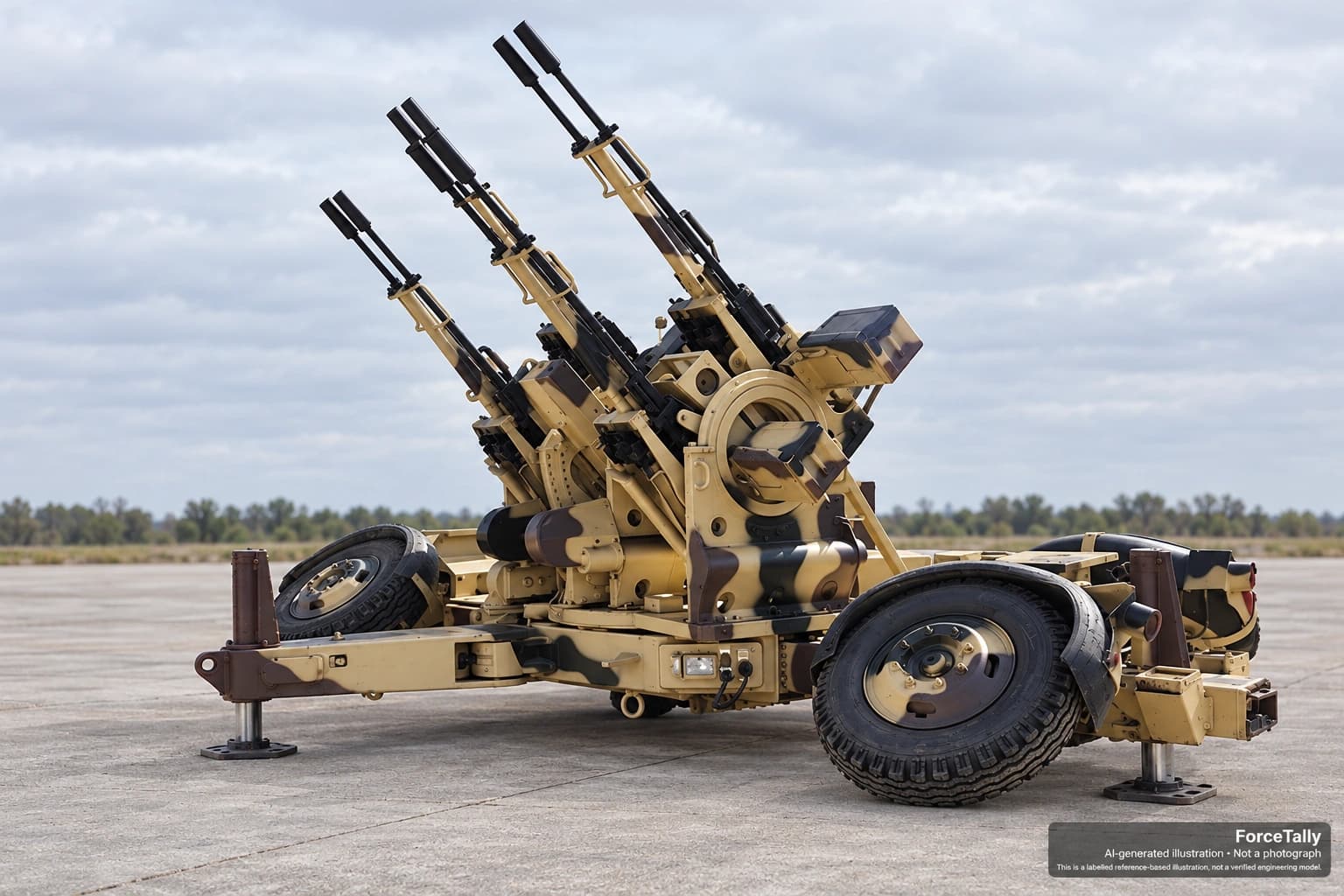
Air defenceIn service
Anti-aircraft system
Mesbah 1 is a anti-aircraft system originating in Iran. It was built by Defense Industries Organization. Reported operators include Iran, Armed Forces, Army, Air Defence Force.
 Iran
AI-generated illustration · Not a photograph · Mesbah1 source-pictured towed gun mount and carriage; separate radar and control components are not shown.
ForceTally · AI-generated illustration based on Ali Jabbari · CC BY 4.0; original reference attribution retained. · CC BY 4.0 · AI-generated illustration · Source ↗ · ModifiedAnti-aircraft system
Iran
Defense Industries Organization
2010
23 mm (0.91 in)
4000 rpm
970 m/s (3,200 ft/s)
2.5 km
4 km
Iran
Armed Forces
Army
Air Defence Force
Mesbah 1 is an Iranian anti aircraft artillery system developed to defend against incoming cruise missiles .
Mesbah uses 4 Iranian built Russian ZU-23-2 installed on a rotatable mount. Each autocannon has its own feed magazine. Each ZU-23-2 has a reported fire rate of 2000 rpm. But surprisingly the whole system is reported to have a rate of 4000 rpm instead of 8000. This is probably because developers wanted it to save ammunition. The mount can rotate in different angles but the exact degrees are unknown.
The system uses Radar and IR /Optical sensors to find its target automatically. Its radar is described as a 3D flat-antenna radar with a good accuracy that finds and traces the target and gives its position to the fire control system .
Reference text from Wikipedia contributors, used under CC BY-SA 4.0.
Points represent sourced observations, including revisions. Revisions on the same effective date are not separate inventory events. Ranges appear in the table and are not plotted as exact points.
| Observation / report period | Value | Source | Claim state |
|---|---|---|---|
| 29 Sept 2026 | 23 mm | Wikipedia contributors | superseded |
| 29 Sept 2026 | 23 mm | Wikipedia contributors | approved |
Mesbah 1 equipment records. Variants, orders and quantities are shown as reported in each inventory source; coverage is incomplete.
Keep exploring
Anti-Aircraft System
 Poland
Self-propelled anti-aircraft weapon system
Self-propelled anti-aircraft gun /missile system
 China
Anti-aircraft and anti-missile missile
Air defense system
IranTracked self-propelled anti-aircraft gun