FORCETALLY
Loading the evidence…
Preparing your view.


Preparing your view.
Air defenceIn service
Self-propelled anti-aircraft gun /missile system
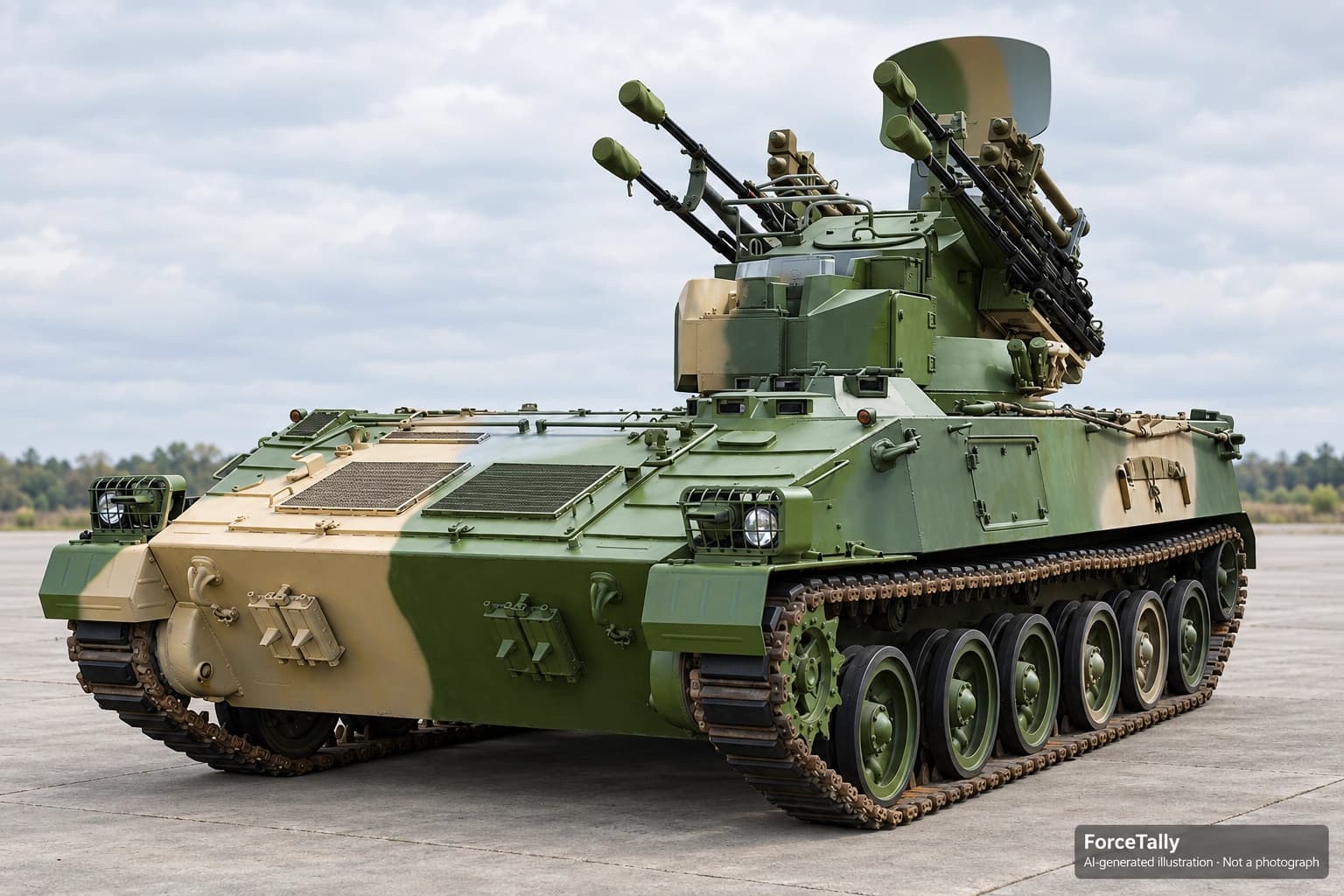
PGZ-95 is a self-propelled anti-aircraft gun /missile system originating in China. It was built by Norinco.

AI-generated illustration · Not a photograph · PGZ95 source-pictured tracked gun installation with raised radar panel and covered cylindrical side fittings.
ForceTally · AI-generated illustration based on Max Smith, release into the public domain but a photo credit would be nice · Public domain; original reference attribution retained. · ForceTally · AI-generated illustration · Source ↗ · ModifiedSelf-propelled anti-aircraft gun /missile system
China
1999-present
Northwest Institute of Mechanical & Electrical Engineering
Norinco
1999–present
22.5 tons
6.71 m (20 ft)
3.2 m (10 ft 6 in)
3.4 m (11 ft 2 in) (radar down) 4.82 m (15 ft 10 in) (radar up)
3
4 × 25 mm Type 87 autocannon; 4 × QW-2 or FN-6 missile
diesel
torsion bar
450 km (280 mi)
53 km/h (33 mph)
The PGZ-95 ( Chinese : 95式自行高射炮 ; pinyin : 95 shi zixing gaoshepao , Type 95 self-propelled anti-aircraft artillery ) is a Chinese self-propelled anti-aircraft vehicle.
The PGZ-95 ( Chinese : 95式自行高射炮 ; pinyin : 95 shi zixing gaoshepao , Type 95 self-propelled anti-aircraft artillery ) is a Chinese self-propelled anti-aircraft vehicle. It is armed with four 25 mm caliber cannons and optionally four fire-and-forget QW-2 infrared homing missiles. It was first displayed publicly at the Beijing Military Parade in 1999. Earlier in development the system was designated Type 90-II and Type 90-III .
The tracking cameras have a day range of approximately 6,000 meters and a night range of 5,000 meters.
The laser rangefinder has a range of between 500 and 5,500 meters with an accuracy of 5 meters.
Mounted on either side of the turret are two 25 millimeter Type 87 25x183mmB gas-operated cannons.
The cannons have a rate of fire of 600–800 rpm each, eject spent shell casings to either side of the vehicle.
The cannons are used to engage targets out to a range of 2,500 meters and at altitudes of up to 2,000 meters.
The QW-2 missiles are based on a shoulder-launched missile and can engage targets flying between 10 and 3,500 meters in altitude at a slant range of between 500 and 6,000 meters, but has to be manually reloaded which is known to take about 2.45 minutes.
To the rear of the turret is the CLC-1 S-band pulse-doppler search radar which has a reported range of 11 kilometers, and is optimized to detect low-flying targets.
The system has a reaction time of around 10 seconds when in radar search mode, and six seconds in optical mode.
A battery control vehicle using the same chassis is also built. It has a crew of five people. It uses a S-band CLC-2 surveillance radar with a maximum range of 45 kilometers and a maximum altitude of 4,500 meters. The communication system in the vehicle allows it to communicate digitally to a range of up to 5 kilometers and via a normal radio link up to 15 kilometers. Additionally it can use signal wire to communicate up to 500 meters. An Auxiliary Power Unit (APU) provides power for the electronics. A single 12.7 mm heavy machine gun is provided for self-defense.
The system can automatically optically track targets and provide the gunner with an alert when the target is within range. The gunner can also manually aim the guns, using either the optical system or an external backup ring sight provided on the outside of the turret.
The system can automatically optically track targets and provide the gunner with an alert when the target is within range. The gunner can also manually aim the guns, using either the optical system or an external backup ring sight provided on the outside of the turret.
Combat Weight 22,500 kg
Reference text from Wikipedia contributors, used under CC BY-SA 4.0.
True scale
Sourced dimensions beside a 1.75 m human reference.
Points represent sourced observations, including revisions. Revisions on the same effective date are not separate inventory events. Ranges appear in the table and are not plotted as exact points.
| Observation / report period | Value | Source | Claim state |
|---|---|---|---|
| 28 Sept 2026 | 3 people | Wikipedia contributors | superseded |
| 28 Sept 2026 | 3 people | Wikipedia contributors | superseded |
| 28 Sept 2026 | 3 people | Wikipedia contributors | superseded |
| 28 Sept 2026 | 3 people | Wikipedia contributors | superseded |
| 28 Sept 2026 | 3 people | Wikipedia contributors | superseded |
| 28 Sept 2026 | 3 people | Wikipedia contributors | approved |
PGZ-95 equipment records. Variants, orders and quantities are shown as reported in each inventory source; coverage is incomplete.
Keep exploring
Self-propelled anti-aircraft weapon system
Tracked self-propelled anti-aircraft gun
Hybrid mobile surface-to-air missile launcher system and self-propelled anti-aircraft gun
 United States
self-propelled Surface-to-air missile system
 Poland
Self-propelled anti-aircraft weapon Mobile air defense missile system Surface to air missile
Self-propelled anti-aircraft gun ( very short-range air defence )