FORCETALLY
Loading the evidence…
Preparing your view.


Preparing your view.
ArtilleryIn service
Light Howitzer
M3 howitzer is a light Howitzer originating in United States. Reported operators include United States.
 United States
Technical data
True scale
Sourced dimensions beside a 1.75 m human reference.
Points represent sourced observations, including revisions. Revisions on the same effective date are not separate inventory events. Ranges appear in the table and are not plotted as exact points.
| Observation / report period | Value | Source | Claim state |
|---|---|---|---|
| 29 Sept 2026 | 1.88 m | Wikipedia contributors | superseded |
| 29 Sept 2026 | 1.88 m | Wikipedia contributors | superseded |
| 29 Sept 2026 | 1.88 m | Wikipedia contributors | approved |
Light Howitzer
United States
1943–present
United States
World War II First Indochina War Korean War
1941
1943–1945
2,580
2,495 lb (1,130 kg)
12 ft 11 in (3.94 m)
Overall: 6 ft 2 in (1.88 m) L/17.9 Bore: 5 ft 6 in (1.68 m) L/16
5 ft 7 in (1.70 m)
4 ft 2 in (1.27 m)
10
105 × 372 mm R
36 lb 10 oz – 43 lb 3 oz (16.6–19.6 kg)
4.1 in (105 mm)
Horizontal-block
Hydro-pneumatic , constant
Split trail
−9° to 30°
45°
Burst: 4 rpm Sustained: 2 rpm
1,020 ft/s (311 m/s)
HE: 8,300 yd (7,600 m)
Argentina
Brazil
Dominican Republic
France
Mexico
Philippines
Republic of Korea
South Vietnam
United Kingdom
United States
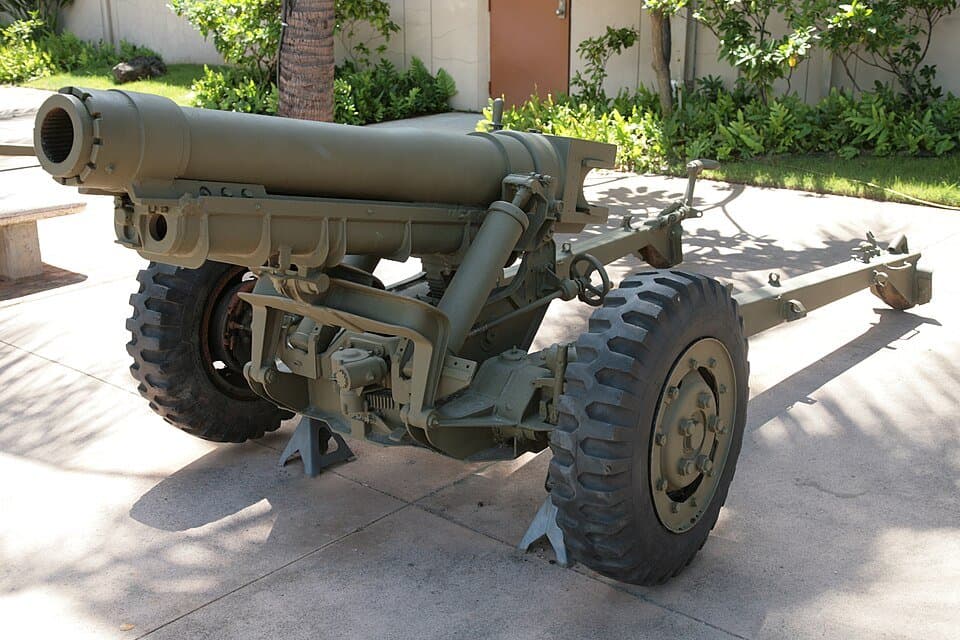
The 105 mm Howitzer M3 was a U.S. light howitzer designed for use by airborne troops. The gun utilized the barrel of the 105 mm Howitzer M2 , shortened and fitted to a slightly modified split trail carriage of the 75 mm pack howitzer .
The process of building airborne forces in 1941 led to a requirement for an air-portable 105 mm howitzer. The weapon, initially designated T7, featured a barrel from the 105mm Howitzer M2 , shortened by 27 inches (690 mm) and combined with the recoil system and carriage from the 75 mm pack howitzer . A prototype reached trials at Aberdeen Proving Ground in March 1942.
The howitzer was designed to fire the same ammunition as the M2 howitzer, however, it was found that the shorter barrel resulted in incomplete burning of the propelling charge. The problem could be solved by use of faster-burning powder, and otherwise, the design was considered acceptable and was standardized as the 105 mm Howitzer M3 on Carriage M3 . The carriage was soon succeeded by the M3A1, which had trails made from thicker steel plate. Even stronger tubular trails were designed, but never reached production.
Even though the M3 was not mentioned in the February 1944 T/O&E, shortly before the Normandy airdrops some airborne divisions received a 105 mm glider field artillery battalion equipped with them as a supplement to their existing three 75 mm howitzer battalions (designated the M1A1 during World War II). 1/4 ton jeeps were used as prime movers . Later increased to four battalions, one, between 1943 and 1945, was converted to 105mm M3. The weapon was finally authorized as an option by the December 1944 TO&E, and by 1945 was employed by all airborne divisions in the European Theater .
The initial production of the M3 was adequate to equip the cannon companies of the three hundred infantry regiments that had been forecast in the initial war plans. The M3 was the primary weapon of these companies, and appeared in the table of organization and equipment (T/O&E) from early 1944 (six, in three platoons of two) Often the cannon companies were integrated into the division artillery. The infantry used 1½ ton cargo trucks as the prime mover. In an assessment written after the war "The cannon company of 1943-45 failed to live up to the expectations of the force designers of 1942. The main problem was the substitution of towed low-velocity howitzers for the self-propelled versions as originally intended. This howitzer, the M3, had a shorter barrel than the regular 105-mm howitzer M2, possessed no ballistic shield, and had an effective range of only 7,250 yards (6.63 km) as compared to 12,500 yards (11.4 km) for the M2."
T10 - variant with elevation increased to 65 degrees.
M3 - based on M3A1 carriage for the 75 mm field howitzer.
M3A1 - had stronger trails, made from 1 ⁄ 8 inch (3.2 mm) plate instead of 3 ⁄ 32 inch (2.4 mm).
105 mm Howitzer Motor Carriage T38 - based on the M3 halftrack , never built.
105 mm Howitzer Motor Carriage T82 (M3 in mount M3A1) - based on the Light Tank M5A1 chassis. Two pilots were built. The project was cancelled in June 1945 due to lack of requirement.
The gun fired semi-fixed ammunition, similar to the ammunition of the M2 ; it used the same projectiles and the same 105 mm Cartridge Case M14, but with different propelling charge. The latter used faster burning powder to avoid incomplete burning; it consisted of a base charge and four increments, forming five charges from 1 (the smallest) to 5 (the largest). In an emergency, gunners were authorized to fire M1 HE rounds prepared for the Howitzer M2, but only with charges from 1 to 3. M1 HE rounds for the M3 could be fired from an M2 with any charge.
Peso 1.130 kg
Lunghezza canna 1,88 m
Calibro 105 mm
Cadenza di tiro 2-4 colpi/min
Peso 1.130 kg
Lunghezza canna 1,88 m
Calibro 105 mm
Cadenza di tiro 2-4 colpi/min
重量 1,130公斤(2,495磅)
槍管 长度 1.880公尺(17.9倍徑)
口径 : 105mm
重量: 1,130kg
発射速度: 4発/分(最大)、2発/分(連続射撃時)
중량: 1,131kg
Designation: M3
Manufacturer: General Dynamics Ordnance and Tactical Systems
Product type: Weapons & Weapon Systems
Name: Towed howitzer
Main weapon caliber (mm) 105
Reference text from Wikipedia contributors, used under CC BY-SA 4.0.
M3 howitzer equipment records. Variants, orders and quantities are shown as reported in each inventory source; coverage is incomplete.
 Argentina
 Brazil
 Dominican Republic
Reported count for M3. Service scope: Dominican Army; does not replace a national total. 1 distinct count cell(s) from the same source list; shared rowspan cells counted once. Retired, wholly reserve and on-order rows are excluded; the reported count retains any explicitly mixed stock scope in the quoted row. Count column(s): quantity: 4. Origin: United States. The listed variants/roles are the scope, not an immediately deployable count. The components do not establish one inventory census date; the stored date is the retrieved source snapshot.
 France
 Mexico
Army exact named equipment holdings: M3. Active, operational-reserve and training units excluding equipment in store; November 2025 IISS assessment. Named service only; no parent-force or national total inferred. Source role: ARTILLERY / 105mm. Original estimates, ranges, reporting names, reserve, lease and employment scopes retained; nested included counts are not added. Missile-system quantities mean launchers, not rounds. No readiness, crew, carried weapon, payload, factory-production or future order count inherited.
 Philippines
 South Korea
 United Kingdom United States
Keep exploring
 Spain
 Israel