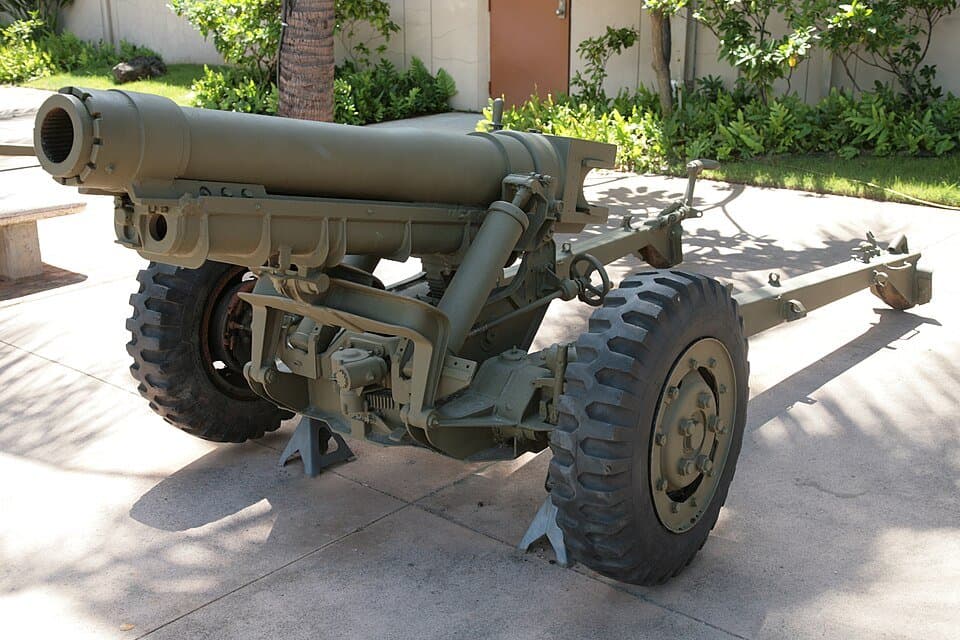

Credit
Max Smith · Public domain · Resized · Public domain · Source ↗ · Modified


Preparing your view.

At a glance
M3 howitzerlarger figure on 0 of 5
Obusier de 105 modèle 1950
Measured figures
Length
Single source12 ft 11 in (3.94 m)[source]
Length
Single sourceConfiguration
| Specification | M3 howitzer | Obusier de 105 modèle 1950 |
|---|---|---|
| Type | Light Howitzer[source] | Howitzer[source] Towed Howitzer[source]105mm Mle 50 TF 105mm 23-caliber ordnance[source]105mm Mle 50 TF Two wheel carriage[source]105mm Mle 50 TF |
| Place of origin | United States[source] | France |
Counts only measures both sources give with the same scope. A larger figure is not a better system.
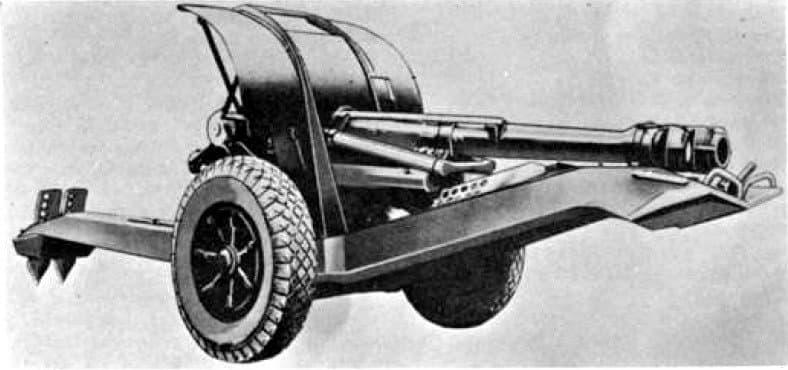
105mm Mle 50 TF · in travel configuration
Single sourceBarrel length
Single sourceL/17.9 Bore L/16
Single sourceOverall
Single sourceOverall: 6 ft 2 in (1.88 m) L/17.9 Bore: 5 ft 6 in (1.68 m) L/16[source]
1,88 m[source]
1,88 m[source]
1.880公尺(17.9倍徑)[source]105 mm Howitzer M3
105mm Mle 50 TF · including muzzle brake
Single sourceL/23 (with muzzle brake )
Single sourceBars compare reported quantities only. A larger figure does not make a system better; configurations and test conditions differ.
| In service | 1943–present[source] | — |
|---|
| Used by | United States[source] | See users[source] |
|---|
| Wars | World War II First Indochina War Korean War[source] | — |
|---|
| Designed | 1941[source] | 1946[source] |
|---|
| Produced | 1943–1945[source] | 1950[source] |
|---|
| No. built | 2,580[source] | — |
|---|
| Shell | 105 × 372 mm R[source] | Semi-fixed 105x372 mm R[source] |
|---|
| Shell weight | 36 lb 10 oz – 43 lb 3 oz (16.6–19.6 kg)[source] | 15 kg (33 lb)[source] |
|---|
| Breech | Horizontal-block[source] | — |
|---|
| Recoil | Hydro-pneumatic , constant[source] | Hydro-pneumatic[source] |
|---|
| Carriage | Split trail[source] | Tripod[source] |
|---|
| Elevation | −9° to 30°[source] | -7° to +70°[source] -7° to -70°, manual[source]105mm Mle 50 TF |
|---|
| Traverse | 45°[source] | 360°[source] 360°, manual[source]105mm Mle 50 TF |
|---|
| Source measurement | The 105 mm Howitzer M3 was a U.S. light howitzer designed for use by airborne troops. The gun utilized the barrel of the 105 mm Howitzer M2 , shortened and fitted to a slightly modified split trail carriage of the 75 mm pack howitzer .[source]M3 howitzer · Lead; only the objects and conditions stated in this passage The process of building airborne forces in 1941 led to a requirement for an air-portable 105 mm howitzer. The weapon, initially designated T7, featured a barrel from the 105mm Howitzer M2 , shortened by 27 inches (690 mm) and combined with the recoil system and carriage from the 75 mm pack howitzer . A prototype reached trials at Aberdeen Proving Ground in March 1942.[source]M3 howitzer · Development and production; only the objects and conditions stated in this passage The howitzer was designed to fire the same ammunition as the M2 howitzer, however, it was found that the shorter barrel resulted in incomplete burning of the propelling charge. The problem could be solved by use of faster-burning powder, and otherwise, the design was considered acceptable and was standardized as the 105 mm Howitzer M3 on Carriage M3 . The carriage was soon succeeded by the M3A1, which had trails made from thicker steel plate. Even stronger tubular trails were designed, but never reached production.[source]M3 howitzer · Development and production; only the objects and conditions stated in this passage Even though the M3 was not mentioned in the February 1944 T/O&E, shortly before the Normandy airdrops some airborne divisions received a 105 mm glider field artillery battalion equipped with them as a supplement to their existing three 75 mm howitzer battalions (designated the M1A1 during World War II). 1/4 ton jeeps were used as prime movers . Later increased to four battalions, one, between 1943 and 1945, was converted to 105mm M3. The weapon was finally authorized as an option by the December 1944 TO&E, and by 1945 was employed by all airborne divisions in the European Theater .[source]M3 howitzer · Service; only the objects and conditions stated in this passage The initial production of the M3 was adequate to equip the cannon companies of the three hundred infantry regiments that had been forecast in the initial war plans. The M3 was the primary weapon of these companies, and appeared in the table of organization and equipment (T/O&E) from early 1944 (six, in three platoons of two) Often the cannon companies were integrated into the division artillery. The infantry used 1½ ton cargo trucks as the prime mover. In an assessment written after the war "The cannon company of 1943-45 failed to live up to the expectations of the force designers of 1942. The main problem was the substitution of towed low-velocity howitzers for the self-propelled versions as originally intended. This howitzer, the M3, had a shorter barrel than the regular 105-mm howitzer M2, possessed no ballistic shield, and had an effective range of only 7,250 yards (6.63 km) as compared to 12,500 yards (11.4 km) for the M2."[source]M3 howitzer · Service; only the objects and conditions stated in this passage T10 - variant with elevation increased to 65 degrees.[source]M3 howitzer · Variants; only the objects and conditions stated in this passage M3 - based on M3A1 carriage for the 75 mm field howitzer.[source]M3 howitzer · Variants; only the objects and conditions stated in this passage M3A1 - had stronger trails, made from 1 ⁄ 8 inch (3.2 mm) plate instead of 3 ⁄ 32 inch (2.4 mm).[source]M3 howitzer · Variants; only the objects and conditions stated in this passage 105 mm Howitzer Motor Carriage T38 - based on the M3 halftrack , never built.[source]M3 howitzer · Self-propelled mounts; only the objects and conditions stated in this passage 105 mm Howitzer Motor Carriage T82 (M3 in mount M3A1) - based on the Light Tank M5A1 chassis. Two pilots were built. The project was cancelled in June 1945 due to lack of requirement.[source]M3 howitzer · Self-propelled mounts; only the objects and conditions stated in this passage The gun fired semi-fixed ammunition, similar to the ammunition of the M2 ; it used the same projectiles and the same 105 mm Cartridge Case M14, but with different propelling charge. The latter used faster burning powder to avoid incomplete burning; it consisted of a base charge and four increments, forming five charges from 1 (the smallest) to 5 (the largest). In an emergency, gunners were authorized to fire M1 HE rounds prepared for the Howitzer M2, but only with charges from 1 to 3. M1 HE rounds for the M3 could be fired from an M2 with any charge.[source]M3 howitzer · Ammunition; only the objects and conditions stated in this passage | In the aftermath of World War II, the French Army was equipped with a variety of weaponry. There were French, British, German and US weapons in use. In 1946 DEFA (Direction des Études et Fabrications d'Armament) began a design study to build a new 105 mm howitzer for the French Army to replace its assortment of weapons. It would be the first 105 mm gun designed and built in Western Europe after World War II.[source]Obusier de 105 modèle 1950 · History; only the objects and conditions stated in this passage The mle 1950 would be a departure from previous designs because it would feature a three outrigger tripod carriage which was more common for anti-aircraft guns than howitzers. For travel, the gun was towed by one rearward facing outrigger which had a towing eye and two outriggers folded forward for the barrel to rest on. The carriage also had a two-wheeled torsion bar suspension and a curved three-piece gun shield for the crew. Once in firing position, the wheels were raised and the outriggers were spread to form a Y. This allowed a wide range of elevation -7° to +70° as well as 360° traverse similar to the Soviet D30 howitzer. However, unlike the D-30 the mle 1950 had a hydro-pneumatic recoil system mounted below the barrel, it had a double-baffle muzzle brake, and there wasn't a towing eye on the barrel.[source]Obusier de 105 modèle 1950 · Design; only the objects and conditions stated in this passage In addition to its towed version the mle 1950 was the primary armament of the Mk 61 105 mm self-propelled howitzer . This consisted of a mle 1950 mounted in a large non-traversing armored casemate on an AMX-13 light tank chassis.[source]Obusier de 105 modèle 1950 · Self-propelled artillery; only the objects and conditions stated in this passage |
|---|
| Designation: | M3[source]M3 | — |
|---|
| Manufacturer | General Dynamics Ordnance and Tactical Systems[source]M3 | DEFA[source] |
|---|
| Product type: | Weapons & Weapon Systems[source]M3 | — |
|---|
| Name: | Towed howitzer[source]M3 | — |
|---|
| Designer | — | DEFA[source] |
|---|
| Role | — | French Howitzer[source] |
|---|
| Origin | — | France[source]105mm Mle 50 TF |
|---|
| Ammunition | — | 105x372mmR, semi-fixed case[source]105mm Mle 50 TF |
|---|
| Muzzle brake | — | Yes, double baffle[source]105mm Mle 50 TF |
|---|
| Sights | — | Indirect fire sight[source]105mm Mle 50 TF Direct fire sight[source]105mm Mle 50 TF |
|---|
| Limber | — | No, towing eye on outrigger[source]105mm Mle 50 TF |
|---|
| Gun shield | — | Yes[source]105mm Mle 50 TF |
|---|
| Towing vehicle | — | 4x4 or 6x6 truck, such as TRM 4000[source]105mm Mle 50 TF |
|---|
| Towed speed | — | 50 km/h[source]105mm Mle 50 TF |
|---|
| Autonomous mobility | — | Can be manhandled over very short distances[source]105mm Mle 50 TF |
|---|
| APU | — | No[source]105mm Mle 50 TF |
|---|
| Reported operators |
|---|
2,922 kg (6,442 lb)[source]
2.922 kg in firing position[source]105mm Mle 50 TF
3.2 t in travel configuration[source]105mm Mle 50 TF
Rate of fire
Single source