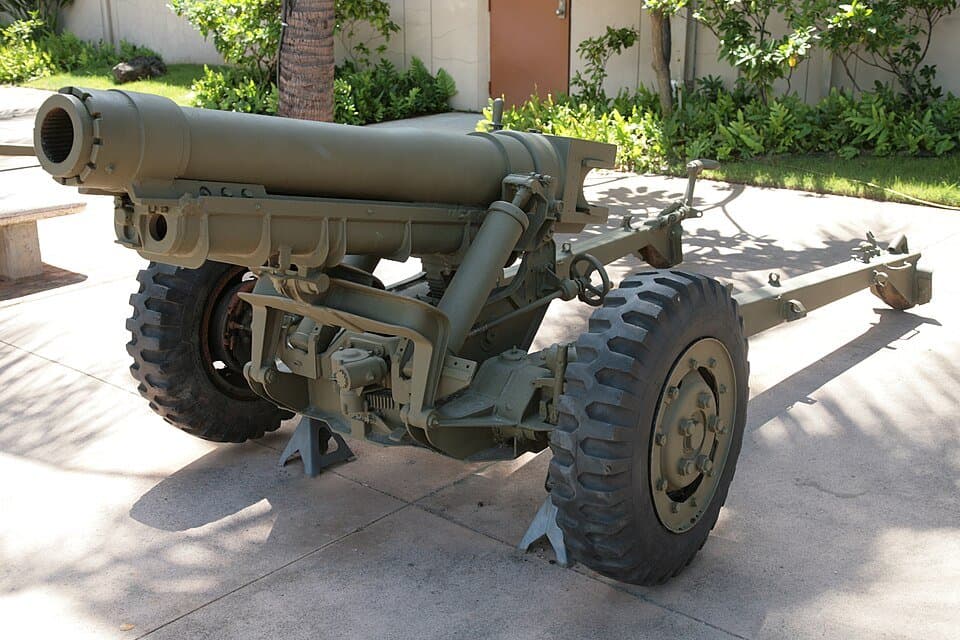

Credit
Max Smith · Public domain · Resized · Public domain · Source ↗ · Modified


Preparing your view.


At a glance
M3 howitzerlarger figure on 0 of 4
Measured figures
Length
Single source12 ft 11 in (3.94 m)[source]
Length
Single sourceConfiguration
| Specification | M3 howitzer | Santa Bárbara Sistemas 155/52 |
|---|---|---|
| Type | Light Howitzer[source] | Howitzer[source] |
| Place of origin | United States[source] | Spain[source] |
| In service | 1943–present[source] | 2002–present[source] |
| Used by | United States[source] | Colombia Spain El Salvador |
Counts only measures both sources give with the same scope. A larger figure is not a better system.
10.3 m (33 ft 10 in)[source]
Maximum; Maximum speed
Single source18 km/h (11 mph)[source]
Diesel APU
Single sourceDiesel APU 106 hp (79 kW )[source]
Muzzle velocity
Single source1,020 ft/s (311 m/s)[source]
Bars compare reported quantities only. A larger figure does not make a system better; configurations and test conditions differ.
| Wars | World War II First Indochina War Korean War[source] | — |
|---|
| Designed | 1941[source] | — |
|---|
| Produced | 1943–1945[source] | — |
|---|
| No. built | 2,580[source] | 111[source] |
|---|
| Shell | 105 × 372 mm R[source] | Separate loading charge and projectiles[source] |
|---|
| Shell weight | 36 lb 10 oz – 43 lb 3 oz (16.6–19.6 kg)[source] | — |
|---|
| Breech | Horizontal-block[source] | Interrupted screw[source] |
|---|
| Recoil | Hydro-pneumatic , constant[source] | Hydro-pneumatic[source] |
|---|
| Carriage | Split trail[source] | Split trail[source] |
|---|
| Elevation | −9° to 30°[source] | −3° to +72°[source] |
|---|
| Traverse | 45°[source] | 40°[source] |
|---|
| Source measurement | The 105 mm Howitzer M3 was a U.S. light howitzer designed for use by airborne troops. The gun utilized the barrel of the 105 mm Howitzer M2 , shortened and fitted to a slightly modified split trail carriage of the 75 mm pack howitzer .[source]M3 howitzer · Lead; only the objects and conditions stated in this passage The process of building airborne forces in 1941 led to a requirement for an air-portable 105 mm howitzer. The weapon, initially designated T7, featured a barrel from the 105mm Howitzer M2 , shortened by 27 inches (690 mm) and combined with the recoil system and carriage from the 75 mm pack howitzer . A prototype reached trials at Aberdeen Proving Ground in March 1942.[source]M3 howitzer · Development and production; only the objects and conditions stated in this passage The howitzer was designed to fire the same ammunition as the M2 howitzer, however, it was found that the shorter barrel resulted in incomplete burning of the propelling charge. The problem could be solved by use of faster-burning powder, and otherwise, the design was considered acceptable and was standardized as the 105 mm Howitzer M3 on Carriage M3 . The carriage was soon succeeded by the M3A1, which had trails made from thicker steel plate. Even stronger tubular trails were designed, but never reached production.[source]M3 howitzer · Development and production; only the objects and conditions stated in this passage Even though the M3 was not mentioned in the February 1944 T/O&E, shortly before the Normandy airdrops some airborne divisions received a 105 mm glider field artillery battalion equipped with them as a supplement to their existing three 75 mm howitzer battalions (designated the M1A1 during World War II). 1/4 ton jeeps were used as prime movers . Later increased to four battalions, one, between 1943 and 1945, was converted to 105mm M3. The weapon was finally authorized as an option by the December 1944 TO&E, and by 1945 was employed by all airborne divisions in the European Theater .[source]M3 howitzer · Service; only the objects and conditions stated in this passage The initial production of the M3 was adequate to equip the cannon companies of the three hundred infantry regiments that had been forecast in the initial war plans. The M3 was the primary weapon of these companies, and appeared in the table of organization and equipment (T/O&E) from early 1944 (six, in three platoons of two) Often the cannon companies were integrated into the division artillery. The infantry used 1½ ton cargo trucks as the prime mover. In an assessment written after the war "The cannon company of 1943-45 failed to live up to the expectations of the force designers of 1942. The main problem was the substitution of towed low-velocity howitzers for the self-propelled versions as originally intended. This howitzer, the M3, had a shorter barrel than the regular 105-mm howitzer M2, possessed no ballistic shield, and had an effective range of only 7,250 yards (6.63 km) as compared to 12,500 yards (11.4 km) for the M2."[source]M3 howitzer · Service; only the objects and conditions stated in this passage T10 - variant with elevation increased to 65 degrees.[source]M3 howitzer · Variants; only the objects and conditions stated in this passage M3 - based on M3A1 carriage for the 75 mm field howitzer.[source]M3 howitzer · Variants; only the objects and conditions stated in this passage M3A1 - had stronger trails, made from 1 ⁄ 8 inch (3.2 mm) plate instead of 3 ⁄ 32 inch (2.4 mm).[source]M3 howitzer · Variants; only the objects and conditions stated in this passage 105 mm Howitzer Motor Carriage T38 - based on the M3 halftrack , never built.[source]M3 howitzer · Self-propelled mounts; only the objects and conditions stated in this passage 105 mm Howitzer Motor Carriage T82 (M3 in mount M3A1) - based on the Light Tank M5A1 chassis. Two pilots were built. The project was cancelled in June 1945 due to lack of requirement.[source]M3 howitzer · Self-propelled mounts; only the objects and conditions stated in this passage The gun fired semi-fixed ammunition, similar to the ammunition of the M2 ; it used the same projectiles and the same 105 mm Cartridge Case M14, but with different propelling charge. The latter used faster burning powder to avoid incomplete burning; it consisted of a base charge and four increments, forming five charges from 1 (the smallest) to 5 (the largest). In an emergency, gunners were authorized to fire M1 HE rounds prepared for the Howitzer M2, but only with charges from 1 to 3. M1 HE rounds for the M3 could be fired from an M2 with any charge.[source]M3 howitzer · Ammunition; only the objects and conditions stated in this passage | For transport, the split trail carriage can be closed and the barrel and rotated 180° while being towed by an IVECO Pegaso 6x6 artillery tractor . There is also a 106 hp (79 kW ) diesel auxiliary power unit (APU) at the front of the carriage with a driver's station that can move the gun at 18 km/h (11 mph) over short distances. The APU also powers the hydraulic automatic gun-laying system (AGLS) that controls elevation, traverse, spreading, and retraction. Two retractable wheels on the tail of the gun carriage can be lowered when the gun is being moved by the APU.[source]Santa Bárbara Sistemas 155/52 · Design; only the objects and conditions stated in this passage The howitzer fires a variety of separate loading NATO standard projectiles, including extended-range base bleed and rocket-assisted projectiles up to 40 km (25 mi). The howitzer has a hydraulic ammunition loader that can be loaded at any angle and provides a high rate of fire.[source]Santa Bárbara Sistemas 155/52 · Design; only the objects and conditions stated in this passage Santa Bárbara Sistemas 155/52 APU (V07) – is an upgraded coastal artillery model. There are 16 in service with the Coastal Artillery Regiment No. 4 ( Regimiento de Artillería de Costa nº 4 ) of the Spanish Army. The system software is specialized for tracking and firing at mobile naval targets instead of static land targets.[source]Santa Bárbara Sistemas 155/52 · Models; only the objects and conditions stated in this passage |
|---|
| Designation: | M3[source]M3 | — |
|---|
| Manufacturer | General Dynamics Ordnance and Tactical Systems[source]M3 | Santa Bárbara Sistemas[source]Santa Bárbara Sistemas 155/52 — explicit named producer; no component/sibling identity |
|---|
| Product type: | Weapons & Weapon Systems[source]M3 | — |
|---|
| Name: | Towed howitzer[source]M3 | — |
|---|
| Action | — | Hydraulic loader[source] |
|---|
| Role | — | modern field howitzer[source] |
|---|
| Source manufacturer statement | — | The Santa Bárbara Sistemas 155/52 is a modern field howitzer designed and manufactured by the Spanish armament manufacturer Santa Bárbara Sistemas (SBS) a division of General Dynamics and was produced from 2002 to 2009 at the La Vega and Trubia factories in Asturias .[source]Only the subject, component or variant named in this passage; unresolved names do not create a manufacturer identity The barrel is produced by the German company Rheinmetall , while the gun carriage is produced by SBS.[source]Only the subject, component or variant named in this passage; unresolved names do not create a manufacturer identity |
|---|
| Reported operators | — |
|---|