FORCETALLY
Loading the evidence…
Preparing your view.


Preparing your view.
Engineering & recoveryIn service
armored vehicle-launched bridge vehicle
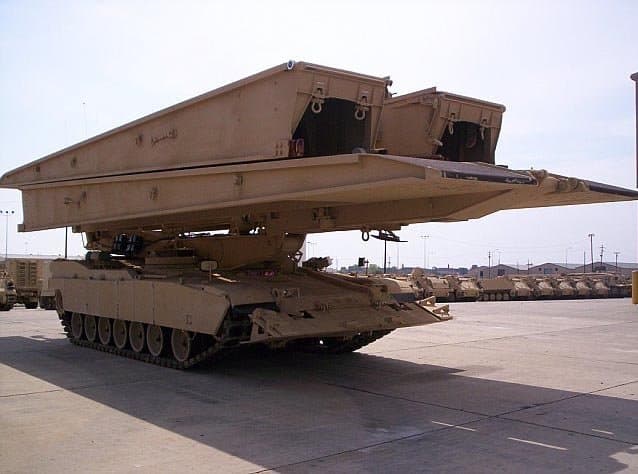
M104 Wolverine is a armored vehicle-launched bridge vehicle originating in United States.
 United States
Technical data
is United States armored vehicle-launched bridge vehicle
is United States armored vehicle-launched bridge vehicle
by 1994 General Dynamics Land Systems and the German MAN Mobile Bridges GmbH (since 2005 Krauss-Maffei Wegmann ) had been awarded a contract
vehicle itself is completely unarmed
operated by two crewmen who sit within the hull
Once launched, the 26-meter Leguan bridge
bridge can support a 70-ton vehicle moving at 16 km/h, or 10 miles per hour
Since the 1960s the United States Army has made use of armored bridge-laying vehicles based on the M48 Patton / M60 series of tanks. In recent years, however, the Army discovered that the aging M60 AVLB was too slow to keep up with the M1 Abrams main battle tanks' top speed of roughly 70 km/h during field maneuvers. Additionally, the Abrams was so heavy that it could safely cross the AVLB's bridge only at a very slow speed.
The Wolverine is operated by two crewmen who sit within the hull. Both crewmen have access to the bridging controls, while the bridge is carried in two sections, stacked above the hull. Once a bridging site is chosen the vehicle securely anchors itself in place with a spade. The two sections of the bridge are joined together, and then the entire bridge is extended across the obstacle and dropped into place. The crewmen have the ability to make minor corrections during launch, if needed. Once operations are complete, the Wolverine drives across the bridge and retrieves it from the other side simply by reversing the process. The bridge can be lowered in under five minutes or raised in less than ten minutes, all without the crewmen ever leaving the safety of their vehicle.
Once launched, the 26-meter Leguan bridge can support a 70-ton vehicle moving at 16 km/h, or 10 miles per hour. The Wolverine thus allows the heaviest of vehicles to cross craters, ditches, and damaged bridges at combat speed. This mobility is a decisive advantage for armored units .
The Joint Assault Bridge also has an Abrams tank chassis but is equipped with a 18.3-metre (60 ft) scissor bridge. While the M104 was intended to replace the AVLB, it was found to be too expensive and complicated to maintain and operate. While the JAB's bridge is shorter, it has a faster deployment time of three minutes, compared to the Wolverine's 3-5 minute set-up time. In 2016, the U.S. Army awarded DRS Technologies an indefinite quantity contract worth up to $400 million to build the new M1074 JAB. Low-rate production concluded in mid-2018, and initial series production began in 2019.
General Dynamics Land Systems (GDLS) finalized their LRIP contract negotiations under the M1A2 SEP Production Contract with the Government, with contract awarded 9 Apr 98. Under this contract, GDLS is to fabricate six prototypes for delivery to the government in the Mar-Aug 99 timeframe.
Besatzung 2
Länge 13,4 m
Breite 4 m
Höhe 3,95 m
Masse 69 t
Hauptbewaffnung unbewaffnet
Antrieb AGT-1500-Gasturbine 1119 kW (1500 hp, 1521 PS)
Geschwindigkeit 72 km/h (45 mph)
Reichweite 418 km (260 mi)
Antrieb AGT-1500-Gasturbine 1119 kW (1500 hp, 1521 PS)
Reference text from Wikipedia contributors, used under CC BY-SA 4.0.
True scale
Sourced dimensions beside a 1.75 m human reference.
M104 Wolverine equipment records. Variants, orders and quantities are shown as reported in each inventory source; coverage is incomplete.
 Egypt United States
Reported count for M104 Wolverine. Service scope: United States Army; does not replace a national total. 1 distinct count cell(s) from the same source list; shared rowspan cells counted once. Retired, wholly reserve and on-order rows are excluded; the reported count retains any explicitly mixed stock scope in the quoted row. Count column(s): quantity: 40. Origin: United States. The listed variants/roles are the scope, not an immediately deployable count. Dates are the count-cell citations' stated source period (2024), not the article revision. Cited source 2024-02-12. Edition or publication years do not claim an exact inventory census day.
Keep exploring
Armored vehicle-launched bridge
United StatesCompare with M104 Wolverine Armored vehicle-launched bridge
United StatesCompare with M104 Wolverine Armoured vehicle-launched bridge
 Poland
Armoured vehicle-launched bridge
Compare with M104 WolverineArmoured vehicle-launched bridge
 FranceCompare with M104 Wolverine
Armoured vehicle-launched bridge
Compare with M104 Wolverine