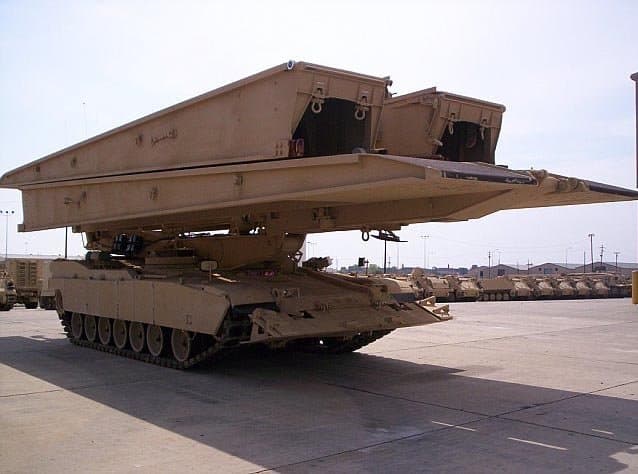

Credit
20th Engineers Bn · Public domain · Resized · Public domain · Source ↗ · Modified


Preparing your view.
At a glance
Measured figures
M104 Wolverine only · own German infobox · Länge · M104 Wolverine only · own German infobox · Länge
Single source13,4 m[source]M104 Wolverine only · own German infobox · Länge
with bridge
Configuration
| Specification | M104 Wolverine | M1074 Joint Assault Bridge System |
|---|---|---|
| Type | armored vehicle-launched bridge vehicle[source] | Armored vehicle-launched bridge[source] |
| National origin | United States[source] | — |
| Design contractors | General Dynamics Land Systems and the German MAN Mobile Bridges GmbH (since 2005 Krauss-Maffei Wegmann )[source] | — |
| Armament | completely unarmed[source] | — |
| Bridge length | 26-meter Leguan bridge[source] |
32.25 ft (9.83 m) with bridge[source]
Maximum; M104 Wolverine only · own German infobox · Geschwindigkeit · M104 Wolverine only · own German infobox · Geschwindigkeit
Single source72 km/h (45 mph)[source]M104 Wolverine only · own German infobox · Geschwindigkeit
Maximum; Off-road
Single sourceMaximum; Road governed
Single sourceRoad 45 mph (72 km/h) (governed); Off-road: 30 mph (48 km/h)[source]
AGT-1500-Gasturbine
Single sourceAGT-1500-Gasturbine 1119 kW (1500 hp, 1521 PS)[source]M104 Wolverine only · own German infobox · Antrieb
1119 kW (1500 hp, 1521 PS)[source]M104 Wolverine only · own German infobox · Antrieb · explicitly stated engine output, not AGT-1500 model digits
Honeywell AGT1500 C multi-fuel turbine engine 1,500 shp (
Single sourceHoneywell AGT1500 C multi-fuel turbine engine 1,500 shp (1,120 kW)[source]
Bars compare reported quantities only. A larger figure does not make a system better; configurations and test conditions differ.
| — |
| Bridge capacity | 70-ton vehicle moving at 16 km/h, or 10 miles per hour[source] | — |
|---|
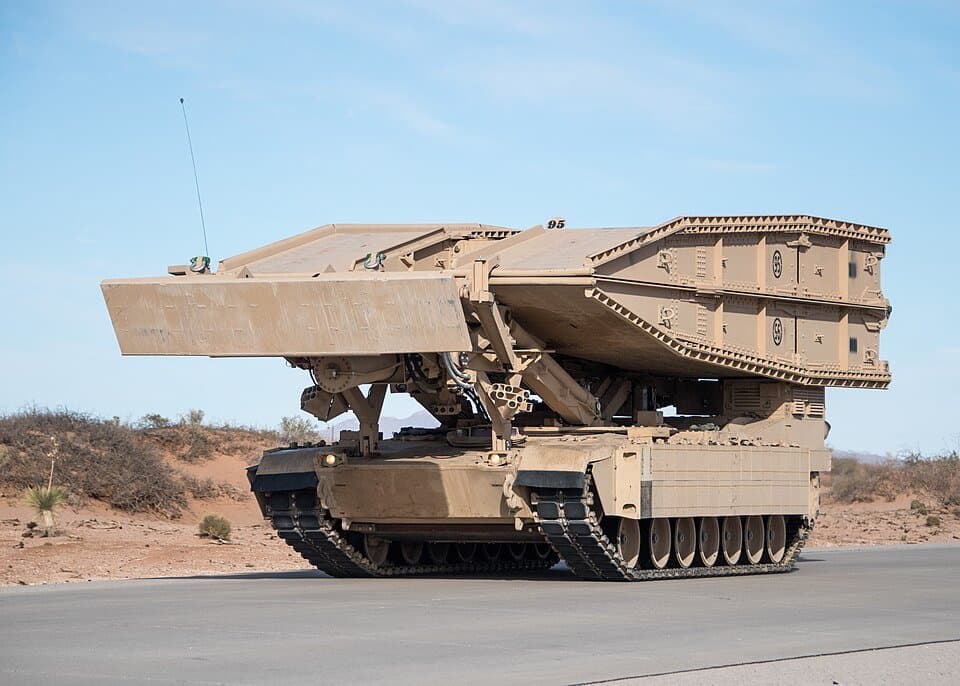
| Source measurement | Since the 1960s the United States Army has made use of armored bridge-laying vehicles based on the M48 Patton / M60 series of tanks. In recent years, however, the Army discovered that the aging M60 AVLB was too slow to keep up with the M1 Abrams main battle tanks' top speed of roughly 70 km/h during field maneuvers. Additionally, the Abrams was so heavy that it could safely cross the AVLB's bridge only at a very slow speed.[source]M104 Wolverine · Background; only the objects and conditions stated in this passage The Wolverine is operated by two crewmen who sit within the hull. Both crewmen have access to the bridging controls, while the bridge is carried in two sections, stacked above the hull. Once a bridging site is chosen the vehicle securely anchors itself in place with a spade. The two sections of the bridge are joined together, and then the entire bridge is extended across the obstacle and dropped into place. The crewmen have the ability to make minor corrections during launch, if needed. Once operations are complete, the Wolverine drives across the bridge and retrieves it from the other side simply by reversing the process. The bridge can be lowered in under five minutes or raised in less than ten minutes, all without the crewmen ever leaving the safety of their vehicle.[source]M104 Wolverine · Description; only the objects and conditions stated in this passage Once launched, the 26-meter Leguan bridge can support a 70-ton vehicle moving at 16 km/h, or 10 miles per hour. The Wolverine thus allows the heaviest of vehicles to cross craters, ditches, and damaged bridges at combat speed. This mobility is a decisive advantage for armored units .[source]M104 Wolverine · Description; only the objects and conditions stated in this passage The Joint Assault Bridge also has an Abrams tank chassis but is equipped with a 18.3-metre (60 ft) scissor bridge. While the M104 was intended to replace the AVLB, it was found to be too expensive and complicated to maintain and operate. While the JAB's bridge is shorter, it has a faster deployment time of three minutes, compared to the Wolverine's 3-5 minute set-up time. In 2016, the U.S. Army awarded DRS Technologies an indefinite quantity contract worth up to $400 million to build the new M1074 JAB. Low-rate production concluded in mid-2018, and initial series production began in 2019.[source]M104 Wolverine · Future plans and replacement; only the objects and conditions stated in this passage | — |
|---|
| Manufacturer | General Dynamics Land Systems[source]Wolverine bridge-and-launcher system fabrication under the M1A2 SEP production contract; original LRIP configuration | Leonardo DRS , West Plains, Missouri Anniston Army Depot (final assembly)[source] |
|---|
| Main armament | unbewaffnet[source]M104 Wolverine only · own German infobox · Hauptbewaffnung | None[source] |
|---|
| Place of origin | — | United States[source] |
|---|
| In service | — | 2016–present[source] |
|---|
| Used by | — | United States Army United States Marine Corps[source] |
|---|
| Designer | — | United States Army Tank Automotive Research, Development and Engineering Center (TARDEC)[source] |
|---|
| Designed | — | 2012[source] |
|---|
| Unit cost | — | $1.87 million with MLC95 bridge (2018)[source] |
|---|
| Produced | — | in production as of 2016[source] |
|---|
| No. built | — | 144 (as of 2024) Full rate production starts 2021[source] |
|---|
| Armor | — | Burlington composite armor[source] |
|---|
| Secondary armament | — | None[source] |
|---|
| Power/weight | — | 23.8 hp/t (17.74 kW/t)[source] |
|---|
| Payload capacity | — | 1× scissors-type folding bridge MLC115 (HASB)[source] |
|---|
| Transmission | — | Allison DDA X-1100-3B (4 forward 2 reverse gears)[source] |
|---|
| Suspension | — | High-hardness-steel torsion bars with rotary shock absorbers[source] |
|---|
| Ground clearance | — | 0.48 m (1 ft 7 in)[source] |
|---|
| Fuel capacity | — | 500 US gallons (1,900 L; 420 imp gal)[source] |
|---|
| Reported operators | — |
|---|