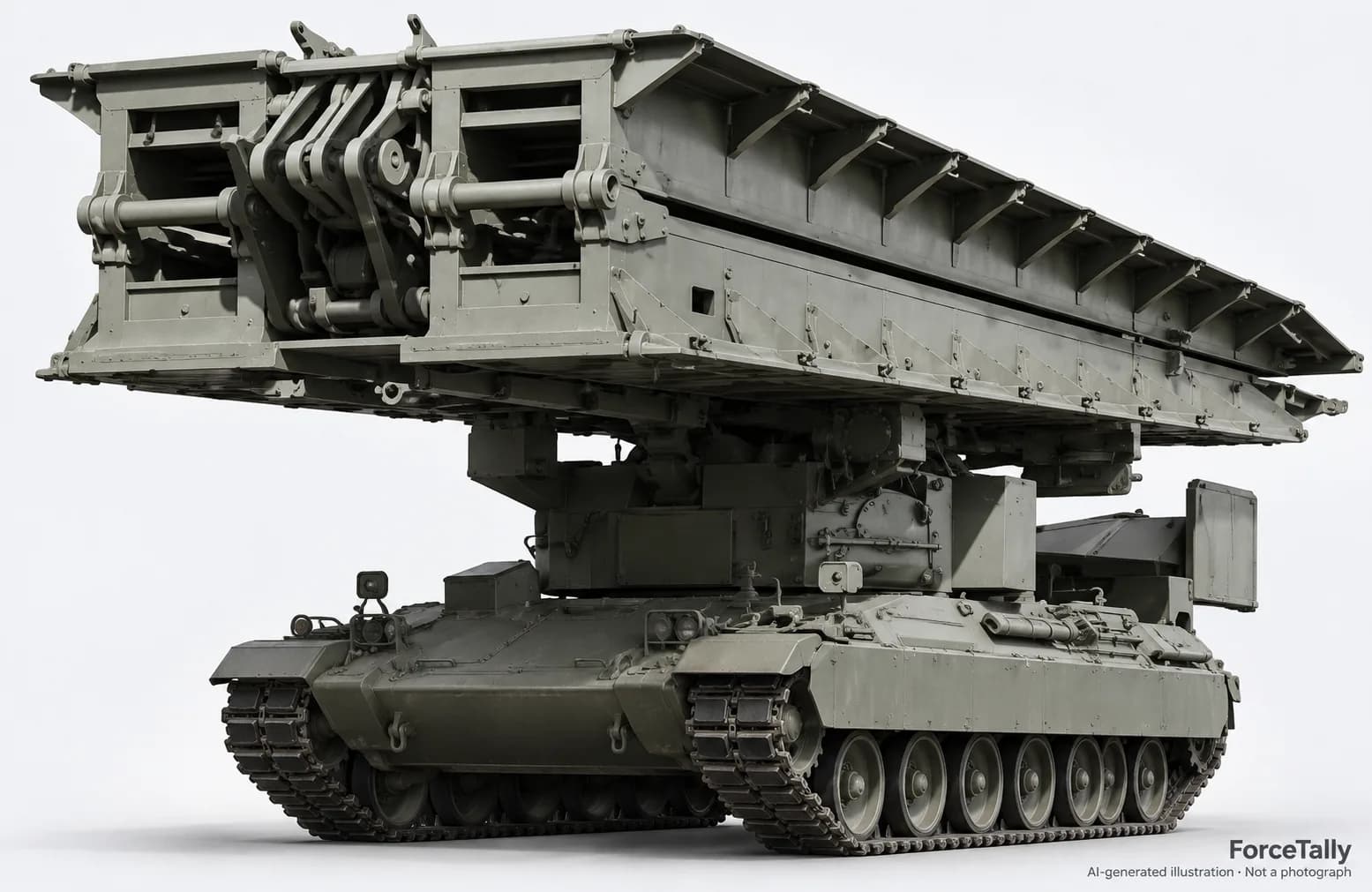
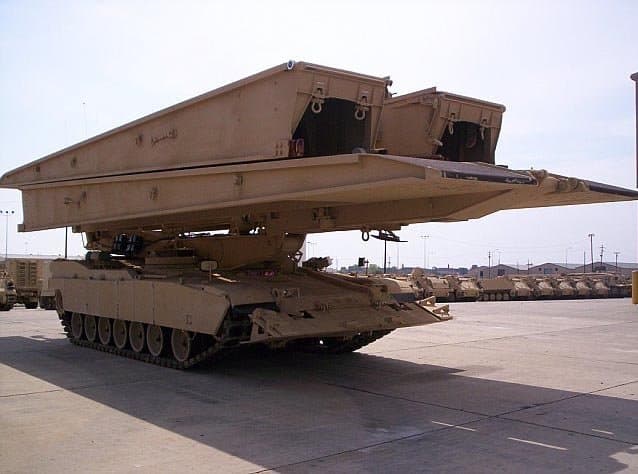
| Source measurement | The chassis of this variant is almost identical to the AMX-30. Instead of the turret, a scissors bridge is laid hydraulically over the rear of the vehicle. Deployment and retraction time of the bridge is about 5 minutes, and has a span of 20 meters. The bridge is erected vertically, and can therefore be easily seen by enemy forces.[source]AMX-30 Bridge · Design; only the objects and conditions stated in this passage The AMX-30 bridgelayer is not used by the French Army, although a few are used by Saudi Arabia. It is basically an AMX-30 MBT with its turret removed and replaced with a scissors-type bridge which is launched over the rear of the hull in 5 minutes. The bridge is a class 50 and when opened out is 22 m long and will span a gap up to 20 m. The bridge is 3.1 m wide or 3.92 m when fitted with widening panels. Weight is 42,500 kg with the bridge and 34,000 kg without.[source]AMX-30 · Armoured vehicle-launched bridge · conditions stated in this passage | Since the 1960s the United States Army has made use of armored bridge-laying vehicles based on the M48 Patton / M60 series of tanks. In recent years, however, the Army discovered that the aging M60 AVLB was too slow to keep up with the M1 Abrams main battle tanks' top speed of roughly 70 km/h during field maneuvers. Additionally, the Abrams was so heavy that it could safely cross the AVLB's bridge only at a very slow speed.[source]M104 Wolverine · Background; only the objects and conditions stated in this passage The Wolverine is operated by two crewmen who sit within the hull. Both crewmen have access to the bridging controls, while the bridge is carried in two sections, stacked above the hull. Once a bridging site is chosen the vehicle securely anchors itself in place with a spade. The two sections of the bridge are joined together, and then the entire bridge is extended across the obstacle and dropped into place. The crewmen have the ability to make minor corrections during launch, if needed. Once operations are complete, the Wolverine drives across the bridge and retrieves it from the other side simply by reversing the process. The bridge can be lowered in under five minutes or raised in less than ten minutes, all without the crewmen ever leaving the safety of their vehicle.[source]M104 Wolverine · Description; only the objects and conditions stated in this passage Once launched, the 26-meter Leguan bridge can support a 70-ton vehicle moving at 16 km/h, or 10 miles per hour. The Wolverine thus allows the heaviest of vehicles to cross craters, ditches, and damaged bridges at combat speed. This mobility is a decisive advantage for armored units .[source]M104 Wolverine · Description; only the objects and conditions stated in this passage The Joint Assault Bridge also has an Abrams tank chassis but is equipped with a 18.3-metre (60 ft) scissor bridge. While the M104 was intended to replace the AVLB, it was found to be too expensive and complicated to maintain and operate. While the JAB's bridge is shorter, it has a faster deployment time of three minutes, compared to the Wolverine's 3-5 minute set-up time. In 2016, the U.S. Army awarded DRS Technologies an indefinite quantity contract worth up to $400 million to build the new M1074 JAB. Low-rate production concluded in mid-2018, and initial series production began in 2019.[source]M104 Wolverine · Future plans and replacement; only the objects and conditions stated in this passage |
|---|