FORCETALLY
Loading the evidence…
Preparing your view.


Preparing your view.
Drones & UAVsIn service
Reconnaissance Unmanned aerial vehicle Unmanned combat aerial vehicle Electronic warfare
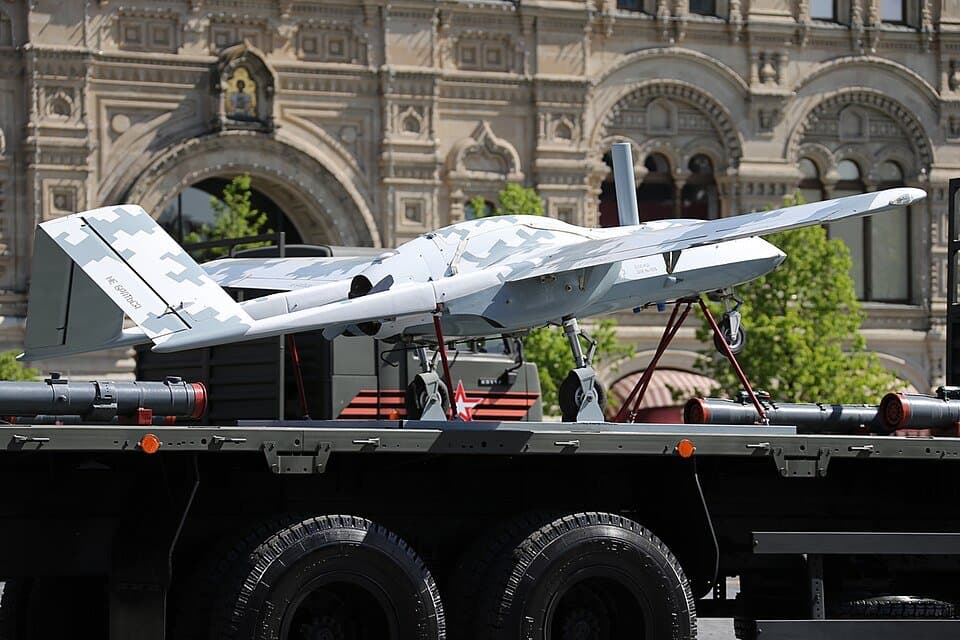
Luch Korsar is a reconnaissance Unmanned aerial vehicle Unmanned combat aerial vehicle Electronic warfare originating in Russia. It was built by OKB Luch. Reported operators include Russian Ground Forces.

Reconnaissance Unmanned aerial vehicle Unmanned combat aerial vehicle Electronic warfare
Russia
OKB Luch
OKB Luch , Ruselectronics
In limited service
Russian Ground Forces
2018
2015
None
4.2 m (13 ft 9 in)
6.5 m (21 ft 4 in)
200 kg (441 lb)
400 kg (882 lb)
150 km/h (93 mph, 81 kn)
250 km (160 mi, 130 nmi)
12 hours
2,000 m (6,600 ft)
The Luch Korsar ( Russian : Корсар , English: 'Corsair' ) is a medium-weight Russian unmanned aerial vehicle developed by OKB Luch , member of Ruselectronics owned by Rostec , to perform reconnaissance, strike and electronic attack missions on behalf of the Russian Ground Forces and Navy .
At first, the Korsar was considered to be a medium-weight UAV for tactical applications with no mention of its ability to perform kinetic strikes. According to Rostec in May 2018, Korsar serial production is being set up. In the future, this system may come with improved air vehicles whose operational range would be increased from 120 to 160 km (65 to 86 nautical miles) currently to 250 km (135 nmi). They will carry mission equipment with enhanced functionality in air reconnaissance and electronic warfare and reconnaissance.
The Korsar features a twin-boom design with V-tail empennage and a single 50-to-70 hp piston engine driving a twin-blade pushing propeller, similar in design to the US RQ-7 Shadow and the Turkish Bayraktar TB2 .
Length: 4.2 m (13 ft 9 in)
Wingspan: 6.5 m (21 ft 4 in)
Empty weight: 200 kg (441 lb)
Max takeoff weight: 400 kg (882 lb)
Maximum speed: 150 km/h (93 mph, 81 kn)
Range: 250 km (160 mi, 130 nmi)
Endurance: 12 hours
Service ceiling: 2,000 m (6,600 ft)
The Korsar features a twin-boom design with V-tail empennage and a single 50-to-70 hp piston engine driving a twin-blade pushing propeller, similar in design to the US RQ-7 Shadow and the Turkish Bayraktar TB2 .
Reference text from Wikipedia contributors, used under CC BY-SA 4.0.
True scale
Sourced dimensions beside a 1.75 m human reference.
See it in your room. Scan with your phone to open this model in 3D, then place it in your space.
Points represent sourced observations, including revisions. Revisions on the same effective date are not separate inventory events. Ranges appear in the table and are not plotted as exact points.
| Observation / report period | Value | Source | Claim state |
|---|---|---|---|
| 28 Sept 2026 | 12 h | Wikipedia contributors | superseded |
Luch Korsar equipment records. Variants, orders and quantities are shown as reported in each inventory source; coverage is incomplete.
RussiaReported count for Luch Korsar. Service scope: Russian Ground Forces; does not replace a national total. 1 distinct count cell(s) from the same source list; shared rowspan cells counted once. Retired, wholly reserve and on-order rows are excluded; the reported count retains any explicitly mixed stock scope in the quoted row. Count column(s): quantity: 2 (one was found destroyed in Ukraine on 9 November 2022). Origin: Russia. The listed variants/roles are the scope, not an immediately deployable count. Dates are the count-cell citations' stated source period (2022), not the article revision. Cited source 2022-11-10. Edition or publication years do not claim an exact inventory census day.
Keep exploring
Reconnaissance unmanned aerial vehicle Unmanned combat aerial vehicle Electronic warfare
RussiaReconnaissance unmanned aerial vehicle
RussiaUnmanned surveillance and reconnaissance aerial vehicle and Unmanned combat aerial vehicle (armed variant)
 Iran
Unmanned surveillance and reconnaissance aerial vehicle (reconnaissance variant) and unmanned combat aerial vehicle (armed variant)
RussiaUnmanned surveillance and reconnaissance aerial vehicle and unmanned combat air vehicle (armed variant)
 Israel
Unmanned surveillance and reconnaissance aerial vehicle