FORCETALLY
Loading the evidence…
Preparing your view.


Preparing your view.
Rockets & launchersIn service
Multiple rocket launcher Tactical ballistic missile
K239 Chunmoo is a multiple rocket launcher Tactical ballistic missile originating in South Korea. It was built by Hanwha Aerospace (2015–present) Korea Defense Industry (2020–present) Huta Stalowa Wola (2023–present).
 South Korea
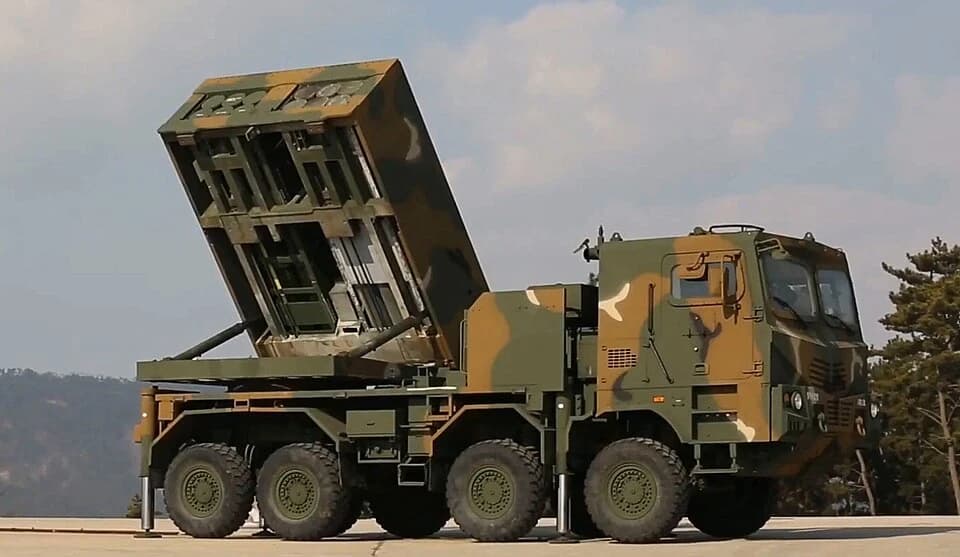
K239 Chunmoo · source-pictured K239L launcher vehicle
국방부 - ROK Ministry of National Defense · K239 Chunmoo Image7 · Original video: (K-weapon source) K-239 천무 -3 - 대한민국 국방부 K-239 -3 - Republic of Korea MND · original upload 1 April 2020 · KOGL Type 1 · Source: https://commons.wikimedia.org/wiki/File:K239_Chunmoo_Image7.jpg · Resized / optimised · KOGL Type 1 · Source ↗ · ModifiedMultiple rocket launcher Tactical ballistic missile
South Korea
2015–present
See Operators
Agency for Defense Development (launcher) Doosan DST (vehicle) Hanwha (rocket) Samyang Comtech (armor)
2009–2013
Hanwha Aerospace (2015–present) Korea Defense Industry (2020–present) Huta Stalowa Wola (2023–present)
₩ 3.6 billion ( US$ 2.94 million) per one launcher+K239L vehicle (2020)
2014–present
356/705
Homar-K
31 metric tons (31 long tons; 34 short tons)
9 meters (29 ft 6 in)
2.9 meters (9 ft 6 in)
3.3 meters (10 ft 10 in)
3 (K239L launcher vehicle) 2 (K239T ammunition support vehicle)
131 mm (K33) 230 mm (KM26A2) 239 mm (CGR-080) 280 mm (CTM-MR/ASBM) 600 mm ( CTM-290 )
6 rds/in 30 sec (CGR-080)
36 km (K33) 45 km (KM26A2) 80 km (CGR-080) 160 km (CTM-MR/ASBM) 290 km (CTM-290)
Samyang Comtech Steel / Ceramic + Polymer Matrix Composites ( STANAG 4569 Level 2 )
20×2 K33 6×2 KM26A2 6×2 CGR-080 4×2 CTM-MR/ASBM 1×2 CTM-290
HD Hyundai Infracore DV11K 6-cylinder water-cooled diesel engine 450 hp (340 kW)
14.5 hp/t (10.81 kW/t)
Allison Transmission 4500SP
250 liters (66 U.S. gal)
450 km (280 mi)
80 km/h (50 mph)
GPS-aided INS
9 m CEP (CTM-290) 15 m CEP (CGR-080)
The K239 Chunmoo ( Korean : 천무 ; Hanja : 天橆 ; RR : Cheon-mu ) is a rocket artillery system developed in 2013 to replace the aging K136 Kooryong of the South Korean military .
In October 2025 at ADEX 2025 in Seoul, Hanwha Aerospace unveiled the High-Performance Multiple Rocket Launcher (HPMRL). Developed for Marine Corps usage as a more mobile launcher than the K239 Chunmoo, the HPMRL prototype weighs 19 tons and is 8.5 meters long, 2.6 meters wide, and 3.2 meters high. Its smaller size means that HPMRL only carry a single ammunition pod of the type used by Chunmoo. However, HPMRL is capable of being transported by C-130 aircraft without disassembly and can fire from the deck of a moving ship in Sea State 5 . With initial development of HPMRL as an internal Hanwha program being complete, full-scale development in cooperation with DAPA is expected to start in 2030.
The K239 is capable of launching K33 131 mm rockets, but not 130 mm rockets (such as the K30, K37 and K38), which are used in the existing K136 Kooryong rocket artillery system. The K239 launcher carries two launch pods, each of which can hold three types of loadouts:
20 K33 131 mm unguided rockets, previously used on the K136 Kooryong, with a range of 36 kilometers (22 mi) (40 total).
Six KM26A2 230 mm rockets which are based on the M26 227 mm unguided DPICM rocket used in M270 MLRS vehicles operated by the South Korean Army, with a range of 45 kilometers (28 mi) (12 total).
Six 239 mm chunmoo guided rockets (CGR-080) with either high explosive penetration warheads , or cluster bombs with 300 bomblets, designed for the K239 Chunmoo with a range of 80 kilometers (50 mi) (12 total).
The CGR-080 239 mm rockets are 3.96 meters (13.0 ft) long and GPS -aided INS guided, and the rocket is designed to be equipped with two types of warheads, a high explosive warhead developed as a bunker buster , or a cluster bomb warhead, with hundreds of bomblets, for use against personnel in a wide area. The high explosive warhead bursts on impact for use against personnel and bursts after a delay to destroy bunkers; it was a requirement of the ROK Army for the guided rocket to have a penetrator warhead to be used as a bunker buster solution against the large number of bunkers along the DMZ . A guided rocket containing cluster bombs is capable of extensive artillery fire on a specific area of three times the area of a soccer field .
Two different types of rocket pods can be loaded at once. The rocket pod can launch six 239 mm rockets in 30 seconds and a total of 12 rockets in one minute, and it's possible to reload two rocket pods in seven minutes. The launch vehicle is based on a Doosan DST (now Hanwha Defense ) K239L 8×8 truck chassis with an armored cab that protects its 3-man crew from small arms fire and artillery shell splinters as well as providing NBC protection . The vehicle can climb 60% slopes (20 degrees), and is equipped with an Anti-lock Braking System (ABS), Run-flat tires , and a Central Tire Inflation System (CTIS). Each Chunmoo launcher is paired with an K239T Ammunition Support Vehicle (ASV) which uses the same type of truck chassis and carries four reload pods. An ROK Army Chunmoo battery consists of 18 vehicles and uses a K200A1 as a command vehicle.
It is equipped with a load-lifting device, similar to that of the MLRS. The estimated maximum recharging time is 10 minutes.
The Korean army requested that the Chunmoo be designed to fire different types of ammunition. This includes 227 mm standard MLRS, but also 131 mm and 239 mm South Korean rockets. The maximum range of the 131 mm ammunition is up to 36 kilometers (22 mi) and approximately 80 kilometers (50 mi) for the 239 mm ammunition.
On 27 April 2022, South Korean Defense Acquisition Program Administration announced a plan to develop a vehicle-mounted tactical surface-to-surface guided weapon (Ure-2). The purpose of this development project is to improve the existing Ure-1 to increase the range from 180 kilometers (110 mi) to 290 kilometers (180 mi) and integrate tactical ballistic missile systems into various types of Transporter Erector Launcher (TEL) such as the K239 Chunmoo. The development project is scheduled to begin in 2023 and plans to complete the development with a total budget of 1.56 trillion won ( US$ 1.232 billion) by 2034.
On 21 December 2022, the Agency for Defense Development conducted a public test of Ure-2 under further development at Anheung Proving Ground . The missile was mounted on the K239 Chunmoo vehicle and hit a target 200 kilometers away after it was launched.
On 24 April 2024, ADD conducted a test launch of CTM-290 integrated into the Homar-K system in the presence of Poland's Deputy Defense Minister Paweł Bejda and government officials from each country. The missile that was launched successfully hit the target after flying for more than 200 seconds.
In June 2022, South Korean Agency for Defense Development (ADD) revealed efforts to increase the range of the Chunmoo's 239 mm rockets to 200 kilometers (120 mi). This would give them range similar to the North Korean 300 mm KN-09 . Research and development efforts are evaluating ducted rocket propulsion technology, which adds an air inlet that absorbs external air and combines it with a gas generator for combustion to produce greater thrust, as well as a valve that controls the flow of gas for maneuvering. There is also research into a larger 400 mm rocket based on a miniaturized version of the Ure surface to surface missile , which the Chunmoo could carry four of.
Homar-K (English: Lobster ; K for koreański , meaning Korean) is a Polish multiple launch rocket system combining the improved K239 launcher and Jelcz P882.57 8x8 chassis (ultimately to be replaced with the third-generation Jelcz P883.57 chassis) produced by Huta Stalowa Wola . Built to meet Polish military requirements, the system is equipped with Topaz Integrated Combat Management System and is armed with a South Korean 239 mm CGR-080 guided rocket produced in Poland under license as well as a 600 mm CTM-290 tactical ballistic missile (Chunmoo Tactical Missile) with a range of 290 kilometers (180 mi). Further development is underway for integration with Polish 122 mm M-21 Feniks unguided rocket.
A supply contract for 288 Chunmoo MLRS mounted on Jelcz 8x8 chassis and equipped with Polish TOPAZ Integrated Combat Management System along with 23 thousand missiles with the range of 80 and 290 kilometers was signed in Poland on October 19, 2022.
On 27 September 2022, Hanwha Defense signed a memorandum of understanding (MOU) with Norway's Kongsberg Gruppen to introduce the K239 Chunmoo multiple rocket artillery system. On 27 January 2026, the Norwegian Parliament approved the government's proposal to purchase the K239 Chunmoo system with a budget of 19 billion krone . Hanwha Aerospace will sign a supply contract with the Norwegian government in January and will be supplied to the Norwegian Army from 2029. On 30 January 2026, the Norwegian government, through The Norwegian Defence Materiel Agency (NDMA) signed a contract for procuring 16 K239 Chunmoo systems and a significant amount of precision-guided missiles, plus training and logistical support from Hanwha Areospace. There will be three types of missiles with a range of up to 500 kilometers. Hanwha will set up a production line for the missiles in Poland, which will supply all the European operators. The K239 mobile launchers are expected to be delivered in 2028 and 2029, with the missiles expected to be delivered in 2030 and 2031.
Royal Saudi Land Forces – 36 in service with Royal Saudi Land Forces.
Croatian Army – A total of 18 K239 Chunmoo self-propelled rocket launchers with accompanying assets and systems. The procurement package includes CTM-290 tactical ballistic missiles with a precision strike range exceeding 300 km.
Norwegian Army – A total of 16 K239 launchers and a significant number of precision-guided missiles, with a range of up to 500 kilometers plus training and logistical support. The Contract was signed with Hanwha Aerospace on 30 January 2026.
The rocket pod can launch six 239 mm rockets in 30 seconds and a total of 12 rockets in one minute, and it's possible to reload two rocket pods in seven minutes.
Reference text from Wikipedia contributors, used under CC BY-SA 4.0.
True scale
Sourced dimensions beside a 1.75 m human reference.
Points represent sourced observations, including revisions. Revisions on the same effective date are not separate inventory events. Ranges appear in the table and are not plotted as exact points.
| Observation / report period | Value | Source | Claim state |
|---|---|---|---|
| 28 Sept 2026 | 131 mm | Wikipedia contributors | superseded |
| 28 Sept 2026 | 131 mm | Wikipedia contributors | superseded |
| 28 Sept 2026 | 131 mm | Wikipedia contributors | approved |
K239 Chunmoo equipment records. Variants, orders and quantities are shown as reported in each inventory source; coverage is incomplete.
 Croatia
Number column of the Wikipedia list table under "Artillery". The list's own wording applies; it is a compiled secondary source, not an official census.
 Estonia
Reported count for K239 Chunmoo. Country-wide list; no individual service specified. 1 distinct quantity component(s) from the same source list; shared rowspan cells counted once. Explicit source inventory scope: ordered; no other stock status or total inferred. Count column(s): quantity: 9. Origin: South Korea. The listed variants/roles are the scope, not an immediately deployable count. Dates are the count-cell citations' stated source period (2025), not the article revision. Cited source 2025-12-12. Edition or publication years do not claim an exact inventory census day.
 Norway
Reported count for K239 "Gungnir" (Odin's spear). Service scope: Norwegian Army; does not replace a national total. 1 distinct quantity component(s) from the same source list; shared rowspan cells counted once. Explicit source inventory scope: ordered; no other stock status or total inferred. Count column(s): quantity: + 16. Origin: South Korea. The listed variants/roles are the scope, not an immediately deployable count. The components do not establish one inventory census date; the stored date is the retrieved source snapshot.
 Poland
Army exact named equipment holdings: K239 Chunmoo (Homar-K). Active, operational-reserve and training units excluding equipment in store; November 2025 IISS assessment. Named service only; no parent-force or national total inferred. Source role: ARTILLERY / 239mm. Original estimates, ranges, reporting names, reserve, lease and employment scopes retained; nested included counts are not added. Missile-system quantities mean launchers, not rounds. No readiness, crew, carried weapon, payload, factory-production or future order count inherited.
 Saudi Arabia
Army exact named equipment holdings: K239 Chunmoo. Active, operational-reserve and training units excluding equipment in store; November 2025 IISS assessment. Named service only; no parent-force or national total inferred. Source role: ARTILLERY / 239mm. Original estimates, ranges, reporting names, reserve, lease and employment scopes retained; nested included counts are not added. Missile-system quantities mean launchers, not rounds. No readiness, crew, carried weapon, payload, factory-production or future order count inherited.
South KoreaArmy exact named equipment holdings: K239 Chunmoo. Active, operational-reserve and training units excluding equipment in store; November 2025 IISS assessment. Named service only; no parent-force or national total inferred. Source role: ARTILLERY / 239mm. Original estimates, ranges, reporting names, reserve, lease and employment scopes retained; nested included counts are not added. Missile-system quantities mean launchers, not rounds. No readiness, crew, carried weapon, payload, factory-production or future order count inherited.
 United Arab Emirates
Army exact named equipment holdings: K239 Chunmoo. Active, operational-reserve and training units excluding equipment in store; November 2025 IISS assessment. Named service only; no parent-force or national total inferred. Source role: ARTILLERY / 239mm. Original estimates, ranges, reporting names, reserve, lease and employment scopes retained; nested included counts are not added. Missile-system quantities mean launchers, not rounds. No readiness, crew, carried weapon, payload, factory-production or future order count inherited.
Keep exploring
Multiple rocket launcher Tactical ballistic missile launcher
 Israel
Multiple rocket launcher
Multiple rocket launcher
IsraelMultiple Rocket Launcher
Multiple rocket launcher
 Serbia
Multiple rocket launcher
 United StatesCompare with K239 Chunmoo