FORCETALLY
Loading the evidence…
Preparing your view.


Preparing your view.
Rockets & launchersIn service
Multiple Rocket Launcher
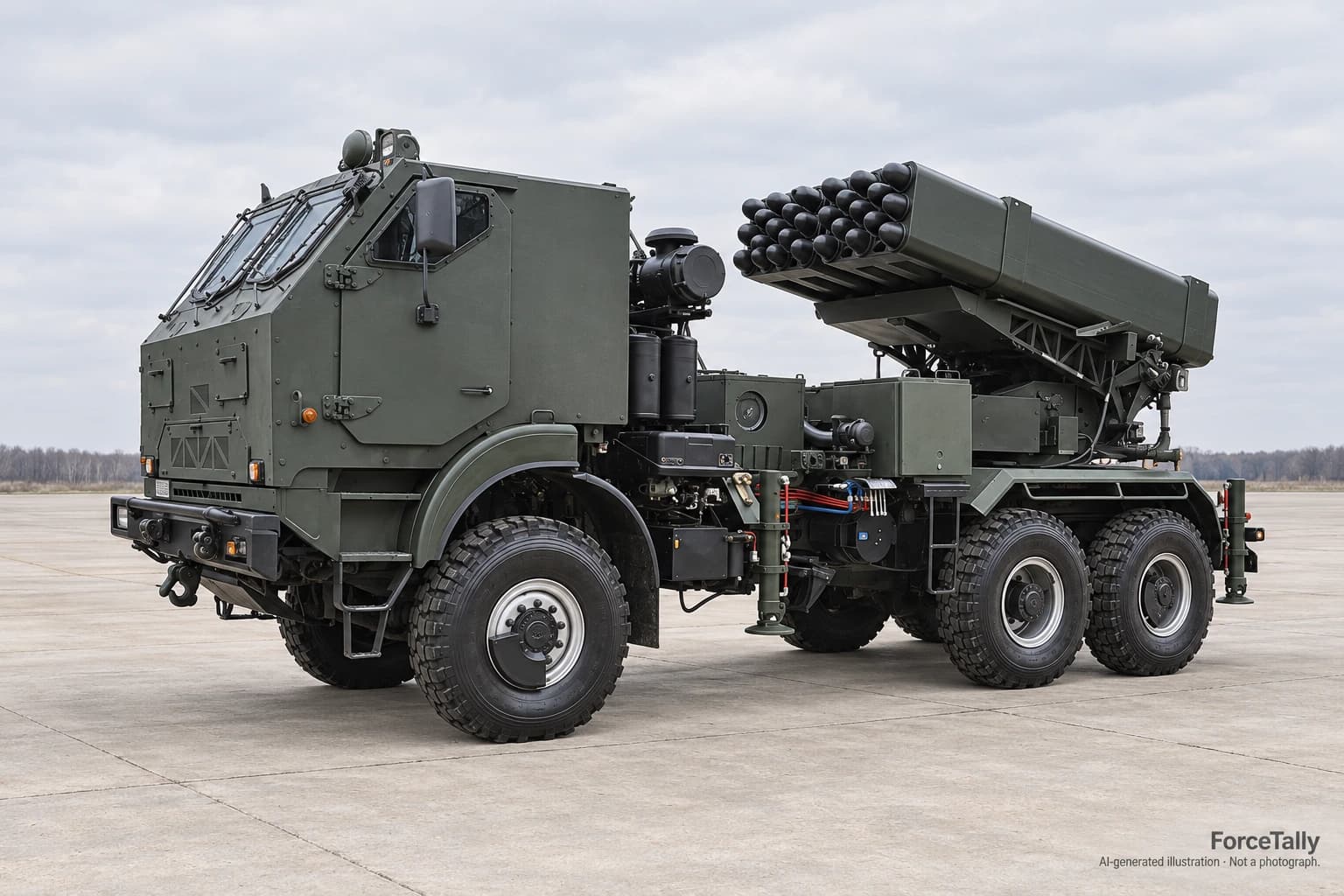
LAROM is a multiple Rocket Launcher originating in Romania , Israel.


AI-generated illustration · Not a photograph · LAROM. Exterior details are illustrative.
DoloresRKT · CC BY-SA 3.0 reference · ForceTally adaptation · AI-generated illustration · Not a photograph · CC BY-SA 3.0 · AI-generated illustration · Source ↗ · ModifiedMultiple Rocket Launcher
Romania , Israel
2001 - present
Romanian Land Forces
1999-
54
13.7 tonnes
7.35 m
2.40 m
3.10 m
4
26× LAR Mk.4 160mm rockets or 40×122mm rockets
410 hp
The LAROM is a Romanian native-made, highly mobile, multiple rocket launcher , in service with the Romanian Land Forces , built in collaboration with Israel .
It was influenced by the BM-21 Grad 122 mm multiple rocket launcher (MRL) system which entered service with the Soviet Army in 1963 also utilizing a six-by-six truck chassis fitted with a bank of 40 122mm launch tubes arranged in a rectangular shape that can be turned away from the unprotected cabin .
The LAROM standard launch pod containers hold 20 GRAD (122 mm) rockets or 13 LAR Mk. IV (160 mm) rockets, with two pods on a launcher.
The GRAD 122 mm rocket is utilised to suppress and annihilate concentrated targets. It has an 18 kg high-explosive warhead, a range of approximately 20 km and can be fired in salvos of up to 2 rounds per second.
The LAR Mk. IV 160 mm rockets employ composite solid propellants . The rocket is spin-stabilizing in flight via wraparound stabilizing fins deployed upon rocket exiting launcher. The Mk IV rocket is capable of taking various warheads and commonly fitted with either a HE-COFRAM type or a Cluster munition warhead. The cluster warhead operates by a remotely set electronic time-fuse which opens the bomblet canister at the calculated height to give area coverage of about 31,400 m 2 for each cluster warhead. The LAR Mk IV has a minimum range of 10 km and maximum range of 45 km and can be fired in salvos of up to 1 round every 1.8 seconds.
The LAR Mk. IV 160 mm rockets employ composite solid propellants . The rocket is spin-stabilizing in flight via wraparound stabilizing fins deployed upon rocket exiting launcher. The Mk IV rocket is capable of taking various warheads and commonly fitted with either a HE-COFRAM type or a Cluster munition warhead. The cluster warhead operates by a remotely set electronic time-fuse which opens the bomblet canister at the calculated height to give area coverage of about 31,400 m 2 for each cluster warhead. The LAR Mk IV has a minimum range of 10 km and maximum range of 45 km and can be fired in salvos of up to 1 round every 1.8 seconds.
The LAR Mk. IV 160 mm rockets employ composite solid propellants . The rocket is spin-stabilizing in flight via wraparound stabilizing fins deployed upon rocket exiting launcher. The Mk IV rocket is capable of taking various warheads and commonly fitted with either a HE-COFRAM type or a Cluster munition warhead. The cluster warhead operates by a remotely set electronic time-fuse which opens the bomblet canister at the calculated height to give area coverage of about 31,400 m 2 for each cluster warhead. The LAR Mk IV has a minimum range of 10 km and maximum range of 45 km and can be fired in salvos of up to 1 round every 1.8 seconds.
The GRAD 122 mm rocket is utilised to suppress and annihilate concentrated targets. It has an 18 kg high-explosive warhead, a range of approximately 20 km and can be fired in salvos of up to 2 rounds per second.
{"datatype": "wikibase-item", "datavalue": {"type": "wikibase-entityid", "value": {"entity-type": "item", "id": "Q1148423", "numeric-id": 1148423}}, "hash": "e6a7ce01ace8e69b62da13463ed08c5932db1abf", "property": "P176", "snaktype": "value"}
Reference text from Wikipedia contributors, used under CC BY-SA 4.0.
True scale
Sourced dimensions beside a 1.75 m human reference.
Points represent sourced observations, including revisions. Revisions on the same effective date are not separate inventory events. Ranges appear in the table and are not plotted as exact points.
| Observation / report period | Value | Source | Claim state |
|---|---|---|---|
| 28 Sept 2026 | 4 people | Wikipedia contributors | superseded |
| 28 Sept 2026 | 4 people | Wikipedia contributors | superseded |
| 28 Sept 2026 | 4 people | Wikipedia contributors | approved |
LAROM equipment records. Variants, orders and quantities are shown as reported in each inventory source; coverage is incomplete.
RomaniaArmy exact named equipment holdings: LAROM. Active, operational-reserve and training units excluding equipment in store; November 2025 IISS assessment. Named service only; no parent-force or national total inferred. Source role: ARTILLERY / 122mm. Original estimates, ranges, reporting names, reserve, lease and employment scopes retained; nested included counts are not added. Missile-system quantities mean launchers, not rounds. No readiness, crew, carried weapon, payload, factory-production or future order count inherited.
Keep exploring
 Serbia
 United States
 China