FORCETALLY
Loading the evidence…
Preparing your view.


Preparing your view.
Drones & UAVsIn service
Remote piloted aircraft, UAV/UAS
Denel Dynamics Seeker is a remote piloted aircraft, UAV/UAS. It was built by Denel Dynamics. Reported operators include Denel Dynamics on behalf of the South African Air Force , South African National Parks , South African National Defence Force (leased by Denel Dynamics) Algerian Air Force , United Arab Emirates Air Force.
 South Africa
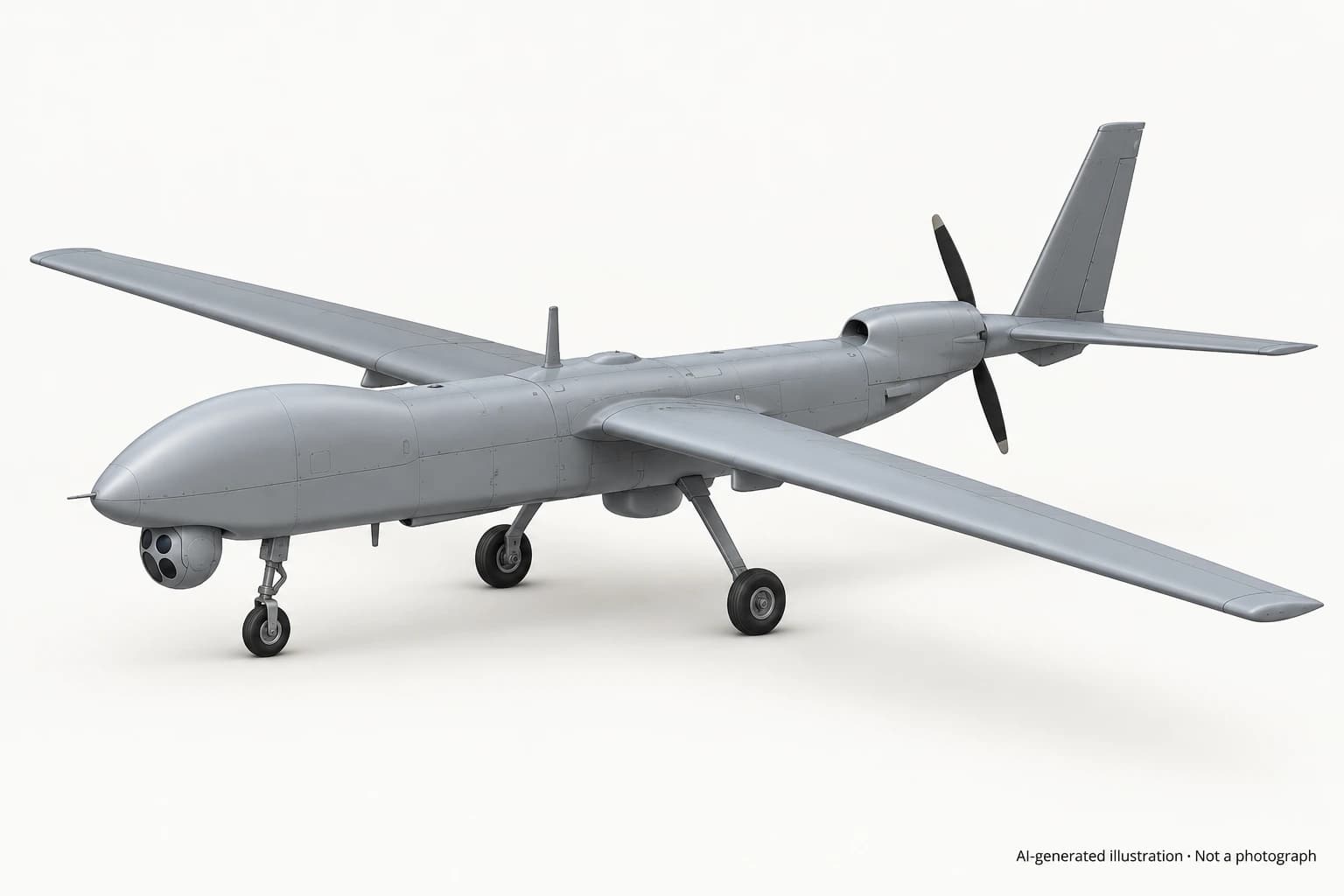
AI-generated illustration · Not a photograph — Representative exterior; geometry is illustrative. Not evidence for specifications.
ForceTally · AI-generated illustration · Not a photograph · AI-generated · OpenAI output terms · Source ↗ · ModifiedRemote piloted aircraft, UAV/UAS
Denel Dynamics
In service South African Air Force , South African National Defence Force (Seeker 400 variant) in service with other organizations.
Denel Dynamics on behalf of the South African Air Force , South African National Parks , South African National Defence Force (leased by Denel Dynamics) Algerian Air Force , United Arab Emirates Air Force
1986 ( South African Air Force )
Saudi Arabia
South African Air Force and South African National Defence Force - Seeker 400 Variant
Algerian Air Force - 10 Seeker IIs delivered between 1998 and 1999 in a $20 million deal.
United Arab Emirates Air Force - 11 Seeker IIs in total delivered in 1996, 2003 and 2010.
The Denel Dynamics Seeker is an unmanned aerial vehicle (UAV) manufactured in South Africa by Denel Dynamics (formerly Kentron).
The Super Colour Payload that consisted of a 2-axis gimbal platform on which two sensors were mounted, namely: Colour TV camera with a 20x zoom lens and switchable 2x converter; and a secondary sensor consisting of a TV (monochrome) camera fitted with a wide-angle lens. This variant, when observing a standard 2.3m x 2.3m target, was able to detect it at 15.90 km, recognize it at 7.10 km and identify it at 5.20 km. When observing a standard 6.0 x 6.0 m target, the sensor allows for detection at 37.40 km, recognition at 17.90 km and identification at 13.20 km.
The UAV can operate 250 km from the control station at altitudes of up to 20,000 feet (6,100 m) and employs an array of various day and night time sensors and electronic surveillance payloads. The UAV also features digital avionics and several autonomous flight modes.
In recent years this system has undergone further upgrades and is designated as the Seeker 2+. Communication links are now standard and of a modular design. One mission control unit can now operate four to six UAVs simultaneously. These models feature an all-composite, low-drag airframe in order to ensure optimal performance in the operational area. The UAV can operate for up to 10 hours up to a service ceiling of 18,000 feet (5,500 m) with a full payload of 40 kg of equipment. On-board directional antennas also provide high jamming resistance and allow real time communication. A Tracking and Communications Unit (TCU) can now be utilised to enable optimum line-of-sight communication with the UAV. Sensor packages include:
The Goshawk II LD multi-sensor payload combining EO/IR (day and night sensors) with an integrated laser designator and laser range-finder that can target objects up to 20 km. It also contains a single CCD with x20 zoom, a 3rd generation 3 – 5 mm infrared (IR) camera with a continuous zoom lens, automatic video tracker, azimuth and elevation gimbal with <20 mrad stabilization. Four new auto trackers are also available (histogram, edge, correlation and scene-based).
An Electronic Surveillance Payload (ESP) is available for emitter location, with a high probability of interception of radars (0.5 to 18 GHz angle of arrival measurement, 120 degrees sector to port on-board emitter library). This provides the system with an Enemy Electronic Order of Battle (EEOB) through emitter identification.
The newest Seeker variant under development at Denel Dynamics offers enhanced situational awareness capabilities and other improvements over the Seeker 2. It can provide real-time day and night reconnaissance; target location, surveillance and designation; artillery fire support; Electronic Intelligence (ELINT) and Electronic Support Measures (ESM) and conduct border and maritime patrol missions. New additions include the capability of carrying weapons such as the laser guided missile with a missile stand-off range of 10 km. It can also operate up to 16 hours with a maximum of 100 kg of multi-mission payloads. It also features dual uplinks and downlinks, brake-assisted ground operation, piloted and autonomous flight capability, VHF and UHF FM tactical radios and Mode S Transponder and VHF AM Air Traffic Control (ATC) radio for ATC interfacing. The mission control units remain relatively the same as the Seeker 2s with modular hardware and software.
The system includes the capability of carrying dual imaging payloads with the images being transmitted to the ground control station via the dual video downlinks. Electro-optical sensor payloads with diameters of up to 530 mm can be integrated for use. This typically includes the following sensor combinations on a gimbal :
Remote piloted aircraft, UAV/UAS
The UAV can operate for up to 10 hours up to a service ceiling of 18,000 feet (5,500 m) with a full payload of 40 kg of equipment.
It can also operate up to 16 hours with a maximum of 100 kg of multi-mission payloads.
Endurance: up to 10 h; 5 h over target at 250 km
Service ceiling: up to18 000 ft
Multi-mission payload, excluding fuel: up to 40 kg
Slant range surveillance: 250 km line-of-sight communication
Direct LOS range of 250 km and 700 km with passing of control via the tactical ground station
Up to 16 h endurance with internal fuel
Up to 18 000 ft service ceiling
Up to 100 kg multiple mission payloads (excluding fuel)
Endurance: up to 10 h; 5 h over
Service ceiling: up to18 000 ft
Length: 5.77m
Span: 10m
Maximum take-off weight: 450kg
Range: 250km
Speed: 81kts
Endurance: 16hrs
Altitude: 18,000ft
Maximum Speed 120kts (222km/h)
Role Intelligence, surveillance, reconnaissance and target acquisition Crew Three (Pilot and two Payload operators) and five Technicians Status Final Development Phase Cruise Speed 150km/h Endurance 16 hours Length 5.77m Wingspan 10m Height 1.85m Maximum Take-Off Weight 450kg Maximum Useful Load 200kg Type Four Stroke Aircraft Engine Number of Engines One Power Capacity 85hp (63.4kW) Maximum Speed 120kts (222km/h) Service Ceiling 18,000ft (5,486m) Range 250km Manufacturer Denel Dynamics Electro-Optic Sensors Carl Zeiss Optronics Ground Control Station Denel Dynamics
Seeker 400 is an unmanned aerial vehicle surveillance system being designed and manufactured by Denel Dynamics, South Africa. Each system will comprise four to six unmanned aerial vehicles (UAV), a mission control unit (MCU), tracking and communication unit (TCU), aircraft payloads, thermal imaging camera, high resolution video camera and an optional tactical ground control station (TGCS).
Flying at an altitude of up to 18,000ft, the Seeker 400 will render real time intelligence data by executing reconnaissance operations over a large area. It will capture the real time imagery of the battlefield and transmit to the TGCS through a satellite communication data link.
Denel Seeker South Africa ISTAR , UAV Intelligence, surveillance, target acquisition, and reconnaissance , unmanned aerial vehicle – 10
Reference text from Wikipedia contributors, used under CC BY-SA 4.0.
Payload: 100kg.
S400 can carry dual imaging EO/IR payloads with gimbal diameters of up to 530mn with day TV, thermal imaging, colour/ monochrome spotter camera, night spotter camera. Laser illuminator and LRF, electronic intelligence payload.
Powerplant: 1 x 85hp two-cylinder, air-cooled 4-str engine
Launch/recovery: conv/conv
Seeker 200 is a smaller variant with a 40kg payload.
The Seeker 400 is designed to be 30% larger than Seeker II and will carry 100kg of payload. It can execute intelligence, surveillance, reconnaissance and target acquisition (ISTAR) operations both day and night even under worst climatic conditions. The vehicle can also perform border patrol, maritime patrol and target designation missions.
It is designed to carry two Impi laser guided missiles or two external fuel tanks on under wing hard points. The Impi is a missile being built by Denel Dynamics for a lightweight platform. The stand-off range of the missile will be 10km.
The vehicle is currently in the final phase of development and its first round of flight tests were conducted in February 2014. The UAV with full payload onboard successfully met the range and performance requirements during the second round of flight tests conducted in July 2014.
An electro-optic camera will be incorporated beneath the front fuselage section to capture the imagery of battlefield. A directional antenna will be fitted on top of the front fuselage section to decrease jamming and facilitate communications up to 250km range from the control station. The operational range can be increased from 250km to 750km by passing the control to a forward deployed TGCS.
The Seeker 400 will be powered by a single four stroke aircraft engine, which produces 63.4kW of output power.
The TCU is a separate unit that will keep track of the Seeker 400. It can be installed up to 200m away from the MCU to render maximum line of sight (LOS) communications.
The Seeker 400 can fly at a maximum speed of 222km/h. The range and service ceiling of the aircraft will be 250km and 5,486m respectively. The UAV has an endurance of 16 hours.
Denel Dynamics Seeker equipment records. Variants, orders and quantities are shown as reported in each inventory source; coverage is incomplete.
 Algeria
Reported count for Denel Seeker · –. Service scope: Algerian Air Force; does not replace a national total. 1 distinct quantity component(s) from the same source list; shared rowspan cells counted once. Explicit source inventory scope: active; no other stock status or total inferred. Count column(s): in service: 10. Origin: South Africa. The listed variants/roles are the scope, not an immediately deployable count. The components do not establish one inventory census date; the stored date is the retrieved source snapshot.
 Nigeria
 Saudi Arabia South Africa
Air Force exact named equipment holdings: Seeker 400. Active, operational-reserve and training units excluding equipment in store; November 2025 IISS assessment. Named service only; no parent-force or national total inferred. Source role: UNINHABITED AERIAL VEHICLES / Medium. Original estimates, ranges, reporting names, reserve, lease and employment scopes retained; nested included counts are not added. Missile-system quantities mean launchers, not rounds. No readiness, crew, carried weapon, payload, factory-production or future order count inherited.
 Sri Lanka
Army exact named equipment holdings: Seeker. Active, operational-reserve and training units excluding equipment in store; November 2025 IISS assessment. Named service only; no parent-force or national total inferred. Source role: UNINHABITED AERIAL VEHICLES / Medium. Original estimates, ranges, reporting names, reserve, lease and employment scopes retained; nested included counts are not added. Missile-system quantities mean launchers, not rounds. No readiness, crew, carried weapon, payload, factory-production or future order count inherited.
 United Arab Emirates
Reported count for Denel Dynamics Seeker · Seeker II. Service scope: United Arab Emirates Air Force; does not replace a national total. 1 distinct quantity component(s) from the same source list; shared rowspan cells counted once. Explicit source inventory scope: active; no other stock status or total inferred. Count column(s): in service: 11. Origin: South Africa. The listed variants/roles are the scope, not an immediately deployable count. The components do not establish one inventory census date; the stored date is the retrieved source snapshot.
Denel Dynamics on behalf of the South African Air Force , South African National Parks , South African National Defence Force (leased by Denel Dynamics) Algerian Air Force , United Arab Emirates Air Force
Equipment reference ↗Lower-bound count for Denel Dynamics Seeker 400. Service scope: South African Army; does not replace a national total. 1 distinct quantity component(s) from the same source list; shared rowspan cells counted once. Explicit source inventory scope: active; no other stock status or total inferred. Count column(s): in service: 3+. Origin: South Africa. The listed variants/roles are the scope, not an immediately deployable count. The components do not establish one inventory census date; the stored date is the retrieved source snapshot.
Keep exploring
Remote piloted aircraft/ unmanned combat aerial vehicle
 United States
Reconnaissance aircraft / UAV
 France
unmanned reconnaissance aircraft
Remotely-controlled, UAV
Unmanned maritime surveillance and patrol aircraft
Maritime unmanned surveillance and reconnaissance aerial vehicle and patrol aircraft
United States