FORCETALLY
Loading the evidence…
Preparing your view.


Preparing your view.
Drones & UAVsIn service
Maritime unmanned surveillance and reconnaissance aerial vehicle and patrol aircraft
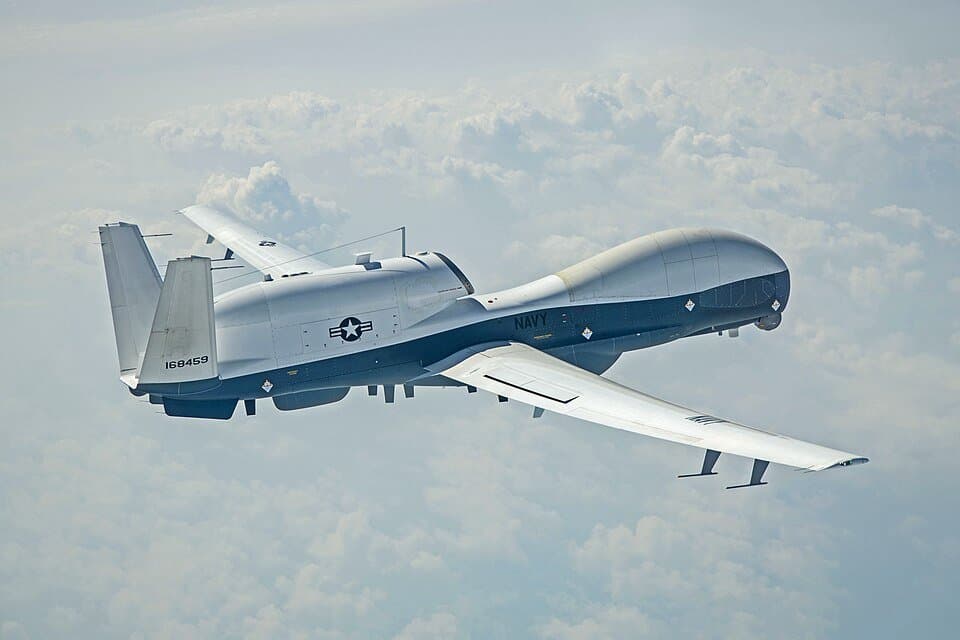
Northrop Grumman MQ-4C Triton is a maritime unmanned surveillance and reconnaissance aerial vehicle and patrol aircraft originating in United States. It was built by Northrop Grumman.
 United States
Northrop Grumman MQ-4C Triton
U.S. Navy · Public domain · Resized · Public domain · Source ↗ · ModifiedTechnical data
Maritime unmanned surveillance and reconnaissance aerial vehicle and patrol aircraft
United States
Northrop Grumman
Limited service
United States Navy Royal Australian Air Force
US: 68 (planned) + 2 prototypes Australia: 3 delivered out of 4 ordered
48 as of 2024
May 2018
22 May 2013 ( 2013-05-22 )
Northrop Grumman RQ-4 Global Hawk
Unmanned – 4 personnel fly aircraft from ground station
47 ft 7 in (14.5 m)
130 ft 11 in (39.9 m)
15 ft 5 in (4.6 m)
14,945 lb (6,781 kg)
32,250 lb (14,630 kg)
1 × Rolls-Royce AE 3007 turbofan engine, 6,495–8,917 lbf (28.89–39.66 kN) thrust
357 mph (575 km/h, 320 kn)
9,400 mi (15,200 km, 8,200 nmi)
30 hours
56,000 ft (17,000 m)
MQ-4C Triton
The Northrop Grumman MQ-4C Triton is an American high-altitude long endurance unmanned aerial vehicle (UAV) developed for and flown by the United States Navy and Royal Australian Air Force as a surveillance aircraft .
51,000-hour airframe life
The MQ-4C can remain aloft more than 30 hours at 55,000 ft (17,000 m) at speeds of up to 330 knots (380 mph; 610 km/h). Its surveillance sensor is the AN/ZPY-3 Multi-Function Active Sensor (MFAS) X-band AESA radar with a 360-degree field-of-regard, capable of surveying 2,700,000 mi 2 (7,000,000 km 2 ) of sea (as well as shoreline or land) in a 24-hour period, or 2,000 mi 2 (5,200 km 2 ) in a single sweep. Using the radar in inverse synthetic aperture mode, the MFAS can identify a target in all weather conditions.
The MQ-4C Triton performed its first flight on 22 May 2013 from United States Air Force Plant 42 / Palmdale Regional Airport , California. The flight lasted 1 hour 20 minutes and the aircraft reached an altitude of 20,000 ft.
On 6 January 2014, Northrop Grumman announced that the MQ-4C had completed 9 test flights with 46 hours of flight time. Half of its envelope expansion testing, which included evaluating the aircraft at different altitudes, speeds, and weights, had been completed. Some flights lasted over 9 hours and reached 50,000 ft. A second Triton aircraft was to fly by March or April 2014. Initial envelope expansion testing was completed in March 2014 through 13 flights, 81 flight hours, and reaching altitudes of 59,900 ft.
On 18 September 2014, the Triton successfully conducted an 11-hour cross-country flight from Northrop Grumman's Palmdale, California facility to Naval Air Station Patuxent River in Maryland. The cross-country flight test had been previously postponed twice due to bad weather. The aircraft flew a pre-approved instrument route along the southern U.S. border, crossing the Gulf of Mexico and Florida, then was directed north along the Atlantic coast and up the Chesapeake Bay, a distance of 3,290 nmi (3,790 mi; 6,090 km) at 50,000 ft (15,000 m) to avoid commercial air traffic.
A test fleet of three Tritons completed 15 flights demonstrating speed and altitude capabilities prior to the transcontinental mission. With the completion of the cross-country flight, the MQ-4C program transitions from initial safety flight testing to validating its ability to perform operational missions over the ocean. Operations from Patuxent River in the coming weeks will test the aircraft's sensors, communications, interoperability, and expanded envelope flight coverage. The three test Tritons are scheduled to fly a total of 2,000 hours before reaching initial operating capability.
Crew: Unmanned – 4 personnel fly aircraft from ground station
Length: 47 ft 7 in (14.5 m)
Wingspan: 130 ft 11 in (39.9 m)
Height: 15 ft 5 in (4.6 m)
Empty weight: 14,945 lb (6,781 kg)
Gross weight: 32,250 lb (14,630 kg)
Powerplant: 1 × Rolls-Royce AE 3007 turbofan engine, 6,495–8,917 lbf (28.89–39.66 kN) thrust
Maximum speed: 357 mph (575 km/h, 320 kn)
Range: 9,400 mi (15,200 km, 8,200 nmi)
Endurance: 30 hours
Service ceiling: 56,000 ft (17,000 m)
Propulsion: Rolls-Royce AE3007H
Length: 47.6 feet (14.5 meters)
Wingspan: 130.9 feet (39.9 meters)
Weight: Max design gross take-off: 32,250 pounds (14,628.4 kilograms)
Reference text from Wikipedia contributors, used under CC BY-SA 4.0.
True scale
Sourced dimensions beside a 1.75 m human reference.
See it in your room. Scan with your phone to open this model in 3D, then place it in your space.
Points represent sourced observations, including revisions. Revisions on the same effective date are not separate inventory events. Ranges appear in the table and are not plotted as exact points.
| Observation / report period | Value | Source | Claim state |
|---|---|---|---|
| 28 Sept 2026 | 30 h | Wikipedia contributors | superseded |
| 28 Sept 2026 | 30 h | Wikipedia contributors | superseded |
| 28 Sept 2026 | 30 h | Wikipedia contributors | superseded |
| 28 Sept 2026 | 30 h | Wikipedia contributors | superseded |
| 28 Sept 2026 | 30 h | Wikipedia contributors | superseded |
| 28 Sept 2026 | 30 h | Wikipedia contributors | superseded |
| 28 Sept 2026 | 30 h | Wikipedia contributors | superseded |
| 28 Sept 2026 | 30 h | Wikipedia contributors | superseded |
| 28 Sept 2026 | 30 h | Wikipedia contributors | superseded |
| 28 Sept 2026 | 30 h | Wikipedia contributors | superseded |
| 28 Sept 2026 | 30 h | Wikipedia contributors | superseded |
| 28 Sept 2026 | 30 h | Wikipedia contributors | approved |
Northrop Grumman MQ-4C Triton equipment records. Variants, orders and quantities are shown as reported in each inventory source; coverage is incomplete.
 Australia
Air Force exact named equipment holdings: MQ-4C Triton. Active, operational-reserve and training units excluding equipment in store; November 2025 IISS assessment. Named service only; no parent-force or national total inferred. Source role: UNINHABITED AERIAL VEHICLES / Heavy. Original estimates, ranges, reporting names, reserve, lease and employment scopes retained; nested included counts are not added. Missile-system quantities mean launchers, not rounds. No readiness, crew, carried weapon, payload, factory-production or future order count inherited.
United StatesNaval Aviation exact named equipment holdings: MQ-4C Triton. Active, operational-reserve and training units excluding equipment in store; November 2025 IISS assessment. Named service only; no parent-force or national total inferred. Source role: UNINHABITED AERIAL VEHICLES / Heavy. Original estimates, ranges, reporting names, reserve, lease and employment scopes retained; nested included counts are not added. Missile-system quantities mean launchers, not rounds. No readiness, crew, carried weapon, payload, factory-production or future order count inherited.
Keep exploring
Unmanned surveillance and reconnaissance aerial vehicle
Unmanned surveillance and reconnaissance aerial vehicle
 Ukraine
Unmanned surveillance and reconnaissance aerial vehicle
Unmanned surveillance and reconnaissance aerial vehicle
United StatesUnmanned surveillance and reconnaissance aerial vehicle
Unmanned surveillance and reconnaissance aerial vehicle
 Israel