FORCETALLY
Loading the evidence…
Preparing your view.


Preparing your view.
Drones & UAVsIn service
Remote piloted aircraft/ unmanned combat aerial vehicle
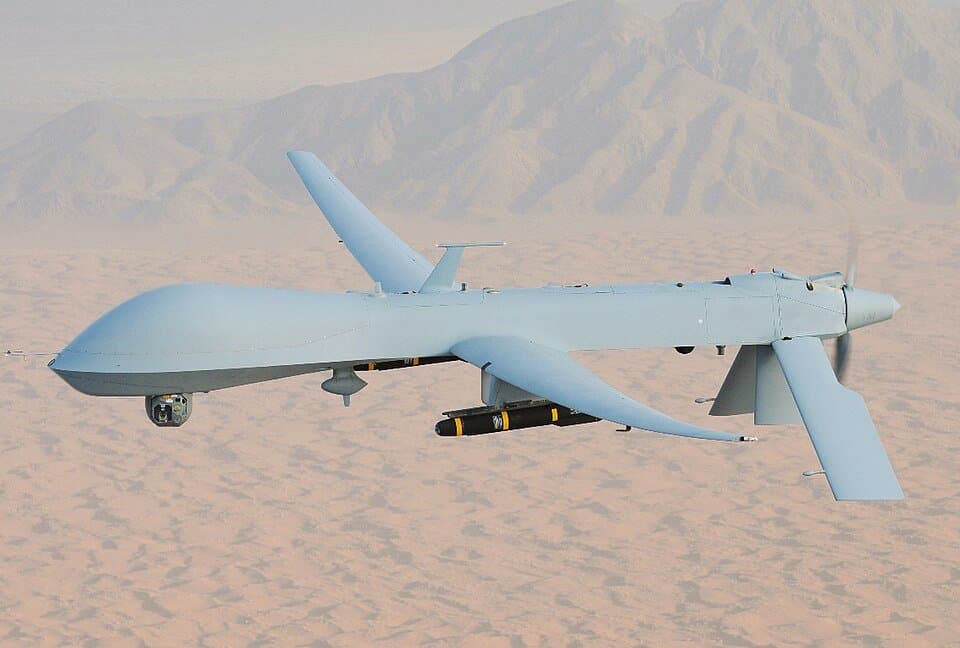
General Atomics MQ-1 Predator is a remote piloted aircraft/ unmanned combat aerial vehicle originating in United States. The cited manufacturer or builder is General Atomics Aeronautical Systems.
 United States
General Atomics MQ-1 Predator
Lt. Col. Leslie Pratt · Public domain · Resized · Public domain · Source ↗ · ModifiedTechnical data
Remote piloted aircraft/ unmanned combat aerial vehicle
United States
General Atomics Aeronautical Systems
In limited service
United States Air Force (retired) Italian Air Force (retired) Turkish Air Force Royal Moroccan Air Force
360 (285 RQ-1, 75 MQ-1)
1995–2018
1 July 1995
3 July 1994
9 March 2018 (USAF)
General Atomics Gnat
General Atomics MQ-1C Gray Eagle
General Atomics MQ-9 Reaper
0, 3 on ground out of theater (remote pilot, sensor operator, and intelligence analyst), with in-theater ground handling crew
27 ft 0 in (8.23 m)
48 ft 7 in (14.8 m) MQ-1B Block 10/15: 55.2 ft (16.84 m)
6 ft 11 in (2.1 m)
123.3 sq ft (11.45 m 2 )
1,130 lb (513 kg)
2,249 lb (1,020 kg)
851 lb (387 kg)
1 × Rotax 914F 4-cylinder air-cooled turbocharged horizontally-opposed piston engine, 115 hp (86 kW)
117 kn (135 mph, 217 km/h)
70 kn (81 mph, 130 km/h) to 90 kn (100 mph; 170 km/h)
675 nmi (777 mi, 1,250 km)
24 hours
25,000 ft (7,600 m)
2 , with provisions to carry combinations of: Missiles: 2 × AGM-114 Hellfire (MQ-1B) 4 × Air-to-Air Stinger (ATAS) (MQ-1B) 6 × AGM-176 Griffin air-to-surface missiles
19
2-bladed constant-speed pusher propeller
54 kn (62 mph, 100 km/h)
2 × AGM-114 Hellfire (MQ-1B) 4 × Air-to-Air Stinger (ATAS) (MQ-1B) 6 × AGM-176 Griffin air-to-surface missiles
The USAF describes the Predator as a "Tier II" MALE UAS (medium-altitude, long-endurance unmanned aircraft system). The UAS consists of four aircraft or "air vehicles" with sensors, a ground control station (GCS), and a primary satellite link communication suite. Powered by a Rotax engine and driven by a propeller, the air vehicle can fly up to 400 nmi (460 mi ; 740 km ) to a target, loiter overhead for 14 hours, then return to its base.
Each Predator air vehicle can be disassembled into six modules and loaded into a container. This enables all system components and support equipment to be rapidly deployed worldwide. The largest component is the ground control station (GCS) which is designed to roll into a C-130 Hercules . The Predator primary satellite link consists of a 6.1-meter (20-ft) satellite dish with associated support equipment. The satellite link provides communications between the GCS and the aircraft when it is beyond line-of-sight and links to networks that disseminate secondary intelligence. The RQ-1A system can operate on a 5,000 by 75 foot (1,524 meters by 23 meters) of hard surface runway with clear line-of-sight to each end from the GCS to the air vehicles. Initially, all components needed to be located on the same airfield.
On 18 May 2006, the Federal Aviation Administration (FAA) issued a certificate of authorization which will allow the M/RQ-1 and M/RQ-9 aircraft to be used within U.S. civilian airspace to search for survivors of disasters. Requests had been made in 2005 for the aircraft to be used in search and rescue operations following Hurricane Katrina , but because there was no FAA authorization in place at the time, the assets were not used. The Predator's infrared camera with digitally enhanced zoom has the capability of identifying the infrared signature of a human body from an altitude of 3 km (10,000 ft), making the aircraft an ideal search and rescue tool.
The longest declassified Predator flight as of 2011 lasted for 40 hours and 5 minutes. The total flight time reached 1 million hours in April 2010, according to General Atomics Aeronautical Systems Inc.
Budget proposals planned to retire the Predator fleet between FY 2015 and 2017 in favor of the larger MQ-9 Reaper , which has greater payload and range.
On 28 August 2013, a Predator belonging to the 163d Reconnaissance Wing was flying at 18,000 to 20,000 feet over the Rim Fire in California providing infrared video of lurking fires, after receiving emergency approvals. Rules limit the Predator behavior; it must be accompanied by a manned aircraft, and its camera must only be active above the fire.
In September 2013, the Air Force Special Operations Command tested the ability to rapidly deploy Predator aircraft. Two MQ-1s were loaded into a Boeing C-17 Globemaster III in a cradle system that also carried a control terminal, maintenance tent, and the crew. The test was to prove the UAVs could be deployed and set up at an expeditionary base within four hours of landing. In a recent undisclosed deployment, airmen set up a portable hangar in a tent and a wooden taxiway to operate MQ-1s for a six-week period.
A second aircraft (serial 95-3019) was lost on 13 May, when it was shot down by a Serbian Strela-1M surface-to-air missile over the village of Biba. A Serbian TV crew videotaped this incident.
On 5 May 2013, an MQ-1 Predator surpassed 20,000 flight hours over Afghanistan by a single Predator. Predator P107 achieved the milestone while flying a 21-hour combat mission; P107 was first delivered in October 2004.
An Iraqi MiG-25 shot down a Predator performing reconnaissance over the no fly zone in Iraq on 23 December 2002. This was the first time in history a conventional aircraft and a drone had engaged each other in combat. Predators had been armed with AIM-92 Stinger air-to-air missiles, and were purportedly being used to "bait" Iraqi fighters, then run. However, the Predator's maximum speed is 135 mph (217 km/h) lower than the MiG-25's, and its service ceiling is nearly 60,000 ft (18,000 m) lower, making the "run" segment of any "bait and run" mission a difficult task. In this incident, the Predator did not run (or could not run fast enough), but instead fired one of its Stingers. The Stinger's heat-seeker became "distracted" by the MiG's missile and missed the MiG. The Predator was hit by the MiG's missile and destroyed. Another two Predators had been shot down earlier by Iraqi SAMs .
During the initial phases of the 2003 U.S. invasion of Iraq , a number of older Predators were stripped down and used as decoys to entice Iraqi air defenses to expose themselves by firing. From July 2005 to June 2006, the 15th Reconnaissance Squadron participated in more than 242 separate raids, engaged 132 troops in contact-force protection actions, fired 59 Hellfire missiles; surveyed 18,490 targets, escorted four convoys, and flew 2,073 sorties for more than 33,833 flying hours.
On 27 June 2014, the Pentagon confirmed that a number of armed Predators had been sent to Iraq along with U.S. Special Forces following advances by the Islamic State of Iraq and the Levant . The Predators were flying 30 to 40 missions a day in and around Baghdad with government permission, and intelligence was shared with Iraqi forces. On 8 August 2014, an MQ-1 Predator fired a missile at a militant mortar position. From the beginning of Operation Inherent Resolve to January 2016, five USAF Predators were lost; four crashed from technical failures in Iraq, one in June 2015, two in October 2015, and one in January 2016.
On 1 November 2012, two Iranian Sukhoi Su-25 attack aircraft engaged an unarmed Predator conducting routine surveillance over the Persian Gulf just before 05:00 EST. The Su-25s made two passes at the drone firing their 30 mm cannon; the Predator was not hit and returned to base. The incident was not revealed publicly until 8 November. The U.S. stated that the Predator was over international waters, 16 miles (26 km) away from Iran and never entered its airspace. Iran states that the drone entered Iran's airspace and that its aircraft fired warning shots to drive it away.
On 12 March 2013, an Iranian F-4 Phantom pursued an MQ-1 flying over the Persian Gulf. The unarmed reconnoitering Predator was approached by the F-4, coming within 16 miles of the UAV. Two U.S. fighters were escorting the Predator and verbally warned the jet, which made the Iranian F-4 break off. All American aircraft remained over international waters. An earlier statement by the Pentagon that the escorting planes fired a flare to warn the Iranian jet was later amended. The Air Force later revealed that the American jet that forced the Iranian F-4 to break off was an F-22 Raptor .
Iraq, Tallil: from January 2005 to November 2006 for "Antica Babilonia" mission (1.600 hours flew)
Afghanistan, Herat: from June 2007 to January 2014 (beginning with Predator A, then A+ and finally replaced by MQ-9 Reaper). Flew 6.000 hours in 750 missions only from June 2007 to May 2011.
MQ-1B Predator : Later airframes capable of carrying ordnance. Modified antenna fit, including introduction of spine-mounted VHF fin. Enlarged dorsal and ventral air intakes for Rotax engine. MQ-1B Block 10 / 15: Current production aircraft include updated avionics, datalinks, and countermeasures, modified v-tail planes to avoid damage from ordnance deployment, upgraded AN/AAS-52 Multi-Spectral Targeting System, wing deicing equipment, secondary daylight and infrared cameras in the nose for pilot visual in case of main sensor malfunction, and a 3 ft (0.91 m) wing extension from each wingtip. Some older MQ-1A aircraft have been partially retrofitted with some Block 10 / 15 features, primarily avionics and the modified tail planes.
Export variant of the Predator designed specifically to be unable to carry weapons to allow for wider exportation opportunities. Markets for it are expected in the Middle East and Latin America. First flight on 27 June 2014. Features winglets with an endurance of 35 hours and a service ceiling of 25,000 ft (7,600 m). Is equipped with the Lynx synthetic aperture radar , may contain laser rangefinder and laser designator for target illumination for other aircraft.
MQ-1C 25M
General Atomics MQ-1C 25M Gray Eagle The “M” in 25M refers to “Modernized,” including open architecture ground and aerial systems, advanced datalinks, and an improved propulsion system. This dramatically improves the capacity for developing new capabilities, supplying electronic threat resistance, and delivering expeditionary employment to remote areas
Italian Air Force retired on 19 December 2022. 32° Stormo (32nd Wing) Armando Boetto— Foggia , Amendola Air Force Base 28° Gruppo (28th Unmanned Aerial Vehicle Squadron) 61° Gruppo (61st Unmanned Aerial Vehicle Squadron)
95-3013 – RQ-1K on static display at Goodfellow Air Force Base in San Angelo, Texas . Tail 13 was formerly deployed in support of Operation Allied Force ; it is noted for having been presumed lost on a mission due to loss of communications only to reappear at its base six hours later, allowing its crew to recover it.
Length: 27 ft 0 in (8.23 m)
Wingspan: 48 ft 7 in (14.8 m) MQ-1B Block 10/15: 55.2 ft (16.84 m)
Height: 6 ft 11 in (2.1 m)
Wing area: 123.3 sq ft (11.45 m 2 )
Empty weight: 1,130 lb (513 kg)
Gross weight: 2,249 lb (1,020 kg)
Fuel capacity: 851 lb (387 kg)
Powerplant: 1 × Rotax 914F 4-cylinder air-cooled turbocharged horizontally-opposed piston engine, 115 hp (86 kW)
Maximum speed: 117 kn (135 mph, 217 km/h)
Cruise speed: 70 kn (81 mph, 130 km/h) to 90 kn (100 mph; 170 km/h)
Stall speed: 54 kn (62 mph, 100 km/h)
Range: 675 nmi (777 mi, 1,250 km)
Endurance: 24 hours
Service ceiling: 25,000 ft (7,600 m)
Power Plant: Rotax 914F four cylinder engine
Thrust: 115 horsepower
Wingspan: 55 feet (16.8 meters)
Length: 27 feet (8.22 meters)
Height: 6.9 feet (2.1 meters)
Weight: 1,130 pounds ( 512 kilograms) empty
Maximum takeoff weight: 2,250 pounds (1,020 kilograms)
Fuel Capacity: 665 pounds (100 gallons)
Payload: 450 pounds (204 kilograms)
Speed: Cruise speed around 84 mph (70 knots), up to 135 mph
Reference text from Wikipedia contributors, used under CC BY-SA 4.0.
True scale
Sourced dimensions beside a 1.75 m human reference.
See it in your room. Scan with your phone to open this model in 3D, then place it in your space.
Points represent sourced observations, including revisions. Revisions on the same effective date are not separate inventory events. Ranges appear in the table and are not plotted as exact points.
| Observation / report period | Value | Source | Claim state |
|---|---|---|---|
| 28 Sept 2026 | 24 h | Wikipedia contributors | superseded |
| 28 Sept 2026 | 24 h | Wikipedia contributors | superseded |
| 28 Sept 2026 | 24 h | Wikipedia contributors | superseded |
| 28 Sept 2026 | 24 h | Wikipedia contributors | superseded |
| 28 Sept 2026 | 24 h | Wikipedia contributors | superseded |
| 28 Sept 2026 | 24 h | Wikipedia contributors | superseded |
| 28 Sept 2026 | 24 h | Wikipedia contributors | superseded |
| 28 Sept 2026 | 24 h | Wikipedia contributors | superseded |
| 28 Sept 2026 | 24 h | Wikipedia contributors | approved |
Range: Up to 770 miles (675 nautical miles)
Ceiling: Up to 25,000 feet (7,620 meters)
Armament: Two laser-guided AGM-114 Hellfire missiles
Crew (remote): Two (pilot and sensor operator)
General Atomics MQ-1 Predator equipment records. Variants, orders and quantities are shown as reported in each inventory source; coverage is incomplete.
United States Air Force (retired) Italian Air Force (retired) Turkish Air Force Royal Moroccan Air Force
Equipment reference ↗Keep exploring
Unmanned combat aerial vehicle
United StatesCompare with General Atomics MQ-1 Predator Unmanned combat aerial vehicle
 Iran
Unmanned combat aerial vehicle
IranUnmanned combat aerial vehicle
 South Africa
Unmanned combat aerial vehicle
 SerbiaCompare with General Atomics MQ-1 Predator
Unmanned combat aerial vehicle
IranCompare with General Atomics MQ-1 Predator  United Arab Emirates