FORCETALLY
Loading the evidence…
Preparing your view.


Preparing your view.
Armoured vehiclesIn service
Infantry fighting vehicle
M2 Bradley is a infantry fighting vehicle originating in United States. The cited manufacturer or builder is United Defense (1981–1995) BAE Systems Platforms & Services (since 2004). Published specifications list mass 25 tonnes and length 6.55 m; the configuration for each measurement is shown below.
 United States
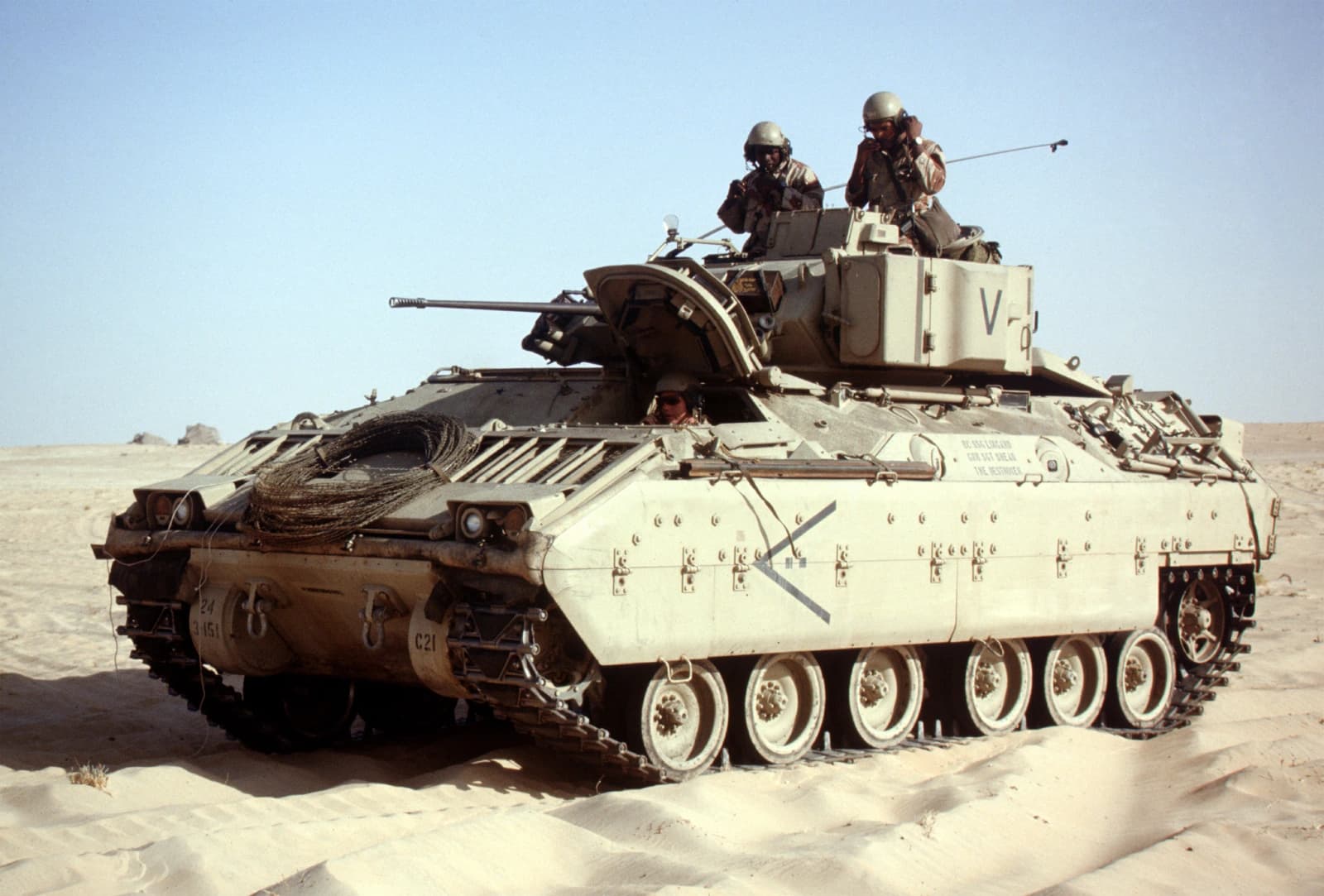
M2 Bradley — pictured M2A1 during Operation Desert Shield; the whole vehicle is the main subject.
SGT. Brian Cumper · Public domain · Resized / converted to WebP · Public domain · Source ↗ · ModifiedInfantry fighting vehicle
United States
1981–present
See Operators
Gulf War Iraq War Yemeni Civil War Syrian Civil War Russo-Ukrainian War
United Defense (1981–1995) BAE Systems Platforms & Services (since 2004)
$3,166,000 in 1998.
1981–1995 ( United Defense ) 2004–present ( BAE Systems Platforms & Services )
27.6 short tons (25.0 t )
21.49 ft (6.55 m)
11.82 ft (3.60 m)
9.78 ft (2.98 m)
3 (commander, gunner, driver)
6 (7 in M2A2 ODS/M2A3/M2A4)
Spaced laminate armor offering 14.5 mm all around protection. Hull base is 7017 aluminum
25 mm M242 chain gun (900 rounds) 2 × TOW anti-tank missile launchers (7 missiles)
7.62 mm coaxial M240C machine gun (2,200 rounds)
Cummins VTA-903T 8-cylinder diesel 600 hp (450 kW)
16.18 kW/tonne (21.7 hp/tonne)
Torsion bar
300 mi (480 km)
40 mph (64 km/h); 40 km/h off-road; 7.2 km/h in water
Croatia
Lebanon
Russia
Saudi Arabia
Ukraine
1033 Program
The M2 Bradley , or Bradley IFV , is an American infantry fighting vehicle that is a member of the Bradley Fighting Vehicle family.
In the year 2000, the total cost of the program was US$ 5,664,100,000 for 1,602 units, giving an average unit cost of $3,166,000, equivalent to $5,841,000 in 2025.
The Bradley is equipped with the M242 25 mm autocannon as its main weapon. The M242 has a single barrel with an integrated dual-feed mechanism and remote feed selection. The Bradley carries 300 ready rounds in two ready boxes, one of 70 rounds – usually AP-type rounds, the other of 230 rounds – usually HE-type rounds, with another 600 rounds in storage. The two ready boxes allow a selectable mix of rounds, including the M791 APDS-T ( Armor-Piercing Discarding Sabot (with) Tracer ), and M792 HEI-T ( High Explosive Incendiary (with) Tracer) rounds. The 25 mm automatic gun is primarily used for clearing bunkers and firing on lightly armored vehicles.
The 25 mm automatic gun is not the weapon of choice for engaging tanks, but vehicle commanders, crews, and CALL and Army Infantry Center personnel have reported isolated instances in which the 25 mm automatic gun disabled older generation tanks. However, Army Materiel Systems Analysis Activity (AMSAA) officials stated that, on the basis of their assessment of combat vehicles in the Persian Gulf war, for the 25 mm automatic gun to incapacitate a tank it would have to be hit at close range in its more vulnerable areas.
It is also armed with an M240C machine gun mounted coaxially to the M242, with 2,200 rounds of 7.62 mm ammunition. For engaging heavier targets, such as tanks, the Bradley has a TOW missile system onboard. It was changed from the M2A1 model to fire TOW II missiles. M2 infantry Bradleys have firing ports for a number of M231 Firing Port Weapons (FPWs; modified M16 assault rifles ), providing a button-up firing position to replace the top-side gunners on the old ACAV, though the M231 is rarely employed. Initial variants carried six, but the side ports were plated over with the new armor used on the A2 and A3 variants, leaving only the two rear-facing mounts in the loading ramp.
The M2's base armor consists of an all-around 1 inch (25.4 mm) thick aluminum hull (mix of no. 5083 and no. 7039 alloys), heavily sloped in the front and mostly vertical on the sides and rear. The bottom of the hull front has an additional 0.375 inch (9.5 mm) thick steel applique plate, primarily intended to protect against mines. Both sides of the vehicle have an additional 0.5 inch (12.7 mm) of high hardness steel armor consisting of two quarter-inch applique armor plates spaced 1 inch apart from each other, the first spaced 3.5 inches from the aluminum hull. The turret, unlike the hull, is armored only in steel. The M2A1 version has identical armor but adds a gas particulate filter unit for NBC protection. This armor offers protection against threats up to and including 14.5x114mm AP.
The M2A2 upgrade adds additional armor. More steel applique armor is added to the vehicle's front, requiring removal of the trim-vane. 1.25 inch (32 mm) steel plates were added to the hull sides, replacing the earlier applique armor, as well as to the front and sides of the turret. The new armor covered up the infantry firing ports on the vehicle's sides. Spaced laminate armor was added to the hull rear, and kevlar spall liners were added to critical areas. Options for ERA were also added. These armor upgrades added about 3 tons to the vehicle's weight.
The use of aluminum armor and the storage of large quantities of ammunition in the vehicle initially raised questions about its combat survivability. Spaced laminate belts and high hardness steel skirts were added to later versions to improve armor protection, increasing overall weight to 33 tons. However, combat operations have not shown the Bradley to be deficient, with few losses. In friendly fire incidents in Desert Storm many crew members survived hits that totally destroyed lighter USMC LAV-25 vehicles.
The original Bradley had room for 3 crew members and 6 passengers, called dismounts by the U.S.
In the later M2A2 and M2A3 versions of the Bradley, the Army rearranged the interior stowage and created space for an extra dismount in each vehicle, resulting in spaces for 7 dismounts in each vehicle and a total of 40 soldiers in the four-vehicle platoon.
Even with the extra space in the revised Bradleys, the squads were split among more than one Bradley. A split squad can be difficult to organize and control immediately after dismounting, especially when under fire and in complex terrain. The Army seeks to avoid that difficulty by requiring the GCV to carry the full 9-man squad. A four-vehicle GCV platoon will have room for 12 crew members and 36 dismounts. With three squads fully occupying three GCVs, the fourth GCV will have room for the platoon leader, forward observers, radio-telephone operator, and medic.
Ukrainian forces have used M2 Bradleys in ambushes and defensive fighting around Avdiivka . The 25 mm autocannon has been used to destroy three Russian MT-LB vehicles in one engagement, while also engaging supporting Russian infantry. The enhanced optics allow for night attacks.
On 12 January 2024, footage emerged of a pair of Ukrainian M2A2 Bradleys from the 47th Mechanized Brigade engaging and disabling a Russian T-90M Proryv tank at close range in Stepove , Ukraine. In an engagement which lasted ten minutes, the two Bradleys were able to incapacitate the tank by firing at the mechanism which turned the tank's turret, causing it to spin uncontrollably and render it inoperable.
In April 2025, Russian military experts examined a captured M2A2 ODS-SA Bradley and testing found it superior to a Soviet-era BMP-3 . Finding the Bradley to better protected from gunfire, shell splinters and land mines. The 25 mm cannon had “reportedly double” the range of the BMP-3 30mm cannon. By contrast, Sergey Chemezov , CEO of Rostec , acknowledged the Bradley's protection and troop-compartment comfort but criticized Russian experts for claiming its superiority over the BMP-3, citing survivability and operational limitations as key reasons.
The U.S. Army began the Future Combat Systems (FCS) Manned Ground Vehicles program in 1999. This family of 18-ton lightweight tracked vehicles centered around a common chassis. It would consist of eight variants, including infantry carriers, scouting vehicles and main battle tanks. FCS was canceled in 2009 due to budget cuts.
In 2010, the Army began the Ground Combat Vehicle program to replace the M2 Bradley. Entries from BAE and General Dynamics were selected for evaluation. Concerns grew around the vehicle's proposed weight of around 70 tons. The GCV program was cancelled in 2014 due to sequestration budget cuts.
The M2 was the basic production model, designed to carry 10 person teams, first fielded in 1981. The M2 can be identified by its standard TOW missile system, steel laminate armor, and 500 horsepower (370 kW) Cummins VT903 engine with HMPT-500 hydromechanical transmission. Basic features included an integrated sight unit for the M242 25 mm gun, and thermal imaging system. The M2 was amphibious with the use of a "swim barrier" or " flotation screen " and was transportable by C-141 Starlifter and C-5 Galaxy aircraft. All M2 vehicles have been upgraded to improved standards. The M2 armor protects the vehicle through a full 360 degrees against 14.5 mm armor-piercing incendiary (API) ammunition.
The turret was offset to the right to maximize the room in the passenger compartment. Six infantry soldiers for dismounted fighting were held in the passenger compartment. Vision for the troops was provided through three periscopes placed between the rear ramp and the cargo hatch just behind the turret, as well as two periscopes on each side of the hull above the side firing ports. The passenger compartment held up to five TOW or Dragon missile reloads. The side and rear hull armor consisted of two 0.25 in (6.4 mm) steel plates one inch apart and 3.5 in (89 mm) away from the aluminum armor. The hull top, bottom, and front consisted of 5083 aluminum armor, and 0.357 in (9.1 mm) steel armor was added to the front third of the hull bottom to increase mine protection.
The M3 Bradley CFV is very similar to the M2 Bradley IFV (Infantry Fighting Vehicle) and is fielded with the same two-man 25 mm Bushmaster cannon turret with the coaxial 7.62 mm machine gun. It only varies from the M2 in a few subtle ways and by role. The M3 is classified as an armored reconnaissance and scout vehicle and does away with the firing ports found in the M2 series. The M3 carries more TOW missiles as well as more ammunition for its 25 mm and 7.62 mm guns.
Introduced in 1988, the A2 received an improved 600 horsepower (447 kW) engine with an HMPT-500-3 Hydromechanical transmission. Armor was improved, both passive and the ability to mount explosive reactive armor . The new armor protects the Bradley against 30 mm APDS rounds and RPGs, or similar anti-armor weapons. The new armor eliminated the trim vane that made the Bradley amphibious and covered up the side firing ports. Spaced laminate armor was installed to the hull rear. Spaced laminate track skirts protected the lower hull.
A semicircular shield was attached to the turret rear to add more stowage space, as well as act as spaced armor. Kevlar spall liners were added to critical areas. The troop carrying number was reduced to six, eliminating the periscope position behind the driver. After live firing testing, the seating and stowage arrangements were redrawn. These upgrades raised the cumulative gross weight of the vehicle to 30,519 kg (67,282 lb (30.037 long tons; 33.641 short tons)). The M2A2 was qualified to be transported by the C-17 Globemaster III . M2A2s were all eventually modified to the M2A2 ODS or M2A3 standard.
The A3's fire control software (FCSW) combines laser range, environmental readings, ammunition type, and turret control inputs to automatically elevate the gun for range and to automatically generate a kinematic lead solution if a target is moving. This functionality, very similar to that of the M1A2 Abrams, allows the gunner or commander to center the reticule on a moving target, lase the target, and achieve a first-round-hit, without the need to fire sensing rounds and adjust aim. The FCSW incorporates a thermal aided target tracker (ATT) function that can track two targets in the FLIR field of view and switch between them, primarily intended for employing TOW missiles against moving vehicles. The FCSW allows the turret and gunner's sights to be slewed automatically onto a target that has been designated with the CIV.
The MET-D is an experimental variant of the M2 Bradley that prototypes the use of surrogate robotic combat vehicles (RCVs), which are operated by the crew of the MET-D. It is equipped with a remote turret for the main 25 mm chain gun, 360-degree situational awareness cameras and enhanced crew stations with touchscreens.
The Bradley series has been widely modified. Its chassis is the basis for the M270 Multiple Launch Rocket System , the M4 C2V battlefield command post , and the M6 Bradley Linebacker air defense vehicle. Armed with a quad Stinger surface-to-air missile launcher in place of the TOW anti-tank missiles , but maintaining the 25 mm autocannon, the M6 Bradley Linebacker Air Defense Vehicle (no longer in service) possessed a unique role in the U.S. Army , providing highly mobile air defense at the front line.
Croatia : 89 M2A2 ODS
Lebanon : 32 M2A2
Russia : 12 M2A2 ODS Bradleys captured from Ukraine
Saudi Arabia : 400
Ukraine - 300+ M2A2 ODS-SA (situational awareness) Bradleys were delivered from April 2023 onwards, of this 185 Bradleys were reported as lost, including those damaged, abandoned, or captured.
United States: 4,285 total, estimated 2,000 M2A2 ODS-SA (situational awareness)/A3 & 285 M2A4 Bradleys in operation with the US Army (2000 more M2 Bradleys in storage) as of January 2025. Numerous U.S law enforcement agencies have received demilitarised versions of the vehicle for tactical police ops through the 1033 Program . Prominent operators include the LAPD , OCSD , and NYPD . SDPD is considering acquisition.
Reference text from Wikipedia contributors, used under CC BY-SA 4.0.
True scale
Sourced dimensions beside a 1.75 m human reference.
See it in your room. Scan with your phone to open this model in 3D, then place it in your space.
Points represent sourced observations, including revisions. Revisions on the same effective date are not separate inventory events. Ranges appear in the table and are not plotted as exact points.
| Observation / report period | Value | Source | Claim state |
|---|---|---|---|
| 28 Sept 2026 | 3 people | Wikipedia contributors | superseded |
| 28 Sept 2026 | 3 people | Wikipedia contributors | approved |
| 28 Sept 2026 | 3 people | Wikipedia contributors | superseded |
| 28 Sept 2026 | 3 people | Wikipedia contributors | superseded |
| 28 Sept 2026 | 3 people | Wikipedia contributors | superseded |
| 28 Sept 2026 | 3 people | Wikipedia contributors | superseded |
| 28 Sept 2026 | 3 people | Wikipedia contributors | superseded |
| 28 Sept 2026 | 3 people | Wikipedia contributors | superseded |
Bradley equipment records. Variants, orders and quantities are shown as reported in each inventory source; coverage is incomplete.
 Croatia
Army exact named equipment holdings: M2A2 Bradley. Active, operational-reserve and training units excluding equipment in store; November 2025 IISS assessment. Named service only; no parent-force or national total inferred. Source role: ARMOURED FIGHTING VEHICLES / IFV. Original estimates, ranges, reporting names, reserve, lease and employment scopes retained; nested included counts are not added. Missile-system quantities mean launchers, not rounds. No readiness, crew, carried weapon, payload, factory-production or future order count inherited.
 Lebanon
 Russia
 Saudi Arabia
 Army holdings only. M2A2 Bradley IFVs; no M2A4 variant inference.
 Ukraine
Lower-bound count for Bradley · M2A2 ODS M7 Bradley FiST. Country-wide list; no individual service specified. 1 distinct count cell(s) from the same source list; shared rowspan cells counted once. Retired, wholly reserve and on-order rows are excluded; the reported count retains any explicitly mixed stock scope in the quoted row. Count column(s): number: 300+. Origin: United States. The listed variants/roles are the scope, not an immediately deployable count. Dates are the count-cell citations' stated source period (2024), not the article revision. Cited source 2024-05-10. Edition or publication years do not claim an exact inventory census day.
United StatesUS Army exact named equipment holdings: M2A4 Bradley. Active, operational-reserve and training units excluding equipment in store; November 2025 IISS assessment. Named service only; no parent-force or national total inferred. Source role: ARMOURED FIGHTING VEHICLES / IFV. Original estimates, ranges, reporting names, reserve, lease and employment scopes retained; nested included counts are not added. Missile-system quantities mean launchers, not rounds. No readiness, crew, carried weapon, payload, factory-production or future order count inherited.
Croatia, Lebanon, Russia, Saudi Arabia, Ukraine, 1033 Program
Equipment reference ↗United States Army; estimated stored M2 only: 2000. Stored equipment is excluded from the active family total and ForceTally Index active holdings. Approximate count for M2 Bradley. Service scope: United States Army; does not replace a national total. 1 distinct count cell(s) from the same source list; shared rowspan cells counted once. Retired, wholly reserve and on-order rows are excluded; the reported count retains any explicitly mixed stock scope in the quoted row. Count column(s): quantity: 2,100 M2A2/A3 and 210 M2A4 estimated active 2,000 M2 estimated in storage. Origin: United States. The listed variants/roles are the scope, not an immediately deployable count. Dates are the count-cell citations' stated source period (2024), not the article revision. Cited source 2024-02-12. Edition or publication years do not claim an exact inventory census day.
Keep exploring
Infantry fighting vehicle
Compare with M2 BradleyInfantry fighting vehicle
 RomaniaCompare with M2 Bradley
Infantry fighting vehicle
Compare with M2 BradleyInfantry fighting vehicle
 SwedenCompare with M2 Bradley
Infantry fighting vehicle
 GermanyCompare with M2 Bradley
Infantry fighting vehicle
 South AfricaCompare with M2 Bradley