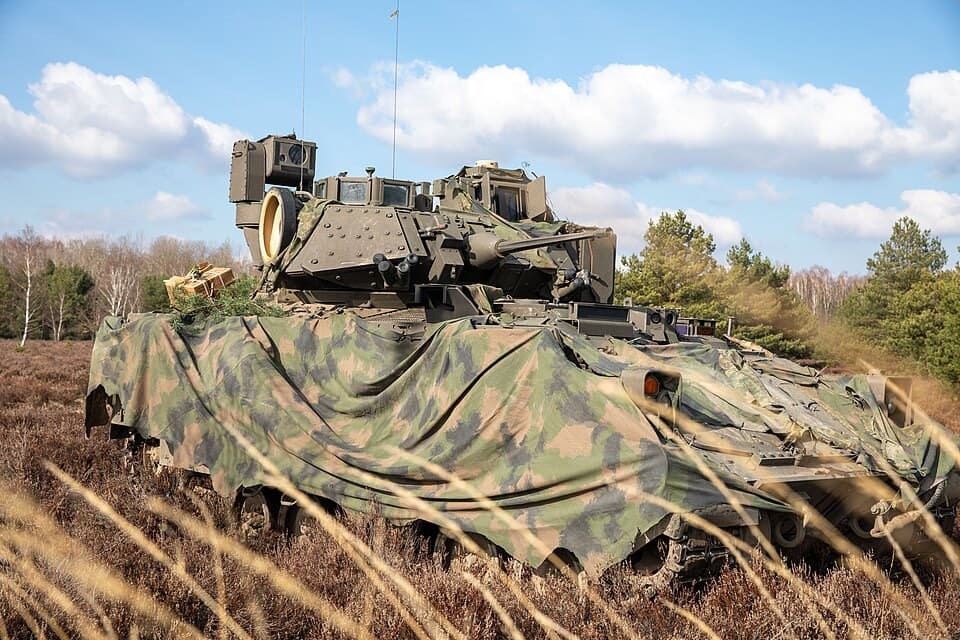

Reference photo · Configuration may differ
Credit
Pfc. Jaidyn Moore · Public domain · Wikimedia Commons · Public domain · Source ↗ · Modified


Preparing your view.

At a glance
M2 Bradleylarger figure on 0 of 1
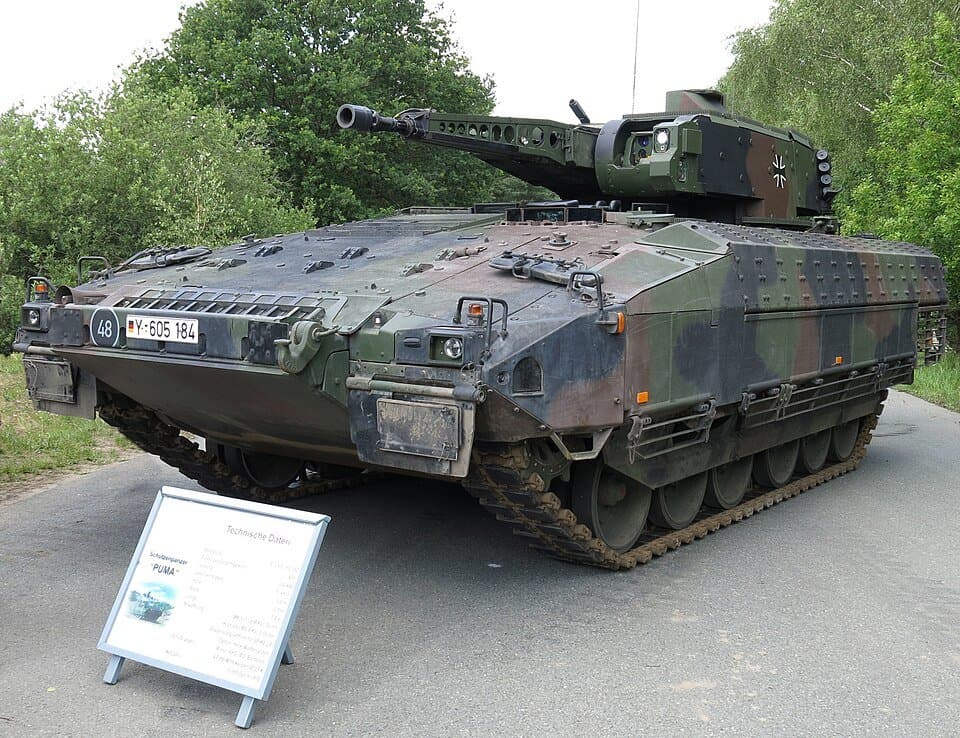
Puma (German infantry fighting vehicle)larger figure on 1 of 1
Counts only measures both sources give with the same scope. A larger figure is not a better system.
Measured figures
Length
Single source21.49 ft (6.55 m)[source]
Length
Single sourceConfiguration
| Specification | M2 Bradley | Puma (German infantry fighting vehicle) |
|---|---|---|
| Type | Infantry fighting vehicle[source] | Infantry fighting vehicle[source] |
| Place of origin | United States[source] | Germany[source] |
| In service | 1981–present[source] | 2015–present[source] |
| Used by | See Operators[source] |
Official specification · puma; 7.4 m
Manufacturer claimSchützenpanzer Puma · Length · Länge
Single sourceWidth
Single source11.82 ft (3.60 m)[source]
Maximum; in water
Single sourceMaximum; Maximum speed
Single sourceMaximum; Off-road
Single source40 mph (64 km/h); 40 km/h off-road; 7.2 km/h in water[source]
Maximum; Official specification · puma; 70 km/h
Manufacturer claimMaximum; On road
Single sourceCummins VTA-903T 8-cylinder diesel
Single sourceCummins VTA-903T 8-cylinder diesel 600 hp (450 kW)[source]
MTU Fried. MT 892 Ka-501 v10 11.1-litre (at 3,800 rpm), 2,200 N⋅m (1,623 ft⋅lb)
Single sourceOfficial specification · puma; 800 kW
Manufacturer claimMTU Fried. MT 892 Ka-501 v10 11.1-litre 1,088 PS (800 kW) (at 3,800 rpm), 2,200 N⋅m (1,623 ft⋅lb)[source]
800 kW[source]
1.088 PS[source]Schützenpanzer Puma · MotorleistungSource text · numeric interpretation needs review
Bars compare reported quantities only. A larger figure does not make a system better; configurations and test conditions differ.
Bundeswehr[source] |
| Wars | Gulf War Iraq War Yemeni Civil War Syrian Civil War Russo-Ukrainian War[source] | — |
|---|
| Manufacturer | United Defense (1981–1995) BAE Systems Platforms & Services (since 2004)[source] | Rheinmetall AG, KNDS Deutschland[source] |
|---|
| Unit cost | $3,166,000 in 1998.[source] | — |
|---|
| Produced | 1981–1995 ( United Defense ) 2004–present ( BAE Systems Platforms & Services )[source] | 2009–present[source] |
|---|
| Passengers | 6 (7 in M2A2 ODS/M2A3/M2A4)[source] |
|---|
| Armor | Spaced laminate armor offering 14.5 mm all around protection. Hull base is 7017 aluminum[source] | AMAP modular composite armor composite armour[source] |
|---|
| Main armament | 25 mm M242 chain gun (900 rounds) 2 × TOW anti-tank missile launchers (7 missiles)[source] | Autocanon MK 30-2/ABM ( 30 mm , 200 rounds ready to fire, 200 in storage)[source] |
|---|
| Secondary armament | 7.62 mm coaxial M240C machine gun (2,200 rounds)[source] | Base variant: HK MG4 ( 5.56×45mm NATO ) S1 variant: Spike LR (MELLS) ATGM Multishot grenade launcher for close-in defense[source] |
|---|
| Power/weight | 16.18 kW/tonne (21.7 hp/tonne)[source] | 18.6 kW/t[source] |
|---|
| Suspension | Torsion bar[source] | Horstman hydrostruts[source] |
|---|
| Role | American infantry fighting vehicle[source] | — |
|---|
| Source measurement | In the year 2000, the total cost of the program was US$ 5,664,100,000 for 1,602 units, giving an average unit cost of $3,166,000, equivalent to $5,841,000 in 2025.[source]M2 Bradley · Lead; only the objects and conditions stated in this passage The Bradley is equipped with the M242 25 mm autocannon as its main weapon. The M242 has a single barrel with an integrated dual-feed mechanism and remote feed selection. The Bradley carries 300 ready rounds in two ready boxes, one of 70 rounds – usually AP-type rounds, the other of 230 rounds – usually HE-type rounds, with another 600 rounds in storage. The two ready boxes allow a selectable mix of rounds, including the M791 APDS-T ( Armor-Piercing Discarding Sabot (with) Tracer ), and M792 HEI-T ( High Explosive Incendiary (with) Tracer) rounds. The 25 mm automatic gun is primarily used for clearing bunkers and firing on lightly armored vehicles.[source]M2 Bradley · Design / Armament; only the objects and conditions stated in this passage The 25 mm automatic gun is not the weapon of choice for engaging tanks, but vehicle commanders, crews, and CALL and Army Infantry Center personnel have reported isolated instances in which the 25 mm automatic gun disabled older generation tanks. However, Army Materiel Systems Analysis Activity (AMSAA) officials stated that, on the basis of their assessment of combat vehicles in the Persian Gulf war, for the 25 mm automatic gun to incapacitate a tank it would have to be hit at close range in its more vulnerable areas.[source]M2 Bradley · Design / Armament; only the objects and conditions stated in this passage It is also armed with an M240C machine gun mounted coaxially to the M242, with 2,200 rounds of 7.62 mm ammunition. For engaging heavier targets, such as tanks, the Bradley has a TOW missile system onboard. It was changed from the M2A1 model to fire TOW II missiles. M2 infantry Bradleys have firing ports for a number of M231 Firing Port Weapons (FPWs; modified M16 assault rifles ), providing a button-up firing position to replace the top-side gunners on the old ACAV, though the M231 is rarely employed. Initial variants carried six, but the side ports were plated over with the new armor used on the A2 and A3 variants, leaving only the two rear-facing mounts in the loading ramp.[source]M2 Bradley · Design / Armament; only the objects and conditions stated in this passage The M2's base armor consists of an all-around 1 inch (25.4 mm) thick aluminum hull (mix of no. 5083 and no. 7039 alloys), heavily sloped in the front and mostly vertical on the sides and rear. The bottom of the hull front has an additional 0.375 inch (9.5 mm) thick steel applique plate, primarily intended to protect against mines. Both sides of the vehicle have an additional 0.5 inch (12.7 mm) of high hardness steel armor consisting of two quarter-inch applique armor plates spaced 1 inch apart from each other, the first spaced 3.5 inches from the aluminum hull. The turret, unlike the hull, is armored only in steel. The M2A1 version has identical armor but adds a gas particulate filter unit for NBC protection. This armor offers protection against threats up to and including 14.5x114mm AP.[source]M2 Bradley · Design / Protection; only the objects and conditions stated in this passage The M2A2 upgrade adds additional armor. More steel applique armor is added to the vehicle's front, requiring removal of the trim-vane. 1.25 inch (32 mm) steel plates were added to the hull sides, replacing the earlier applique armor, as well as to the front and sides of the turret. The new armor covered up the infantry firing ports on the vehicle's sides. Spaced laminate armor was added to the hull rear, and kevlar spall liners were added to critical areas. Options for ERA were also added. These armor upgrades added about 3 tons to the vehicle's weight.[source]M2 Bradley · Design / Protection; only the objects and conditions stated in this passage The use of aluminum armor and the storage of large quantities of ammunition in the vehicle initially raised questions about its combat survivability. Spaced laminate belts and high hardness steel skirts were added to later versions to improve armor protection, increasing overall weight to 33 tons. However, combat operations have not shown the Bradley to be deficient, with few losses. In friendly fire incidents in Desert Storm many crew members survived hits that totally destroyed lighter USMC LAV-25 vehicles.[source]M2 Bradley · Design / Countermeasures; only the objects and conditions stated in this passage The original Bradley had room for 3 crew members and 6 passengers, called dismounts by the U.S.[source]M2 Bradley · Design / Bradley squad and platoon organization; only the objects and conditions stated in this passage In the later M2A2 and M2A3 versions of the Bradley, the Army rearranged the interior stowage and created space for an extra dismount in each vehicle, resulting in spaces for 7 dismounts in each vehicle and a total of 40 soldiers in the four-vehicle platoon.[source]M2 Bradley · Design / Bradley squad and platoon organization; only the objects and conditions stated in this passage Ukrainian forces have used M2 Bradleys in ambushes and defensive fighting around Avdiivka . The 25 mm autocannon has been used to destroy three Russian MT-LB vehicles in one engagement, while also engaging supporting Russian infantry. The enhanced optics allow for night attacks.[source]M2 Bradley · History / Combat history; only the objects and conditions stated in this passage On 12 January 2024, footage emerged of a pair of Ukrainian M2A2 Bradleys from the 47th Mechanized Brigade engaging and disabling a Russian T-90M Proryv tank at close range in Stepove , Ukraine. In an engagement which lasted ten minutes, the two Bradleys were able to incapacitate the tank by firing at the mechanism which turned the tank's turret, causing it to spin uncontrollably and render it inoperable.[source]M2 Bradley · History / Combat history; only the objects and conditions stated in this passage In April 2025, Russian military experts examined a captured M2A2 ODS-SA Bradley and testing found it superior to a Soviet-era BMP-3 . Finding the Bradley to better protected from gunfire, shell splinters and land mines. The 25 mm cannon had “reportedly double” the range of the BMP-3 30mm cannon. By contrast, Sergey Chemezov , CEO of Rostec , acknowledged the Bradley's protection and troop-compartment comfort but criticized Russian experts for claiming its superiority over the BMP-3, citing survivability and operational limitations as key reasons.[source]M2 Bradley · History / Combat history; only the objects and conditions stated in this passage The U.S. Army began the Future Combat Systems (FCS) Manned Ground Vehicles program in 1999. This family of 18-ton lightweight tracked vehicles centered around a common chassis. It would consist of eight variants, including infantry carriers, scouting vehicles and main battle tanks. FCS was canceled in 2009 due to budget cuts.[source]M2 Bradley · History / Replacement; only the objects and conditions stated in this passage In 2010, the Army began the Ground Combat Vehicle program to replace the M2 Bradley. Entries from BAE and General Dynamics were selected for evaluation. Concerns grew around the vehicle's proposed weight of around 70 tons. The GCV program was cancelled in 2014 due to sequestration budget cuts.[source]M2 Bradley · History / Replacement; only the objects and conditions stated in this passage The M2 was the basic production model, designed to carry 10 person teams, first fielded in 1981. The M2 can be identified by its standard TOW missile system, steel laminate armor, and 500 horsepower (370 kW) Cummins VT903 engine with HMPT-500 hydromechanical transmission. Basic features included an integrated sight unit for the M242 25 mm gun, and thermal imaging system. The M2 was amphibious with the use of a "swim barrier" or " flotation screen " and was transportable by C-141 Starlifter and C-5 Galaxy aircraft. All M2 vehicles have been upgraded to improved standards. The M2 armor protects the vehicle through a full 360 degrees against 14.5 mm armor-piercing incendiary (API) ammunition.[source]M2 Bradley · Variants / M2; only the objects and conditions stated in this passage The turret was offset to the right to maximize the room in the passenger compartment. Six infantry soldiers for dismounted fighting were held in the passenger compartment. Vision for the troops was provided through three periscopes placed between the rear ramp and the cargo hatch just behind the turret, as well as two periscopes on each side of the hull above the side firing ports. The passenger compartment held up to five TOW or Dragon missile reloads. The side and rear hull armor consisted of two 0.25 in (6.4 mm) steel plates one inch apart and 3.5 in (89 mm) away from the aluminum armor. The hull top, bottom, and front consisted of 5083 aluminum armor, and 0.357 in (9.1 mm) steel armor was added to the front third of the hull bottom to increase mine protection.[source]M2 Bradley · Variants / M2; only the objects and conditions stated in this passage The M3 Bradley CFV is very similar to the M2 Bradley IFV (Infantry Fighting Vehicle) and is fielded with the same two-man 25 mm Bushmaster cannon turret with the coaxial 7.62 mm machine gun. It only varies from the M2 in a few subtle ways and by role. The M3 is classified as an armored reconnaissance and scout vehicle and does away with the firing ports found in the M2 series. The M3 carries more TOW missiles as well as more ammunition for its 25 mm and 7.62 mm guns.[source]M2 Bradley · Variants / M3; only the objects and conditions stated in this passage Introduced in 1988, the A2 received an improved 600 horsepower (447 kW) engine with an HMPT-500-3 Hydromechanical transmission. Armor was improved, both passive and the ability to mount explosive reactive armor . The new armor protects the Bradley against 30 mm APDS rounds and RPGs, or similar anti-armor weapons. The new armor eliminated the trim vane that made the Bradley amphibious and covered up the side firing ports. Spaced laminate armor was installed to the hull rear. Spaced laminate track skirts protected the lower hull.[source]M2 Bradley · Variants / M2A2; only the objects and conditions stated in this passage A semicircular shield was attached to the turret rear to add more stowage space, as well as act as spaced armor. Kevlar spall liners were added to critical areas. The troop carrying number was reduced to six, eliminating the periscope position behind the driver. After live firing testing, the seating and stowage arrangements were redrawn. These upgrades raised the cumulative gross weight of the vehicle to 30,519 kg (67,282 lb (30.037 long tons; 33.641 short tons)). The M2A2 was qualified to be transported by the C-17 Globemaster III . M2A2s were all eventually modified to the M2A2 ODS or M2A3 standard.[source]M2 Bradley · Variants / M2A2; only the objects and conditions stated in this passage The A3's fire control software (FCSW) combines laser range, environmental readings, ammunition type, and turret control inputs to automatically elevate the gun for range and to automatically generate a kinematic lead solution if a target is moving. This functionality, very similar to that of the M1A2 Abrams, allows the gunner or commander to center the reticule on a moving target, lase the target, and achieve a first-round-hit, without the need to fire sensing rounds and adjust aim. The FCSW incorporates a thermal aided target tracker (ATT) function that can track two targets in the FLIR field of view and switch between them, primarily intended for employing TOW missiles against moving vehicles. The FCSW allows the turret and gunner's sights to be slewed automatically onto a target that has been designated with the CIV.[source]M2 Bradley · Variants / M2A3; only the objects and conditions stated in this passage The MET-D is an experimental variant of the M2 Bradley that prototypes the use of surrogate robotic combat vehicles (RCVs), which are operated by the crew of the MET-D. It is equipped with a remote turret for the main 25 mm chain gun, 360-degree situational awareness cameras and enhanced crew stations with touchscreens.[source]M2 Bradley · Variants / Mission Enabler Technologies-Demonstrator; only the objects and conditions stated in this passage The Bradley series has been widely modified. Its chassis is the basis for the M270 Multiple Launch Rocket System , the M4 C2V battlefield command post , and the M6 Bradley Linebacker air defense vehicle. Armed with a quad Stinger surface-to-air missile launcher in place of the TOW anti-tank missiles , but maintaining the 25 mm autocannon, the M6 Bradley Linebacker Air Defense Vehicle (no longer in service) possessed a unique role in the U.S. Army , providing highly mobile air defense at the front line.[source]M2 Bradley · Variants / Other uses of the Bradley chassis; only the objects and conditions stated in this passage | — |
|---|
| Designer | — | Krauss-Maffei Wegmann Rheinmetall Landsysteme[source] |
|---|
| Designed | — | 1995–2009[source] |
|---|
| No. built | — | 350 as of December 2022[source] |
|---|
| Transmission | — | Renk HSWL 256[source] |
|---|
| Fuel capacity | — | 900 L (240 U.S. gal; 200 imp gal)[source] |
|---|
| Reported occupants | — | 3+6[source]Schützenpanzer Puma · BesatzungSource text · numeric interpretation needs review |
|---|
| Reported operators |
| — |
|---|