Design and configuration
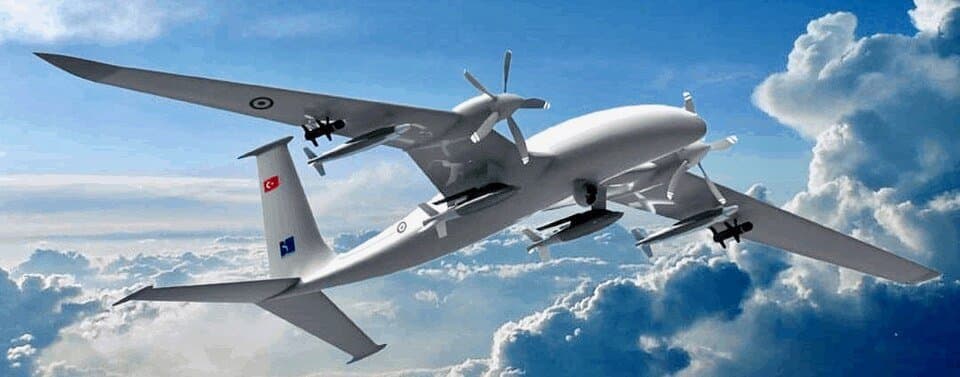
Two wing-mounted propellers and a high, cranked wing distinguish AKINCI from single-engine pusher drones. Retractable gear supports conventional runway operation.1


Preparing your view.
Drones & UAVsIn service
Multirole unmanned combat aerial vehicle
Baykar Bayraktar Akinci is a multirole unmanned combat aerial vehicle originating in Türkiye. It was built by Baykar. Reported operators include Turkish Armed Forces.

Multirole unmanned combat aerial vehicle
Turkey
Baykar
Baykar
In service
Turkish Armed Forces
110+
2019–current
29 August 2021
6 December 2019
1500 kg (3307 lb) payload
12.2 m (40 ft 0 in)
20 m (65 ft 7 in)
4.1 m (13 ft 5 in)
6,000 kg (13,228 lb)
unspecified Jet-A1 or JP-8 fuel capacity
2 × Ivchenko-Progress Motor Sich AI-450T turboprop engines for A variant, 340 kW (450 hp) each
361 km/h (224 mph, 195 kn)
280 km/h (170 mph, 150 kn)
7,500 km (4,700 mi, 4,000 nmi) Traveled 7507 Kilometers in latest test.
24+ hours
13,716 m (45,000 ft)
5-bladed composite constant-speed propeller
9,100 m (30,000 ft)
8, with provisions to carry
The aircraft has a six-ton maximum takeoff weight , of which over 1,500 kg (3,300 lb) is payload. Depending on variant, the Akıncı is equipped with two turboprop engines of either 450 hp (460 PS ; 340 kW ) or 750 hp (760 PS; 560 kW) or 850 hp (860 PS; 630 kW), as well as electronic support and ECM systems, dual satellite communication systems, air-to-air radar, collision avoidance radar, and advanced synthetic-aperture radar .
With the preliminary design phase completed in June 2019, Akıncı started engine ground run testing in August 2019 with a Ukrainian Ivchenko-Progress AI-450C turboprop engine. The first engine test was accomplished on September 1, 2019. Following the completion of other technical tests, the aircraft was moved to the Turkish Army 's Çorlu Airfield Command. The UCAV made its maiden flight with automatic taxiing , take-off, 16-minute flight and successful landing on 6 December 2019.
Akıncı has a payload capacity of 881 lb (400 kg) internal and 2,094 lb (950 kg) external and a maximum combat load of 2,976 lb (1,350 kg). Powered by two 450 hp (460 PS ; 340 kW ) or 750 hp (760 PS; 560 kW) turboprop engines, the drone has a 66 ft (20 m) wingspan . It will be the first UAV capable of launching a cruise missile .
On 22 April 2021, the Bayraktar Akıncı successfully conducted its first firing tests. During the tests, the aircraft was fitted with three different variants of the indigenously developed MAM-L smart munitions . These tests also featured the first public appearance of the ROKETSAN MAM-T smart munition. From 6-7 July, the aircraft completed a test flight of 25 hours and 45 minutes, flying 7,507 km (4,053 nmi ; 4,665 mi ) and reaching an altitude of 38,039 ft (11,594 m). On August 29, 2021, the Akıncı was added to the inventory of the Turkish armed forces.
On 10 January 2020, first prototype made its second flight and passed over 6000 ft.
On 22 August 2020, first prototype exceeded 30.000 ft (9.144 m) during flight testing.
On 7 July 2021, Bayraktar Akıncı set the new national flight altitude record of Turkey by cruising at 38,039 feet (11,594 m) for 25 hours and 46 minutes at a distance of 7,507 km
On 10 July 2021, Bayraktar Akıncı conducted a 13 hours and 24 minute long flight with 1360 kg payload. During the flight Akıncı was equipped with the NEB bunker buster bomb developed by TUBITAK SAGE. Marking the heaviest bomb ever carried by an UCAV
On 2 March 2022, the Baykar announced that the Bayraktar AKINCI-B version with twin 750 hp (560 kW) engines completed its maiden flight
On 21 May 2022, the Bayraktar AKINCI crossed 3 countries (Turkey, Georgia, Azerbaijan), flying approximately 2000 km.
On 14 June 2022, the Bayraktar AKINCI UCAV (Unmanned Combat Aerial Vehicle) has successfully completed its first firing test from 30 kilometers away with the KGK-SIHA-82 (Winged Guidance Kit) ammunition.
On 21 June 2022, the Bayraktar AKINCI B Variant took off to carry out endurance, high altitude and high speed tests, The B Variant rose to an altitude of 45,118 feet (13,752 meters) within the scope of the test, returned to Bayraktar AKINCI Flight, Training and Test Center at Çorlu Airport Command after 20 hours and 23 minutes of flight.
On 24 February 2024, Akıncı C variant successfully carried out its first flight test with two 850 HP engines.
Nine Akıncıs successfully flew over 1551 hours in the earthquake zone of the 2023 Turkey-Syria earthquake . The drones were instrumental in providing continuous updates and data to the crisis response team for damage detection, search and rescue support, and coordination activities.
In May 2024, an Akıncı assisted in finding the site of the 2024 Varzaqan helicopter crash which killed Iranian president Ebrahim Raisi and foreign minister Hossein Amir-Abdollahian . The mission reportedly lasted seven hours. Afterwards, the drone drew the star and crescent .
On 28 January 2025, a GNA Bayraktar Akıncı crashed approximately 15 kilometers west of Ajaylat in northwestern Libya. Video evidence showed smoke in the sky, suggesting the drone could have been hit by missile. The cause of its loss remains unknown.
Capacity: 1500 kg (3307 lb) payload
Length: 12.2 m (40 ft 0 in)
Wingspan: 20 m (65 ft 7 in)
Height: 4.1 m (13 ft 5 in)
Max takeoff weight: 6,000 kg (13,228 lb)
Powerplant: 2 × Ivchenko-Progress Motor Sich AI-450T turboprop engines for A variant, 340 kW (450 hp) each
Powerplant: 2 × PT6A-135A turboprop engines for B variant, 560 kW (750 hp) each
Powerplant: 2 × Pratt & Whitney Canada PT6 turboprop engines for C variant, 630 kW (850 hp) each
Maximum speed: 361 km/h (224 mph, 195 kn)
Cruise speed: 280 km/h (170 mph, 150 kn)
Range: 7,500 km (4,700 mi, 4,000 nmi) Traveled 7507 Kilometers in latest test.
Range: 7,500 km (4,700 mi, 4,000 nmi) Traveled 7507 Kilometers in latest test.
Service ceiling: 13,716 m (45,000 ft)
Operational altitude: 9,100 m (30,000 ft)
Reference text from Wikipedia contributors, used under CC BY-SA 4.0.
True scale
Sourced dimensions beside a 1.75 m human reference.
The system in detail
Two wing-mounted propellers and a high, cranked wing distinguish AKINCI from single-engine pusher drones. Retractable gear supports conventional runway operation.1
The 2026 brochure lists electro-optical, radar and signals-intelligence payload options. Weapon integrations and mission equipment require variant-specific confirmation.1
The brochure groups A, B and C versions. Its programme maxima are retained with that label, rather than being represented as independently demonstrated figures for every B aircraft.1
Compare payload and endurance under one configuration. The brochure operational-range figure is not a guaranteed command-link radius or a loaded mission radius.1
Bayraktar Akinci equipment records. Variants, orders and quantities are shown as reported in each inventory source; coverage is incomplete.
 Azerbaijan
Air Force and Air Defence exact named equipment holdings: Bayraktar Akinci. Active, operational-reserve and training units excluding equipment in store; November 2025 IISS assessment. Named service only; no parent-force or national total inferred. Source role: UNINHABITED AERIAL VEHICLES / Heavy. Original estimates, ranges, reporting names, reserve, lease and employment scopes retained; nested included counts are not added. Missile-system quantities mean launchers, not rounds. No readiness, crew, carried weapon, payload, factory-production or future order count inherited.
 Burkina Faso
Air Force exact named equipment holdings: Bayraktar Akinci. Active, operational-reserve and training units excluding equipment in store; November 2025 IISS assessment. Named service only; no parent-force or national total inferred. Source role: UNINHABITED AERIAL VEHICLES / Heavy. Original estimates, ranges, reporting names, reserve, lease and employment scopes retained; nested included counts are not added. Missile-system quantities mean launchers, not rounds. No readiness, crew, carried weapon, payload, factory-production or future order count inherited.
 Ethiopia
Air Force exact named equipment holdings: Bayraktar Akinci. Active, operational-reserve and training units excluding equipment in store; November 2025 IISS assessment. Named service only; no parent-force or national total inferred. Source role: UNINHABITED AERIAL VEHICLES / Heavy. Original estimates, ranges, reporting names, reserve, lease and employment scopes retained; nested included counts are not added. Missile-system quantities mean launchers, not rounds. No readiness, crew, carried weapon, payload, factory-production or future order count inherited.
 Indonesia
Reported count for Bayraktar Akinci. Service scope: Indonesian Air Force; does not replace a national total. 1 distinct quantity component(s) from the same source list; shared rowspan cells counted once. Explicit source inventory scope: ordered; no other stock status or total inferred. Count column(s): in service: + 9. Origin: Turkey. The listed variants/roles are the scope, not an immediately deployable count. Dates are the count-cell citations' stated source period (2025), not the article revision. Cited source 2025-02-13. Edition or publication years do not claim an exact inventory census day.
 Kyrgyzstan
Border Guards exact named equipment holdings: Bayraktar Akinci. Active, operational-reserve and training units excluding equipment in store; November 2025 IISS assessment. Named service only; no parent-force or national total inferred. Source role: UNINHABITED AERIAL VEHICLES / Heavy. Original estimates, ranges, reporting names, reserve, lease and employment scopes retained; nested included counts are not added. Missile-system quantities mean launchers, not rounds. No readiness, crew, carried weapon, payload, factory-production or future order count inherited.
 Mali
 Pakistan
Air Force exact named equipment holdings: Bayraktar Akinci. Active, operational-reserve and training units excluding equipment in store; November 2025 IISS assessment. Named service only; no parent-force or national total inferred. Source role: UNINHABITED AERIAL VEHICLES / Heavy. Original estimates, ranges, reporting names, reserve, lease and employment scopes retained; nested included counts are not added. Missile-system quantities mean launchers, not rounds. No readiness, crew, carried weapon, payload, factory-production or future order count inherited.
 Somalia
Army exact named equipment holdings: Bayraktar Akinci. Active, operational-reserve and training units excluding equipment in store; November 2025 IISS assessment. Named service only; no parent-force or national total inferred. Source role: UNINHABITED AERIAL VEHICLES / Heavy. Original estimates, ranges, reporting names, reserve, lease and employment scopes retained; nested included counts are not added. Missile-system quantities mean launchers, not rounds. No readiness, crew, carried weapon, payload, factory-production or future order count inherited.
TürkiyeArmy exact named equipment holdings: Bayraktar Akinci. Active, operational-reserve and training units excluding equipment in store; November 2025 IISS assessment. Named service only; no parent-force or national total inferred. Source role: UNINHABITED AERIAL VEHICLES / Heavy. Original estimates, ranges, reporting names, reserve, lease and employment scopes retained; nested included counts are not added. Missile-system quantities mean launchers, not rounds. No readiness, crew, carried weapon, payload, factory-production or future order count inherited.
Reported count for Bayraktar Akinci. Service scope: Indonesian Air Force; does not replace a national total. 1 distinct quantity component(s) from the same source list; shared rowspan cells counted once. Explicit source inventory scope: active; no other stock status or total inferred. Count column(s): in service: 0. Origin: Turkey. The listed variants/roles are the scope, not an immediately deployable count. The components do not establish one inventory census date; the stored date is the retrieved source snapshot.
Air Force exact named equipment holdings: Bayraktar Akinci. Active, operational-reserve and training units excluding equipment in store; November 2025 IISS assessment. Named service only; no parent-force or national total inferred. Source role: UNINHABITED AERIAL VEHICLES / Heavy. Original estimates, ranges, reporting names, reserve, lease and employment scopes retained; nested included counts are not added. Missile-system quantities mean launchers, not rounds. No readiness, crew, carried weapon, payload, factory-production or future order count inherited.
Keep exploring
Unmanned combat aerial vehicle
Unmanned combat aerial vehicle
Unmanned combat aerial vehicle
 United StatesCompare with Baykar Bayraktar Akinci
Unmanned combat aerial vehicle
 Iran
Unmanned combat aerial vehicle
IranUnmanned combat aerial vehicle
 South Africa