FORCETALLY
Loading the evidence…
Preparing your view.


Preparing your view.
Support aircraftIn service
Strategic airlifter
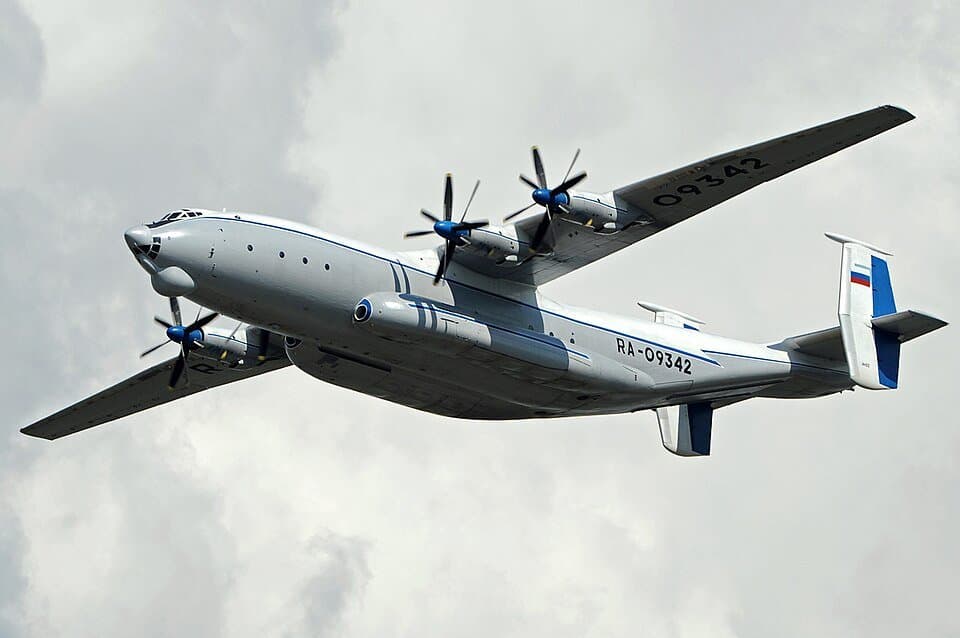
Antonov An-22 is a strategic airlifter originating in Soviet Union. It was built by Antonov. Reported operators include Russian Aerospace Forces Aeroflot Antonov Airlines.
Strategic airlifter
Soviet Union
Antonov
Retired
Russian Aerospace Forces Aeroflot Antonov Airlines
68
1966–1976
1967
27 February 1965
5–6
28–29 passengers / 80,000 kg (176,370 lb) maximum payload
57.92 m (190 ft 0 in) approximate (dependent on nose configuration)
64.4 m (211 ft 3 in)
12.53 m (41 ft 1 in)
345 m 2 (3,710 sq ft)
root: TsAGI S-5-16; tip: TsAGI S-5-13
114,000 kg (251,327 lb)
250,000 kg (551,156 lb)
43,000 kg (94,799 lb) maximum
4 × Kuznetsov NK-12MA turboprop engines, 11,000 kW (15,000 shp) each (equivalent)
8-bladed contra-rotating constant-speed reversible-pitch propeller
740 km/h (460 mph, 400 kn)
5,000 km (3,100 mi, 2,700 nmi) with maximum payload
9,100 m (29,900 ft)
724.6 kg/m 2 (148.4 lb/sq ft) max
0.1789 kW/kg (0.1088 hp/lb) max
1,300 m (4,265 ft)
800 m (2,625 ft)
Antonov worked on multiple improvements and derivatives of the An-22. One variant, which featured a modified electrical system, different navigation apparatus, and an additional augmented flight control system, was referred to by the company as the An-22A , but this designation was never used by the military. A civil airliner variant was also studied; it was to feature a lengthened fuselage and be capable of seating up to 724 passengers across its upper and lower decks, however, no such aircraft were ever built.
Amongst the traditional design features present on the An-22 was its use of a high-mounted wing, which permitted a relatively large cargo deck, possessing 33 m in length and a usable volume of 639 m 3 . This cargo deck was pressurized to a relatively low level, only 3.55 PSI / 0.245 bar, which permitted the use of a lighter airframe. A door equipped with a pressure bulkhead is located at frame 14, separating the cargo attendant's compartment from the main cargo deck; this arrangement permitted the rear cargo doors to be opened during flight for dropping paratroopers and equipment alike. To aid in the loading and unloading of cargo, a total of four cranes, which possessed a combined carrying capacity of 22,046lb (10 tonnes), were typically installed in the cargo bay.
During 1987, the An-22s were used to deliver military equipment to Angola . One year later, the fleet was used to deliver 15,000 tons and 1,000 personnel for the 1988 Armenian earthquake relief operation.
In August 2024, reports indicated that Russia had ceased operating their remaining An-22s, and that Antei RF-09309 was being flown to Yekaterinburg to be prepared for a museum display. On 9 December 2025, the last operational An-22 crashed in the Ivanovo region, north-east of Moscow; seven people on board were presumed dead; witnesses on the ground stated that the aircraft had broken up in midair.
Capacity: 28–29 passengers / 80,000 kg (176,370 lb) maximum payload
Length: 57.92 m (190 ft 0 in) approximate (dependent on nose configuration)
Wingspan: 64.4 m (211 ft 3 in)
Height: 12.53 m (41 ft 1 in)
Wing area: 345 m 2 (3,710 sq ft)
Empty weight: 114,000 kg (251,327 lb)
Max takeoff weight: 250,000 kg (551,156 lb)
Fuel capacity: 43,000 kg (94,799 lb) maximum
Powerplant: 4 × Kuznetsov NK-12MA turboprop engines, 11,000 kW (15,000 shp) each (equivalent)
Maximum speed: 740 km/h (460 mph, 400 kn)
Range: 5,000 km (3,100 mi, 2,700 nmi) with maximum payload
10,950 km (6,800 mi; 5,910 nmi) with maximum fuel and 45,000 kg (99,208 lb) payload
Service ceiling: 9,100 m (29,900 ft)
Take-off run: 1,300 m (4,265 ft)
Landing run: 800 m (2,625 ft)
Reference text from Wikipedia contributors, used under CC BY-SA 4.0.
True scale
Sourced dimensions beside a 1.75 m human reference.
See it in your room. Scan with your phone to open this model in 3D, then place it in your space.
Points represent sourced observations, including revisions. Revisions on the same effective date are not separate inventory events. Ranges appear in the table and are not plotted as exact points.
| Observation / report period | Value | Source | Claim state |
|---|---|---|---|
| 28 Sept 2026 | 5–6 people | Wikipedia contributors | approved |
Antonov An-22 equipment records. Variants, orders and quantities are shown as reported in each inventory source; coverage is incomplete.
 Russia
Aerospace Forces exact named equipment holdings: An-22 Cock. Active, operational-reserve and training units excluding equipment in store; November 2025 IISS assessment. Named service only; no parent-force or national total inferred. Source role: AIRCRAFT / Heavy. Original estimates, ranges, reporting names, reserve, lease and employment scopes retained; nested included counts are not added. Missile-system quantities mean launchers, not rounds. No readiness, crew, carried weapon, payload, factory-production or future order count inherited.
Russian Aerospace Forces Aeroflot Antonov Airlines
Equipment reference ↗Keep exploring
Strategic airlifter
 United StatesCompare with Antonov An-22
Strategic airlifter
 ChinaCompare with Antonov An-22
Strategic and tactical airlifter
United StatesCompare with Antonov An-22 Strategic and tactical airlifter
Compare with Antonov An-22Strategic/tactical airlift / Aerial refueling
Compare with Antonov An-22Tactical airlifter
United StatesCompare with Antonov An-22