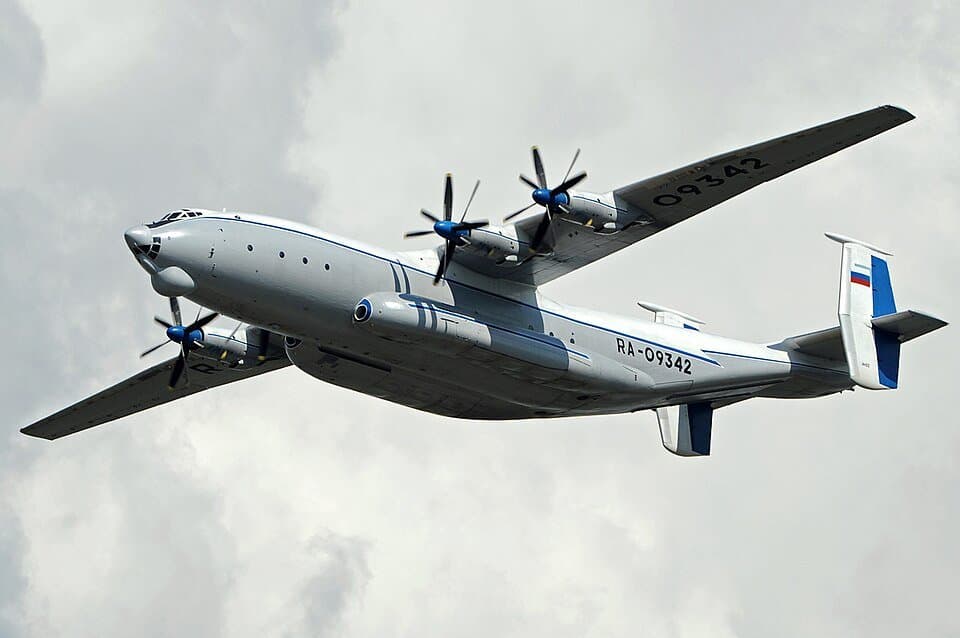
Credit
Toshi Aoki - JP Spotters · CC BY-SA 3.0 · Resized · CC BY-SA 3.0 · Source ↗ · Modified


Preparing your view.

At a glance
True scale
Side by side. From every angle. A human reference for perspective.
3.21 MB · Loads when you open it| Model | Length | Width / span | Height |
|---|---|---|---|
| Antonov An-22 | ≈ 57.92 m | ≈ 64.4 m (Width) | ≈ 12.53 m |
| Lockheed C-130 Hercules | ≈ 29.79 m | ≈ 40.41 m (Width) | ≈ 11.66 m |
Scaled uniformly to the sourced length of 57.92 m. The shape was turned square to the axes; the height was fitted to the sourced 12.53 m; the width was fitted to the sourced 64.4 m. Not an official model or a measured survey.
ForceTally · All rights reserved
Scaled uniformly to the sourced length of 29.79 m. The shape was turned square to the axes; the height was fitted to the sourced 11.66 m; the width was fitted to the sourced 40.41 m. Not an official model or a measured survey.
ForceTally · All rights reserved
The human reference is a generic 1.75 m figure. Models describe external size, not combat performance.
Measured figures
An-22 · approximate (dependent on nose configuration)
Single source57.92 m (190 ft 0 in) approximate (dependent on nose configuration)[source]
Configuration
| Specification | Antonov An-22 | Lockheed C-130 Hercules |
|---|---|---|
| Type | Strategic airlifter[source] | Tactical airlifter[source] |
| National origin | Soviet Union[source] | United States[source] |
| Manufacturer | Antonov[source] | Lockheed Corporation Lockheed Martin[source] Lockheed Corporation[source] Lockheed Martin |
C-130H · Length
Single source97 ft 9 in (29.79 m)[source]
An-22 · 4 × Kuznetsov NK-12MA turboprop engines (15,000 shp) each (equivalent)
Single source4 × Kuznetsov NK-12MA turboprop engines, 11,000 kW (15,000 shp) each (equivalent)[source]
C-130H · 4 × Allison T56 -A-15 turboprop engines, 4,590 shp ( ) each
Single source4 × Allison T56 -A-15 turboprop engines, 4,590 shp (3,420 kW) each[source]
C-130H · 1,830 ft/min (
Single source1,830 ft/min (9.3 m/s)[source]
Bars compare reported quantities only. A larger figure does not make a system better; configurations and test conditions differ.
| Status | Retired[source] | In service[source] |
|---|
| Primary users | Russian Aerospace Forces Aeroflot Antonov Airlines[source] | United States Air Force United States Navy United States Coast Guard United States Marine Corps[source] |
|---|
| Number built | 68[source] | 2,700+ (as of June 2024)[source] |
|---|
| Manufactured | 1966–1976[source] | 1954–present[source] |
|---|
| Introduction date | 1967[source] | December 1956[source] |
|---|
| First flight | 27 February 1965[source] | August 23, 1954 ( 1954-08-23 )[source] |
|---|
| Capacity | 28–29 passengers / 80,000 kg (176,370 lb) maximum payload[source] | 42,000 lb (19,000 kg) payload C-130E/H/J cargo hold: length, 40 ft (12.19 m); width, 9 ft 11 in (3.02 m); height, 9 ft (2.74 m). Rear ramp: length, 123 in (3.12 m); width, 119 in (3.02 m) C-130J-30 cargo hold: length, 55 ft (16.76 m); width, 9 ft 11 in (3.02 m); height, 9 ft (2.74 m). Rear ramp: length, 123 inches (3.12 m); width, 119 in (3.02 m) 92 passengers or 64 airborne troops or 74 litter patients with 5 medical crew or 6 pallets or 2–3 Humvees or 2 M113 armored personnel carriers 1 CAESAR self-propelled howitzer[source] |
|---|
| Airfoil | root: TsAGI S-5-16; tip: TsAGI S-5-13[source] | root: NACA 64A318 ; tip: NACA 64A412[source] |
|---|
| Fuel capacity | 43,000 kg (94,799 lb) maximum[source] | — |
|---|
| Propellers | 8-bladed contra-rotating constant-speed reversible-pitch propeller[source] | 4-bladed Hamilton Standard 54H60 constant-speed fully feathering reversible propellers, 13 ft 6 in (4.11 m) diameter[source] |
|---|
| Wing loading | 724.6 kg/m 2 (148.4 lb/sq ft) max[source] | — |
|---|
| Power/mass | 0.1789 kW/kg (0.1088 hp/lb) max[source] | — |
|---|
| Take-off run | 1,300 m (4,265 ft)[source] | — |
|---|
| Landing run | 800 m (2,625 ft)[source] | — |
|---|
| Source measurement | Antonov worked on multiple improvements and derivatives of the An-22. One variant, which featured a modified electrical system, different navigation apparatus, and an additional augmented flight control system, was referred to by the company as the An-22A , but this designation was never used by the military. A civil airliner variant was also studied; it was to feature a lengthened fuselage and be capable of seating up to 724 passengers across its upper and lower decks, however, no such aircraft were ever built.[source]Antonov An-22 · Development; only the objects and conditions stated in this passage Amongst the traditional design features present on the An-22 was its use of a high-mounted wing, which permitted a relatively large cargo deck, possessing 33 m in length and a usable volume of 639 m 3 . This cargo deck was pressurized to a relatively low level, only 3.55 PSI / 0.245 bar, which permitted the use of a lighter airframe. A door equipped with a pressure bulkhead is located at frame 14, separating the cargo attendant's compartment from the main cargo deck; this arrangement permitted the rear cargo doors to be opened during flight for dropping paratroopers and equipment alike. To aid in the loading and unloading of cargo, a total of four cranes, which possessed a combined carrying capacity of 22,046lb (10 tonnes), were typically installed in the cargo bay.[source]Antonov An-22 · Design; only the objects and conditions stated in this passage During 1987, the An-22s were used to deliver military equipment to Angola . One year later, the fleet was used to deliver 15,000 tons and 1,000 personnel for the 1988 Armenian earthquake relief operation.[source]Antonov An-22 · Operational history; only the objects and conditions stated in this passage In August 2024, reports indicated that Russia had ceased operating their remaining An-22s, and that Antei RF-09309 was being flown to Yekaterinburg to be prepared for a museum display. On 9 December 2025, the last operational An-22 crashed in the Ivanovo region, north-east of Moscow; seven people on board were presumed dead; witnesses on the ground stated that the aircraft had broken up in midair.[source]Antonov An-22 · Operational history; only the objects and conditions stated in this passage Capacity: 28–29 passengers / 80,000 kg (176,370 lb) maximum payload[source]Antonov An-22 · Specifications (An-22); only the objects and conditions stated in this passage Length: 57.92 m (190 ft 0 in) approximate (dependent on nose configuration)[source]Antonov An-22 · Specifications (An-22); only the objects and conditions stated in this passage Wingspan: 64.4 m (211 ft 3 in)[source]Antonov An-22 · Specifications (An-22); only the objects and conditions stated in this passage Height: 12.53 m (41 ft 1 in)[source]Antonov An-22 · Specifications (An-22); only the objects and conditions stated in this passage Wing area: 345 m 2 (3,710 sq ft)[source]Antonov An-22 · Specifications (An-22); only the objects and conditions stated in this passage Empty weight: 114,000 kg (251,327 lb)[source]Antonov An-22 · Specifications (An-22); only the objects and conditions stated in this passage Max takeoff weight: 250,000 kg (551,156 lb)[source]Antonov An-22 · Specifications (An-22); only the objects and conditions stated in this passage Fuel capacity: 43,000 kg (94,799 lb) maximum[source]Antonov An-22 · Specifications (An-22); only the objects and conditions stated in this passage Powerplant: 4 × Kuznetsov NK-12MA turboprop engines, 11,000 kW (15,000 shp) each (equivalent)[source]Antonov An-22 · Specifications (An-22); only the objects and conditions stated in this passage Maximum speed: 740 km/h (460 mph, 400 kn)[source]Antonov An-22 · Specifications (An-22); only the objects and conditions stated in this passage Range: 5,000 km (3,100 mi, 2,700 nmi) with maximum payload[source]Antonov An-22 · Specifications (An-22); only the objects and conditions stated in this passage 10,950 km (6,800 mi; 5,910 nmi) with maximum fuel and 45,000 kg (99,208 lb) payload[source]Antonov An-22 · Specifications (An-22); only the objects and conditions stated in this passage Service ceiling: 9,100 m (29,900 ft)[source]Antonov An-22 · Specifications (An-22); only the objects and conditions stated in this passage Take-off run: 1,300 m (4,265 ft)[source]Antonov An-22 · Specifications (An-22); only the objects and conditions stated in this passage Landing run: 800 m (2,625 ft)[source]Antonov An-22 · Specifications (An-22); only the objects and conditions stated in this passage | — |
|---|
| Variants | — | Lockheed AC-130 Lockheed DC-130 Lockheed EC-130 Lockheed EC-130H Compass Call Lockheed HC-130 Lockheed Martin KC-130 Lockheed LC-130 Lockheed MC-130 Lockheed RC-130 Lockheed WC-130 Lockheed L-100 Hercules Lockheed Martin C-130J Super Hercules[source] |
|---|
| Former operator · Afghanistan | — | Afghanistan[source] |
|---|
| Former operator · Angola | — | Angola[source] |
|---|
| Former operator · Belgium | — | Belgium[source] |
|---|
| Former operator · Brazil | — | Brazil[source] |
|---|
| Former operator · Honduras | — | Honduras[source] |
|---|
| Former operator · Rhodesia | — | Rhodesia[source] |
|---|
| Former operator · South Vietnam | — | South Vietnam[source] |
|---|
| Former operator · Spain | — | Spain[source] |
|---|
| Takeoff distance | — | 3,586 ft (1,093 m) at 155,000 lb (70,307 kg) max gross weight;[source] |
|---|
| Alternative designation | — | C-130 Hercules[source] |
|---|