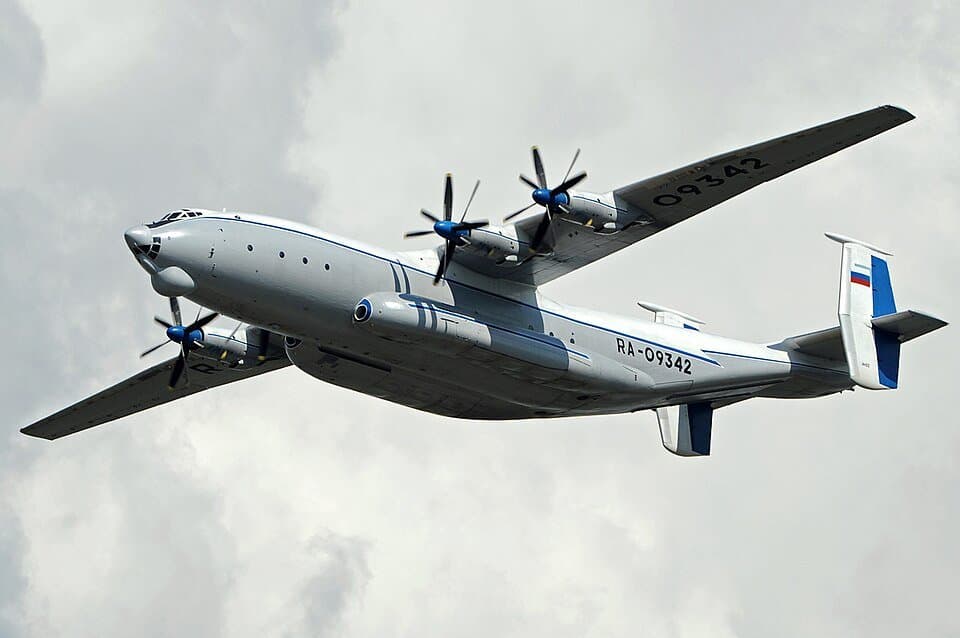
Credit
Toshi Aoki - JP Spotters · CC BY-SA 3.0 · Resized · CC BY-SA 3.0 · Source ↗ · Modified


Preparing your view.

At a glance
Measured figures
An-22 · approximate (dependent on nose configuration)
Single source57.92 m (190 ft 0 in) approximate (dependent on nose configuration)[source]
Configuration
| Specification | Antonov An-22 | Boeing C-17 Globemaster III |
|---|---|---|
| Type | Strategic airlifter[source] | Strategic and tactical airlifter[source] |
| National origin | Soviet Union[source] | United States[source] |
| Manufacturer | Antonov[source] | McDonnell Douglas / Boeing[source] |
| Status | Retired[source] |
C-17A · Length
Single source174 ft (53 m)[source]
An-22 · with maximum payload
Single source5,000 km (3,100 mi, 2,700 nmi) with maximum payload[source]
An-22 · 4 × Kuznetsov NK-12MA turboprop engines (15,000 shp) each (equivalent)
Single source4 × Kuznetsov NK-12MA turboprop engines, 11,000 kW (15,000 shp) each (equivalent)[source]
C-17A · 4 × Pratt & Whitney PW2000 turbofan engines thrust each (U.S. military designation: F117-PW-100)
Single source4 × Pratt & Whitney PW2000 turbofan engines, 40,440 lbf (179.9 kN) thrust each (U.S. military designation: F117-PW-100)[source]
Bars compare reported quantities only. A larger figure does not make a system better; configurations and test conditions differ.
In service[source] |
| Primary users | Russian Aerospace Forces Aeroflot Antonov Airlines[source] | United States Air Force Indian Air Force Royal Air Force Royal Australian Air Force[source] |
|---|
| Number built | 68[source] | 279[source] |
|---|
| Manufactured | 1966–1976[source] | 1991–2015[source] |
|---|
| Introduction date | 1967[source] | 17 January 1995[source] |
|---|
| First flight | 27 February 1965[source] | 15 September 1991[source] |
|---|
| Capacity | 28–29 passengers / 80,000 kg (176,370 lb) maximum payload[source] | 170,900 lb (77,519 kg) of cargo distributed at max over 18 463L master pallets or a mix of palletized cargo and vehicles 102 paratroopers or 134 troops with palletized and sidewall seats or 54 troops with sidewall seats (allows 13 cargo pallets) only or 36 litter and 54 ambulatory patients and medical attendants or Cargo, such as one M1 Abrams tank, two Bradley armored vehicles, or three Stryker armored vehicles[source] |
|---|
| Airfoil | root: TsAGI S-5-16; tip: TsAGI S-5-13[source] | root: DLBA 142; tip: DLBA 147[source] |
|---|
| Fuel capacity | 43,000 kg (94,799 lb) maximum[source] | 35,546 US gal (29,598 imp gal; 134,560 L)[source] |
|---|
| Propellers | 8-bladed contra-rotating constant-speed reversible-pitch propeller[source] | — |
|---|
| Wing loading | 724.6 kg/m 2 (148.4 lb/sq ft) max[source] | 150 lb/sq ft (730 kg/m 2 )[source] |
|---|
| Power/mass | 0.1789 kW/kg (0.1088 hp/lb) max[source] | — |
|---|
| Take-off run | 1,300 m (4,265 ft)[source] | — |
|---|
| Landing run | 800 m (2,625 ft)[source] | — |
|---|
| Source measurement | Antonov worked on multiple improvements and derivatives of the An-22. One variant, which featured a modified electrical system, different navigation apparatus, and an additional augmented flight control system, was referred to by the company as the An-22A , but this designation was never used by the military. A civil airliner variant was also studied; it was to feature a lengthened fuselage and be capable of seating up to 724 passengers across its upper and lower decks, however, no such aircraft were ever built.[source]Antonov An-22 · Development; only the objects and conditions stated in this passage Amongst the traditional design features present on the An-22 was its use of a high-mounted wing, which permitted a relatively large cargo deck, possessing 33 m in length and a usable volume of 639 m 3 . This cargo deck was pressurized to a relatively low level, only 3.55 PSI / 0.245 bar, which permitted the use of a lighter airframe. A door equipped with a pressure bulkhead is located at frame 14, separating the cargo attendant's compartment from the main cargo deck; this arrangement permitted the rear cargo doors to be opened during flight for dropping paratroopers and equipment alike. To aid in the loading and unloading of cargo, a total of four cranes, which possessed a combined carrying capacity of 22,046lb (10 tonnes), were typically installed in the cargo bay.[source]Antonov An-22 · Design; only the objects and conditions stated in this passage During 1987, the An-22s were used to deliver military equipment to Angola . One year later, the fleet was used to deliver 15,000 tons and 1,000 personnel for the 1988 Armenian earthquake relief operation.[source]Antonov An-22 · Operational history; only the objects and conditions stated in this passage In August 2024, reports indicated that Russia had ceased operating their remaining An-22s, and that Antei RF-09309 was being flown to Yekaterinburg to be prepared for a museum display. On 9 December 2025, the last operational An-22 crashed in the Ivanovo region, north-east of Moscow; seven people on board were presumed dead; witnesses on the ground stated that the aircraft had broken up in midair.[source]Antonov An-22 · Operational history; only the objects and conditions stated in this passage Capacity: 28–29 passengers / 80,000 kg (176,370 lb) maximum payload[source]Antonov An-22 · Specifications (An-22); only the objects and conditions stated in this passage Length: 57.92 m (190 ft 0 in) approximate (dependent on nose configuration)[source]Antonov An-22 · Specifications (An-22); only the objects and conditions stated in this passage Wingspan: 64.4 m (211 ft 3 in)[source]Antonov An-22 · Specifications (An-22); only the objects and conditions stated in this passage Height: 12.53 m (41 ft 1 in)[source]Antonov An-22 · Specifications (An-22); only the objects and conditions stated in this passage Wing area: 345 m 2 (3,710 sq ft)[source]Antonov An-22 · Specifications (An-22); only the objects and conditions stated in this passage Empty weight: 114,000 kg (251,327 lb)[source]Antonov An-22 · Specifications (An-22); only the objects and conditions stated in this passage Max takeoff weight: 250,000 kg (551,156 lb)[source]Antonov An-22 · Specifications (An-22); only the objects and conditions stated in this passage Fuel capacity: 43,000 kg (94,799 lb) maximum[source]Antonov An-22 · Specifications (An-22); only the objects and conditions stated in this passage Powerplant: 4 × Kuznetsov NK-12MA turboprop engines, 11,000 kW (15,000 shp) each (equivalent)[source]Antonov An-22 · Specifications (An-22); only the objects and conditions stated in this passage Maximum speed: 740 km/h (460 mph, 400 kn)[source]Antonov An-22 · Specifications (An-22); only the objects and conditions stated in this passage Range: 5,000 km (3,100 mi, 2,700 nmi) with maximum payload[source]Antonov An-22 · Specifications (An-22); only the objects and conditions stated in this passage 10,950 km (6,800 mi; 5,910 nmi) with maximum fuel and 45,000 kg (99,208 lb) payload[source]Antonov An-22 · Specifications (An-22); only the objects and conditions stated in this passage Service ceiling: 9,100 m (29,900 ft)[source]Antonov An-22 · Specifications (An-22); only the objects and conditions stated in this passage Take-off run: 1,300 m (4,265 ft)[source]Antonov An-22 · Specifications (An-22); only the objects and conditions stated in this passage Landing run: 800 m (2,625 ft)[source]Antonov An-22 · Specifications (An-22); only the objects and conditions stated in this passage | — |
|---|
| Developed from | — | McDonnell Douglas YC-15[source] |
|---|
| Aspect ratio | — | 7.165[source] |
|---|
| Thrust/weight | — | 0.277 (minimum)[source] |
|---|
| Takeoff run | — | at MTOW: 8,200 ft (2,499 m)[source] |
|---|
| Landing distance | — | 3,500 ft (1,067 m)[source] |
|---|