FORCETALLY
Loading the evidence…
Preparing your view.


Preparing your view.
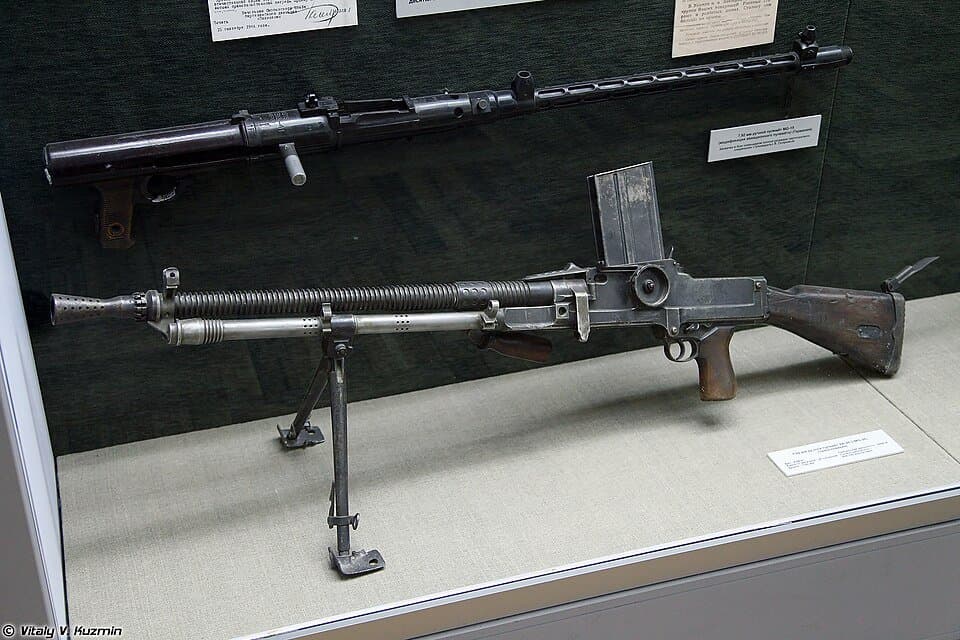
Small armsIn service
Light machine gun
ZB vz. 26 is a light machine gun originating in Czechoslovakia. It was built by Zbrojovka Brno Zastava Arms (License) Gongxian Arsenal (License). Reported operators include Algeria, Biafra, Bolivia, Brazil, Chile, China, Czechoslovakia, Indonesia, Imperial State of Iran, Latvia, Lithuania, Manchukuo, Namibia, North Korea, Paraguay, Romania, Siam, Slovak Republic, Spain, Sweden, Türkiye, United Kingdom, North Vietnam.
Light machine gun
Czechoslovakia
1926–2001
See § Users
See § Conflicts
Václav Holek
1924
Zbrojovka Brno Zastava Arms (License) Gongxian Arsenal (License)
1924–1953
See § Variants
9.65 kg (21.27 lb)
1,161 mm (45.7 in)
672 mm (26.5 in)
7.92×57mm Mauser
Gas-operated , tilting breechblock
500 rounds/min
764 m/s (2,507 ft/s)
1,000 m (1,100 yd)
20- or 30-round detachable box magazine
Front blade, rear leaf sight
Afghanistan — 2,000 Czech-made ZB-30 (chambered in 7.92mm Mauser ) shipped in 1938.
Algeria — ZB-30 used by the National Liberation Army .
Biafra
Bolivia — 3,350 Czech-made ZB-30 (chambered in 7.65mm Mauser ) between 1932 and 1937, used in the Chaco War , still in use in the 1960s
Brazil — 1,080 in 7mm Mauser received in 1930 for the Polícia Militar de Minas Gerais (Military Police of the state of Minas Gerais). Adopted by the São Paulo Public Force
Bulgaria — Ordered 3,000 Czech-made ZB-39 "Bren" guns in the end of 1938, designated as the kartěnice 39 (chambered in 8×56mmR using 25-round box magazine ). 100 delivered before German occupation of Czechoslovakia . The rest were delivered after Germany allowing continued weapon sales.
Chile — 11 in 7mm received in 1928
China
China (ROC) — 30,249 received between 1927 and 1939. Produced under license. Clones made in Taku Naval Dockyard in 1927, later produced in Gongxian Arsenal, the 21st/51st Arsenals.
Croatia
Czechoslovakia — Adopted by the Czechoslovak Army as the LK vz. 26 .
Ecuador — 200 supplied in 1930-1932
Egypt — 1,060 7.7mm ZGB-33 bought in 1937-1939
Ethiopia — Used against the Italians
Germany
Indonesia — Free Aceh Movement
Imperial State of Iran — ZB vz. 30 produced under license 6,000 ZB-26 received in 1934
Iraq — 850 7.7mm ZGB-33 received in 1936-1937
Japan — Used captured Chinese guns 2,200 others were received in 1938-1939
Latvia — 600 7.7mm ZGB-33 ordered in 1940
Lithuania — 3,138 VZ 26 machine guns between 1928 and 1937 (7,92 mm kulkosvaidis Brno 26 m.)
Manchukuo
Namibia — Used by the People's Liberation Army of Namibia .
North Korea
Paraguay — Captured from Bolivian Army during Chaco War, some still in use for training.
Peru
Romania — 17,131 Czech-made ZB-30 were imported in 1933. 10,000 ZB-30 were license-produced at Cugir , with a production rate of 250 pieces per month as of October 1942.
Siam — Bought some in the early 1930s
Slovak Republic
Spain
Sweden — Used as the Kulsprutegevär m/39
Turkey
United Kingdom — 85 Czech-made ZGB-33 "Bren" in 7.7mm bought from 1935 to 1938
North Vietnam
Yugoslavia — 1,500 Czech-made ZB-26 delivered Yugoslav Partisans
Yugoslav Partisans
The ZB-26 was a Czechoslovak light machine gun developed in the 1920s, which went on to enter service with several countries.
The ZB-26 saw service with the Czechoslovak infantry from 1928, as well as being the primary or secondary armament on many later model Škoda armored vehicles. 45,132 were bought by Czechoslovakia during the interwar. It is believed that the ZB factory turned more than 120,000 ZB-26 guns between 1926 and 1939 in a variety of calibers (the most popular being its original 7.92×57mm Mauser). It was exported to twenty-four European, South American and Asian countries, both in its original form and in the slightly improved ZB-30 version. Large batches of ZB light machine guns went to Bolivia, Bulgaria, China, Romania, Turkey and Yugoslavia. Lithuania and Yugoslavia were the first users to adopt the gun, before the Czechoslovak Army. Exports continued until 1939, when Nazi Germany under Adolf Hitler took over Czechoslovakia. More were produced for export than for the Czechoslovak Army 7,136 ZB-26 were produced in Czechoslovakia after the war, from 1945 to 1953.
In the opening phases of World War II, the ZB-26 in 7.92 mm Mauser caliber was used in large numbers by elements of the German Waffen-SS , who at first did not have full access to standard Wehrmacht supply channels.
Chinese Nationalist forces used the ZB-26 chambered for the 7.92×57mm Mauser round in their struggle with Communist Chinese and later Imperial Japanese forces.
ZB-30J — Variant of the ZB-30 developed for export to Yugoslavia , features an adjustable gas system for compatibility with both light and heavy ball 7.92mm Mauser ammunition. Also produced in 7mm Mauser for Venezuela.
Type 97 — A Japanese license built copy of the ZB-26 (chambered in 7.7×58mm Arisaka ) and intended for use in Japanese tanks. It was not normally issued as an infantry light machine gun. Other than the cocking handle being moved from the right side of the receiver to the left it is essentially a duplicate of the Czech gun in operation.
ZB vz. 26 7.92×57mm Light machine gun Czechoslovakia Upgraded by IMBEL ( Brazil )
Reference text from Wikipedia contributors, used under CC BY-SA 4.0.
True scale
Sourced dimensions beside a 1.75 m human reference.
See it in your room. Scan with your phone to open this model in 3D, then place it in your space.
ZB vz. 26 equipment records. Variants, orders and quantities are shown as reported in each inventory source; coverage is incomplete.
 Algeria
 Bolivia
 Brazil
 Chile
 China
 Indonesia
 Latvia
 Lithuania
 Namibia
 North Korea
 Paraguay
 Romania
 Slovakia
 Spain
 Sweden
 Türkiye
 United Kingdom
Algeria, Biafra, Bolivia, Brazil, Chile, China, Czechoslovakia, Indonesia, Imperial State of Iran, Latvia, Lithuania, Manchukuo, Namibia, North Korea, Paraguay, Romania, Siam, Slovak Republic, Spain, Sweden, Türkiye, United Kingdom, North Vietnam
Equipment reference ↗Keep exploring
 South Korea
 France
 Belgium