FORCETALLY
Loading the evidence…
Preparing your view.


Preparing your view.
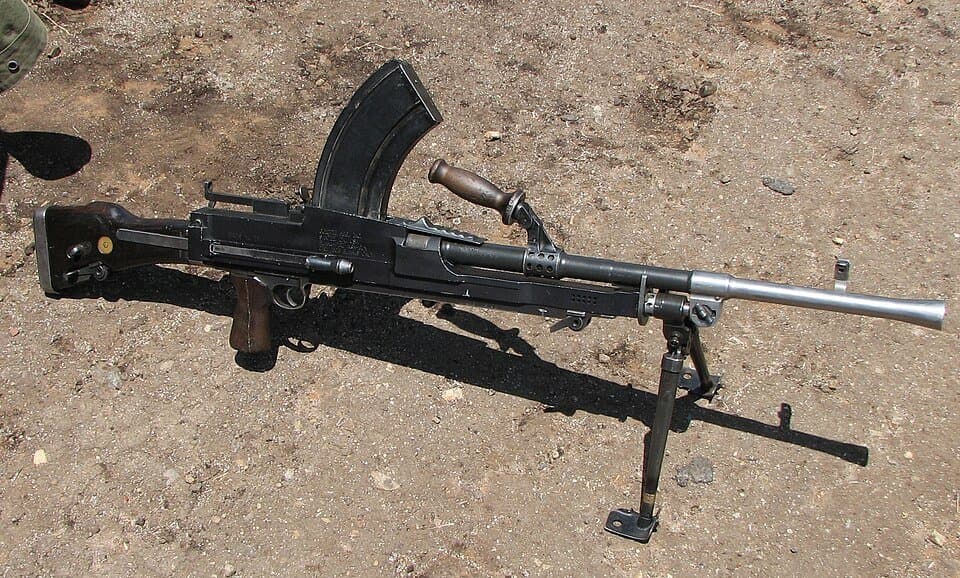
Small armsIn service
Light machine gun
Bren light machine gun is a light machine gun originating in First Czechoslovak Republic (design) United Kingdom (manufacture). It was built by Royal Small Arms Factory John Inglis and Company Lithgow Small Arms Factory Rifle Factory Ishapore. Reported operators include Algeria, Australia, Bangladesh, Barbados, Belize, Belgium, Biafra, Botswana, Chadian, Central African Republic, Croatia, People's Republic of China, Democratic Republic of Congo, Cyprus, Denmark, France, Vichy France, Gambia, Ghana, Greece, Grenada, Guyana, India, Indonesia, Ireland, Israel, Italy, Jamaica, Jordan, Kenya, North Korea, Lesotho, Libya, Malaysia, Myanmar, Mauritius, Nepal, Netherlands, New Zealand, Nigeria, Norway, Pakistan, Papua New Guinea, Poland, Portugal, Provisional IRA, Seychelles, Sierra Leone, Somali Republic, Sri Lanka, Suriname, Swaziland, Tibet, Tonga, Trinidad and Tobago, Uganda, United Kingdom, State of Vietnam, Vietnam, Soviet Union.
Bren light machine gun
Robert DuHamel ( Rsduhamel ) · CC BY-SA 3.0 · Resized · CC BY-SA 3.0 · Source ↗ · ModifiedTechnical data
Light machine gun
First Czechoslovak Republic (design) United Kingdom (manufacture)
1938–2012
See § Users
See § Service
Václav Holek
1935
Royal Small Arms Factory John Inglis and Company Lithgow Small Arms Factory Rifle Factory Ishapore
£40
1935–1971
500,000
See § Variants
Mk1 & Mk2 : 22.8 lb (10.3 kg), 25 lb (11.3 kg) loaded Mk3 & Mk4 : 19.15 lb (8.7 kg), 21.6 lb (9.8 kg) loaded
Mk1 & Mk2: 45.5 in (1,160 mm) Mk3 & Mk4: 42.9 in (1,090 mm)
True scale
Sourced dimensions beside a 1.75 m human reference.
See it in your room. Scan with your phone to open this model in 3D, then place it in your space.
Points represent sourced observations, including revisions. Revisions on the same effective date are not separate inventory events. Ranges appear in the table and are not plotted as exact points.
| Observation / report period | Value | Source | Claim state |
|---|---|---|---|
| 1 Oct 2026 | 0.635 m | Wikipedia contributors | superseded |
| 2 Oct 2026 | 0.635 m | Wikipedia contributors | approved |
25 in (635 mm)
2, gunner and assistant
.303 British 7.92×57mm Mauser .30-06 Springfield 7.62×51mm NATO 7.62×39mm
Gas-operated , tilting bolt
500–520 rounds/min practical 120 rounds/min sustained
2,440 ft/s (743.7 m/s)
600 yd (550 m)
1,850 yd (1,690 m)
30-round detachable box magazine 100-round detachable pan magazine (.303 variants only) 20-round L1A1 SLR magazine (7.62 mm variants only)
Iron
Algeria : National Liberation Army received 500 Brens from Egypt
Australia : during World War II and Korean War. Indonesia–Malaysia confrontation (as L4A4). Continued in limited service until about the time of the general introduction of the F88 Steyr (circa 1990).
Bangladesh
Barbados
Belize
Belgium : post-war
Biafra
Botswana
Canada
Chadian FROLINAT
Central African Republic : used by Gendarmerie and Republican Guard
Croatia : Mark 2 version known to be used in the Croatian War of Independence .
People's Republic of China : Many guns captured from Kuomintang . Used during Korean War . Some converted to fire 7.62x39 caliber ammunition from ammo supplied by their Soviet allies. They used regular AK-47 magazines.
Republic of China : used by National Revolutionary Army 43,000 guns produced in 7.92×57mm Mauser by Inglis in Canada. Later in 1952, Taiwan produced a .30-06 Springfield version of Bren Mk II, the Type 41 .
Democratic Republic of Congo
Cyprus
Denmark : post-war
Egypt
France Free France : Used by the Free French Forces and French Resistance . Vichy France : Captured Brens were issued to the Milice . French Far East Expeditionary Corps
Free France : Used by the Free French Forces and French Resistance .
Vichy France : Captured Brens were issued to the Milice .
Gambia
Ghana
Greece
Grenada : People's Revolutionary Armed Forces
Guyana
Hong Kong : Used by the Royal Hong Kong Regiment .
India : manufactured by the Ordnance Factories Board Phased out of Indian military service in 2012.
Indonesia Used by Republican Forces During Indonesian National Revolution :
Iraq
Ireland : Irish Defence Forces , replaced by the FN MAG in 1960s. Remained in use with Irish military reserve forces until the early 2000s.
Israel : During the 1948 Arab–Israeli War and for some time thereafter by the Haganah and the Israel Defense Forces . Replaced after Operation Kadesh (1956).
Italy : airdropped to partisans and also issued to the Italian Co-Belligerent Army in the latter part of WWII. It continued to see post-war use with the Italian Army. In 1950 rechambered in .30-06 caliber by Breda for the Army, also used by the Italian Police in the same caliber.
Jamaica
Empire of Japan : captured weapons.
Jordan : Arab Legion
Kenya
North Korea
Lesotho
Libya
Malaysia
Myanmar
Mauritius
Nazi Germany : used captured examples under the designation 7.7 mm Leichtes MG 138(e)
Nepal : Bren L4
Netherlands : Used in post-war
New Zealand : WWII and L4 post war
Nigeria
Norway : post-war
Pakistan
Papua New Guinea
Poland : Used by the Polish Underground State and Polish Armed Forces in the West during World War II.
Portugal : m/43
Provisional IRA
Rhodesia
Seychelles
Sierra Leone
Somali Republic
South Africa
Sri Lanka : Used by Ceylon Defence Force in World War II
Suriname
Swaziland (now Eswatini )
Tibet : 294 guns were purchased by the Tibetan Army in 1950.
Tonga
Trinidad and Tobago
Uganda
United Kingdom : British and Commonwealth forces, and cadet forces until the introduction of the L98 Cadet Rifle
State of Vietnam
Vietnam : used by Viet-Minh acquired from China and the Soviet Union or by capture
Soviet Union : Supplied by the United Kingdom during the Lend-Lease program.
Yugoslavia : Yugoslav Partisans and Chetniks during World War II;
The Bren gun (Brno-Enfield) was a series of light machine guns (LMG) made by the United Kingdom in the 1930s and used in various roles until 1992.
In the 1950s, many Bren guns were re-barrelled to accept the 7.62×51mm NATO cartridge and modified to feed from the magazine for the L1 (Commonwealth version of the FN FAL ) rifle as the L4 light machine gun. It was replaced in the British Army as the section LMG by the L7 general-purpose machine gun (GPMG), a belt-fed weapon. This was supplemented in the 1980s by the L86 Light Support Weapon firing the 5.56×45mm NATO round, leaving the Bren gun in use only as a pintle mount on some vehicles. The Bren gun was manufactured by Indian Ordnance Factories as the "Gun Machine 7.62mm 1B" before it was discontinued in 2012.
A modified variant with a shortened gas tube was tested again in June 1932, and then newly developed ZB-30 in .303 yet again tested in November. Receiving more feedback and incorporating it into the design by January 1933, yet two other modifications were tested by British representatives in Brno in July. One of the variants was selected, designated ZGB 33 (for Zbrojovka, Great Britain, 1933), and 10 samples were sent to England in autumn 1933. After additional trials in early 1934, more samples were ordered during the summer of 1934, and on May 24, 1935, the licence for British manufacture was finally acquired, and the design was adopted under the Bren name.
The major changes were in the magazine and barrel and the lower pistol grip assembly which went from a swivelling grip frame pivoted on the front of the trigger guard to a sliding grip frame which included the forward tripod mount and sliding ejection port cover. The magazine was curved in order to feed the rimmed .303 inch SAA ("Small Arms Ammunition") cartridge, a change from the various rimless Mauser -design cartridges such as the 7.9-mm Mauser round previously used by Czech designs. These modifications were categorised in various numbered designations, ZB vz. 27, ZB vz. 30, ZB vz. 32, and finally the ZGB 33, which was licensed for manufacture under the Bren name.
The Bren was a gas-operated weapon using the same .303 ammunition as the standard British bolt-action rifle , the Lee–Enfield , firing at a rate between 480 and 540 rounds per minute (rpm), depending on the model. Propellant gases vented from a port towards the muzzle end of the barrel through a regulator (visible just in front of the bipod) with four quick-adjustment apertures of different sizes, intended to tailor the gas volume to different ambient temperatures (smallest flow at high temperature, e.g. summer desert, largest at low temperature, e.g. winter Arctic). The vented gas drove a piston which in turn actuated the breech block. Each gun came with a spare barrel that could be quickly changed when the barrel became hot during sustained fire, though later guns featured a chrome -lined barrel, which reduced the need for a spare. To change barrels, the release catch in front of the magazine was rotated to unlock the barrel. The carrying handle above the barrel was used to grip and remove the hot barrel without burning the hands.
The Bren was operated by a two-man crew, sometimes commanded by a Lance Corporal as an infantry section's "gun group", the remainder of the section forming the "rifle group". The gunner or "Number 1" carried and fired the Bren, and a loader or "Number 2" carried extra magazines, a spare barrel and a tool kit. Number 2 helped reload the gun and replace the barrel when it overheated, and spotted targets for Number 1. For a light machine gun of the interwar and early World War II era, the Bren was about average in weight. On long marches in non-operational areas it was often partially disassembled and its parts were carried by two soldiers. The top-mounted magazine vibrated and moved during fire, making the weapon more visible in combat, and many Bren gunners used paint or improvised canvas covers to disguise the prominent magazine.
A tripod mount with 42 degrees of traverse was available to allow the Bren to be used on "fixed lines" of fire for defensive shooting at pre-determined areas in the dark or if obscured by fog or smoke.
Each British soldier's equipment normally included two magazines for his section's Bren gun. The large ammunition pouches on the 1937 pattern web equipment were designed around the Bren magazine. The Bren was regarded as the principal weapon of an infantry section, providing the majority of its firepower. As such, all ranks were expected to be "experts in its use". The Bren had an effective range of around 600 yards (550 m) when fired from a prone position with a bipod . It could deliver a beaten ground of 115 yd (105 m) by 12 m (39 ft) at 1,000 yd (910 m) on the bipod. A 'rapid' fire rate of 120 rounds per minute (four magazines a minute) was sustainable with a barrel change after ten magazines (or reduction in fire rate) to limit wear but doctrine was to fire in 4-5 round bursts. Soldiers were instructed to fire single-shot in imitation of rifle fire to conceal the presence of an automatic weapon.
The barrel needed to be unlocked and slid forward slightly to allow the regulator to be turned. It was even said that all problems with the Bren could simply be cleared by hitting the gun, turning the regulator or doing both. It was "by general consent the finest light machine gun in the world of its period, and the most useful weapon provided to the (French) "maquis" ... accurate up to 1,000 meters, and (it) could withstand immense maltreatment and unskilled use. "Resistants" were constantly pleading for maximum drops of Brens".
The Bren's direct ancestor, the Czechoslovak ZB vz. 26, was also used in World War II by German and Romanian forces, including units of the Waffen SS . Many 7.92 mm ZB light machine guns were shipped to China, where they were employed first against the Japanese in World War II, and later against UN forces in Korea, including British and Commonwealth units.
Some ex-Chinese Czech ZB weapons were also in use in the early stages of the Vietnam War . Production of a 7.92 mm round model for the Far East was carried out by Inglis of Canada. The Bren was also delivered to the Soviet Union as part of the lend-lease program.
When the British Army adopted the 7.62 mm NATO cartridge, the Bren was re-designed to 7.62 mm calibre, fitted with a new bolt, barrel and magazine. It was re-designated as the "L4 light machine gun" (in various sub-versions) and remained in British Army service into the 1990s. A slotted flash hider similar to that of the contemporary L1 rifle and L7 general purpose machine gun replaced the conical flash hider. The change from a rimmed to rimless cartridge and nearly straight magazine improved feeding considerably, and allowed use of 20-round magazines from the 7.62 mm L1A1 Self-Loading Rifle . Bren gunners using the L4A1 were normally issued with the 30-round magazine from the SAW L2A1.
Completion of the move to a 5.56 mm NATO cartridge led to the Army removing the Bren/L4 from the list of approved weapons and then withdrawing it from service.
The Mark III Bren remained in limited use with the Army Reserve of the Irish Defence Forces until 2006, when the 7.62 mm GPMG replaced it. The Bren was popular with the soldiers who fired it (known as Brenners) as it was light and durable, and had a reputation for accuracy. The most notable use of the Bren by Irish forces was in the Congo Crisis during the 1960s, when the Bren was the regular army's standard section automatic weapon.
Bren guns were in service with the Rhodesian Security Forces during the Rhodesian Bush War , including a substantial number re-chambered for 7.62 mm cartridges similar to those examples in the British Army. The Rhodesian Bren guns continued to see frequent action until the 1970s, when they were largely replaced by the FN MAG . A few were captured and re-issued by the Zimbabwe People's Revolutionary Army (ZIPRA). Some examples were still in service with reservists of the British South Africa Police in 1980, and were inherited by the Zimbabwe Republic Police upon the country's internationally recognised independence. Zimbabwean policemen continued to deploy Bren guns during operations against ZIPRA dissidents throughout the early 1980s.
While the Bren Mk III design also aimed at reducing cost, it also had the concurrent goal of being lightened for jungle warfare; the final product weighed 19 lb 5 oz (8.8 kg), 3 pounds lighter than the original Bren Mk I design; it was standardised in July 1944 and saw a production of 57,600.
Also standardised in July 1944 was the Bren Mk IV, which was further lightened to 19 lb 2 oz (8.7 kg); however, it did not enter production until July 1945, and only 250 were built before the end of the war. While Enfield was able to produce only 400 Bren Mk I guns each month, with the various simplification efforts production numbers rose to 1,000 guns per week by 1943. Later designs of production Bren guns featured chrome-lined barrels that offered less resistance, preventing overheating and reducing the need for quick changes of barrels.
Introduced September 1937; the original Czechoslovak designed ZGB 33. Overall length 45.5 inches (1.16 m), 25 inches (0.64 m) barrel length. Weight 22 lb 2 oz (10.0 kg).
An Enfield-made .303 Bren Mk 1 was converted to 7.92mm in 1938 due to the suggestion of a possibility of a British Army change over to a rimless cartridge for machine guns being mooted.
Introduced 1941. A simplified version of the Mk1 more suited to wartime production with original design features subsequently found to be unnecessary deleted. Produced by Inglis of Canada and the Monotype Group through a number of component manufacturing factories. Sometimes known as the "Garage hands" model. Overall length 45.5 inches (1.16 m), 25 inches (0.64 m) barrel length. Weight 23 lb 3 oz (10.5 kg).
The Inglis version of the Bren Mk 2 chambered for the .30-06 (7.62 mm) cartridge and known as the M41 was also manufactured in Taiwan after the end of the Chinese Civil War .
A shorter and lighter Bren made by Enfield from 1944 for the war in the East and for Airborne Forces. This was similar to the Mk2 but with the lightweight features of the early Mk1, with the main distinguishing feature being a shorter barrel and serrated area in front of the barrel nut. Overall length 42.9 in (1.09 m), 22.25 in (0.565 m) barrel length. Weight 19 lb 5 oz (8.8 kg).
As with the Mk3 but this was a conversion of a Mk2. Overall length 42.9 in (1.09 m), 22.25 in (0.565 m) barrel length. Weight 19 lb 2 oz (8.7 kg).
Intended for use alongside the intermediate cartridge EM-2 rifle (briefly in service as the "Rifle, No.9, Mk.1" ) , a number of Bren guns (mostly Inglis-produced Mk 2s with 7.92mm Mauser breech blocks) were converted to fire the rimless .280 British ammunition. They could use either the twenty-round magazine from the EM-2 or a new thirty-round magazine. Both these conversions and the accompanying EM-2 fell through after US-driven standardization within NATO on the larger 7.62×51mm NATO round.
After the adoption of the 7.62mm NATO round and the L1A1 SLR variant of the FN FAL Britain briefly considered adopting an automatic rifle version of the FAL. Testing of this "X8" version was seen to prove that the same task could be done more efficiently (and at a lower cost) by converting Brens to 7.62mm NATO instead. After some initial test conversions, what would become known as the L4 series began being fielded from 1955 onwards. L4 Brens can easily be identified by their straighter (but still slightly curved) magazine and the replacement of the original flash hider with a slotted, cylindrical model (similar to that used on the L1A1 and the L7 GPMG), with some weapons additionally having red flashes on the receiver and the barrel to denote the calibre change. The thirty-round L4 magazine was interchangeable with the L1A1 SLR's twenty-round magazine, and the L4 could also take the thirty-round magazine from the Australian L2A1 and Canadian C2A1 automatic rifle versions of the SLR. The L4 remained in British service until the 1990s.
The Taden gun was a post-war development of the Bren to use with the .280 British (7 mm) intermediate round proposed to replace the .303 in British service. The Taden was belt-fed with either spade grips for MMG use or a buttstock and pistol grip for LMG use and would have replaced both the Bren and the Vickers machine gun. Although reliable it was not accepted due to the US-driven standardization within NATO on the larger 7.62×51mm NATO round.
Bren guns were produced at the Royal Small Arms Factory , in Enfield, London . The first Bren guns were built in September 1937, and by December, a total of 42 had been produced. Weekly production was 300 Brens a week in July 1938, and 400 a week in September 1939. The Monotype Group produced Mark 2 Brens. Enfield produced a total of 220,000 Mark I Bren guns, 57,600 in Mark III, and 250 in Mark IV.
John Inglis and Company received a contract from the British and Canadian governments in March 1938 to supply 5,000 Bren machine guns to the UK and 7,000 Bren machine guns to Canada. Both countries shared the capital costs of bringing in this new production facility. Production started in 1940; by August 1942, the Inglis plant was averaging 10,000 Brens per month, and produced 186,000 Bren guns of all variants by the end of the war, including 43,000 chambered in 7.92×57mm Mauser for export to the Chinese National Revolutionary Army .
In 1942, the Ishapore Arsenal began to produce Bren guns, and continued to do so long after the end of World War II, also manufacturing variants in 7.62×51mm NATO . A shadow factory for Ishapore was set up at Kanpur and produced .303 Brens before it was later rechambered to fire 7.62 NATO ammo in 1964 as the 1A LMG. Many of the Bren guns produced at Ishapore went to Indian troops, who had lost a great number of automatic weapons during the disastrous campaigns against the Japanese in Malaya and Burma; 17th Indian Infantry Division , for example, found itself with only 56 Bren guns after fleeing out of Burma in 1942 .
Bren L4 First Czechoslovak Republic (design) United Kingdom (manufacture) Light machine gun 7.62×51mm NATO
Bren 7.62×51mm Light machine gun United Kingdom
Bren 7.62×51mm Light machine gun United Kingdom
Bren 7.62×51mm Light machine gun Czechoslovakia United Kingdom
Bren 7.62×51mm Light machine gun United Kingdom
Bren 7.62×51mm Light machine gun United Kingdom
Bren 7.62×51mm Light machine gun United Kingdom
Reference text from Wikipedia contributors, used under CC BY-SA 4.0.
Bren light machine gun equipment records. Variants, orders and quantities are shown as reported in each inventory source; coverage is incomplete.
 Algeria
 Australia
 Bangladesh
 Barbados
 Belgium
 Belize
 Bhutan
 Botswana
 Central African Republic
 Croatia
 Cyprus
 Democratic Republic of the Congo
 Denmark
 Eswatini
 France
 Ghana
 Greece
 Grenada
 Guyana
 India
 Indonesia
 Ireland
 Israel
 Italy
 Jamaica
 Jordan
 Kenya
 Latvia
 Lesotho
 Libya
 Malaysia
 Mauritius
 Myanmar
 Nepal
 Netherlands
 New Zealand
 Nigeria
 North Korea
 Norway
 Pakistan
 Papua New Guinea
 Poland
 Portugal
 Seychelles
 Sierra Leone
 Sri Lanka
 Suriname
 The Gambia
 Tonga
 Trinidad and Tobago
 Uganda
 United Kingdom
 Vietnam
Algeria, Australia, Bangladesh, Barbados, Belize, Belgium, Biafra, Botswana, Chadian, Central African Republic, Croatia, People's Republic of China, Democratic Republic of Congo, Cyprus, Denmark, France, Vichy France, Gambia, Ghana, Greece, Grenada, Guyana, India, Indonesia, Ireland, Israel, Italy, Jamaica, Jordan, Kenya, North Korea, Lesotho, Libya, Malaysia, Myanmar, Mauritius, Nepal, Netherlands, New Zealand, Nigeria, Norway, Pakistan, Papua New Guinea, Poland, Portugal, Provisional IRA, Seychelles, Sierra Leone, Somali Republic, Sri Lanka, Suriname, Swaziland, Tibet, Tonga, Trinidad and Tobago, Uganda, United Kingdom, State of Vietnam, Vietnam, Soviet Union
Equipment reference ↗Keep exploring
 Spain
 South Korea
 Germany