FORCETALLY
Loading the evidence…
Preparing your view.


Preparing your view.
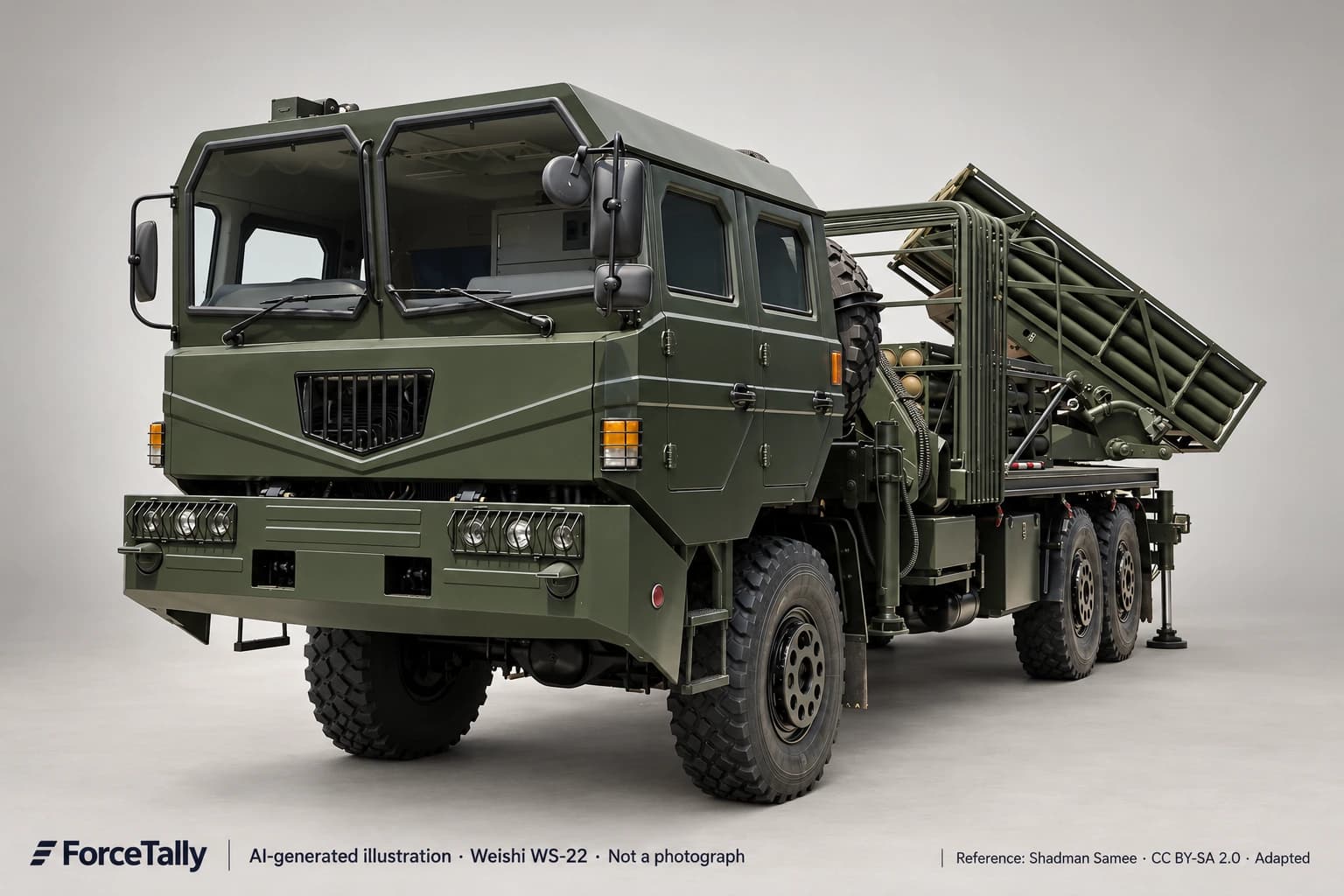
Rockets & launchersIn service
Weishi rockets is documented in the equipment reference catalogue. Reported operators include Azerbaijan, Bangladesh, Iran, North Korea, Palestine, Pakistan, China, Sudan, Thailand, Türkiye, Morocco.

AI-generated illustration · Weishi WS-22 · Not a photograph
ForceTally AI-generated illustration, adapted from the Weishi WS-22 launcher photograph by Shadman Samee from Dhaka, Bangladesh · CC BY-SA 2.0 · Modified · CC BY-SA 2.0 · AI-generated adaptation · Source ↗ · ModifiedAzerbaijan - T-300 Kasırga
Bangladesh - T-300 Kasirga & WS-22
Iran - WS-1 imported in the late 80s or early 90s.
North Korea - WS1B KN-09 (MRL) (?)
Palestine - M-302
Pakistan - WS-1/WS-2, Nasr
China
Sudan - Sudan has acquired an unconfirmed number of the advanced Chinese WS-2 Multiple Rocket launcher In 2009.
Thailand - WS-1B as DTI-1. Technology transfer, produce under license with Thai software.
Turkey - TRG-300 Kasırga
Morocco - 36 WS-2D launchers [1] [2]
The Weishi (WS; Chinese : 卫士 ; lit. 'Guardian') family of multiple rocket launcher systems were mainly developed by Sichuan Academy of Aerospace Technology (SAAT, also known as Base 062) in the central province of Sichuan , China at Chengdu city. The systems include the 302 mm (11.9 in) WS-1 (100 km (62 mi; 54 nmi)), the improved 302 mm (11.9 in) WS-1B (180 km (110 mi; 97 nmi)), the 122 mm (4.8 in) WS-1E (40 km (25 mi; 22 nmi)), the 400 mm (16 in) WS-2 (200 km (120 mi; 110 nmi)), as well as many other models. The Weishi series rocket system did not enter PLA service, but was exported to several countries.
The Weishi (WS; Chinese : 卫士 ; lit. 'Guardian') family of multiple rocket launcher systems were mainly developed by Sichuan Academy of Aerospace Technology (SAAT, also known as Base 062) in the central province of Sichuan , China at Chengdu city. The systems include the 302 mm (11.9 in) WS-1 (100 km (62 mi; 54 nmi)), the improved 302 mm (11.9 in) WS-1B (180 km (110 mi; 97 nmi)), the 122 mm (4.8 in) WS-1E (40 km (25 mi; 22 nmi)), the 400 mm (16 in) WS-2 (200 km (120 mi; 110 nmi)), as well as many other models. The Weishi series rocket system did not enter PLA service, but was exported to several countries.
The Weishi (WS; Chinese : 卫士 ; lit. 'Guardian') family of multiple rocket launcher systems were mainly developed by Sichuan Academy of Aerospace Technology (SAAT, also known as Base 062) in the central province of Sichuan , China at Chengdu city. The systems include the 302 mm (11.9 in) WS-1 (100 km (62 mi; 54 nmi)), the improved 302 mm (11.9 in) WS-1B (180 km (110 mi; 97 nmi)), the 122 mm (4.8 in) WS-1E (40 km (25 mi; 22 nmi)), the 400 mm (16 in) WS-2 (200 km (120 mi; 110 nmi)), as well as many other models. The Weishi series rocket system did not enter PLA service, but was exported to several countries.
SCAIC began to develop an unguided large-calibre multiple launch rocket system for the PLA ground forces in the late 1980s. The resulting Weishi-1 (WS-1) 302 mm, 4-tube multiple rocket system was first tested in 1990. However, the weapon system failed to impress the PLA, and no production order was received. The ground equipment of the WS-1 comprises: a rocket launch truck, a transport and loading truck and a firing command truck.
The weapon is fitted with 6 box-shape launchers and fires 400 mm rockets to a maximum range of 200 km, however some sources claim that it might be up to 350 km.
The weapon is fitted with 6 box-shape launchers and fires 400 mm rockets to a maximum range of 200 km, however some sources claim that it might be up to 350 km.
The weapon is fitted with 6 box-shape launchers and fires 400 mm rockets to a maximum range of 200 km, however some sources claim that it might be up to 350 km.
Built by China Aerospace Long-March International Trade (Alit) – a subsidiary of China Aerospace Science and Technology Corporation (CASC) – the WS-3 features 6 rectangular missile containers for 406 mm rockets, it has simple cascade inertial terminal guidance and has a range of 70-200 km.
Built by China Aerospace Long-March International Trade (Alit) – a subsidiary of China Aerospace Science and Technology Corporation (CASC) – the WS-3 features 6 rectangular missile containers for 406 mm rockets, it has simple cascade inertial terminal guidance and has a range of 70-200 km.
Built by China Aerospace Long-March International Trade (Alit) – a subsidiary of China Aerospace Science and Technology Corporation (CASC) – the WS-3 features 6 rectangular missile containers for 406 mm rockets, it has simple cascade inertial terminal guidance and has a range of 70-200 km.
Lighter version of unguided 122 mm PR50 MLS , with number of tubes reduced by 60% to 40 from the original 100 of PR50 MLS. This is a more compact version of PR50 with reduction of weight for rapid deployment.
WS-22 is a guided version of 122 mm PR50 MLR with simple cascade inertial terminal guidance, with standard range of 45 km.
WS-22 is a guided version of 122 mm PR50 MLR with simple cascade inertial terminal guidance, with standard range of 45 km.
Features two containers of five 300 mm tubes each on a 8X8 truck. Missile is 7.5 m and can carry a 170 kg warhead over 150 km with 30 m CEP accuracy.
Features two containers of five 300 mm tubes each on a 8X8 truck. Missile is 7.5 m and can carry a 170 kg warhead over 150 km with 30 m CEP accuracy.
Features two containers of five 300 mm tubes each on a 8X8 truck. Missile is 7.5 m and can carry a 170 kg warhead over 150 km with 30 m CEP accuracy.
生产商 四川航天工業公司
WS-1/WS-2 China 8x8 wheeled Mounts MLRS and missile systems like Nasr .
Reference text from Wikipedia contributors, used under CC BY-SA 4.0.
Weishi rockets equipment records. Variants, orders and quantities are shown as reported in each inventory source; coverage is incomplete.
 Armenia
Reported count for AR1A. Country-wide list; no individual service specified. 1 distinct count cell(s) from the same source list; shared rowspan cells counted once. Retired, wholly reserve and on-order rows are excluded; the reported count retains any explicitly mixed stock scope in the quoted row. Count column(s): number: 6. Origin: China. The listed variants/roles are the scope, not an immediately deployable count. The components do not establish one inventory census date; the stored date is the retrieved source snapshot.
 Azerbaijan
Army exact named equipment holdings: T-300 Kasirga. Active, operational-reserve and training units excluding equipment in store; November 2025 IISS assessment. Named service only; no parent-force or national total inferred. Source role: ARTILLERY / 302mm. Original estimates, ranges, reporting names, reserve, lease and employment scopes retained; nested included counts are not added. Missile-system quantities mean launchers, not rounds. No readiness, crew, carried weapon, payload, factory-production or future order count inherited.
 Bahrain
 Bangladesh
Army exact named equipment holdings: WS-22. Active, operational-reserve and training units excluding equipment in store; November 2025 IISS assessment. Named service only; no parent-force or national total inferred. Source role: ARTILLERY / 122mm. Original estimates, ranges, reporting names, reserve, lease and employment scopes retained; nested included counts are not added. Missile-system quantities mean launchers, not rounds. No readiness, crew, carried weapon, payload, factory-production or future order count inherited.
China Iran
 Morocco
 Myanmar
 North Korea
 Pakistan
 Palestine
 Qatar
 Sudan
 Thailand
Army exact named DTI-1 (WS-1B), DTI-1G (WS-32) component holdings; active, operational-reserve and training equipment excluding equipment in store, except explicit status exclusions stated below. November 2025 IISS assessment. Named service only, not a national total or combat-readiness measure. Source armament/capacity counts are excluded. Family total 4 is the sum of distinct source-listed configurations: DTI-1 (WS-1B)=1 + DTI-1G (WS-32)=3. The own literal variant/class identity proves each component; no prefix or sibling inference. The own article explicitly declares WS22, WS1B and WS32 systems. Only the exact named configurations are counted, not a general Weishi production total or fired rockets/missile stocks. Thailand DTI designations and the PDF calibre labels retain source scope; no measurements from one variant are copied to another.
 Türkiye
Azerbaijan, Bangladesh, Iran, North Korea, Palestine, Pakistan, China, Sudan, Thailand, Türkiye, Morocco
Equipment reference ↗Keep exploring
 Poland
 Brazil