FORCETALLY
Loading the evidence…
Preparing your view.


Preparing your view.
Rockets & launchersIn service
Artillery rocket
9K52 Luna-M is a artillery rocket originating in Soviet Union.
True scale
Sourced dimensions beside a 1.75 m human reference.
Points represent sourced observations, including revisions. Revisions on the same effective date are not separate inventory events. Ranges appear in the table and are not plotted as exact points.
| Observation / report period | Value | Source | Claim state |
|---|---|---|---|
| 28 Sept 2026 | 544 mm | Wikipedia contributors | approved |
Artillery rocket
Soviet Union
1962–present
Yom Kippur War Soviet–Afghan War Iran–Iraq War Lebanese Civil War Gulf War Yugoslav Wars 2003 invasion of Iraq First Libyan Civil War Syrian Civil War Yemeni Civil War (2014–present)
9M21B (nuclear), 9M21F (HE) and 9M21G (chemical), Laith-90
2.5t
8,950–9,400 mm (352–370 in)
1,700 mm (67 in)
544 mm (21.4 in)
4
65 km (40 mi)
High explosive, chemical, nuclear
420 - 457 kg
Mach 3
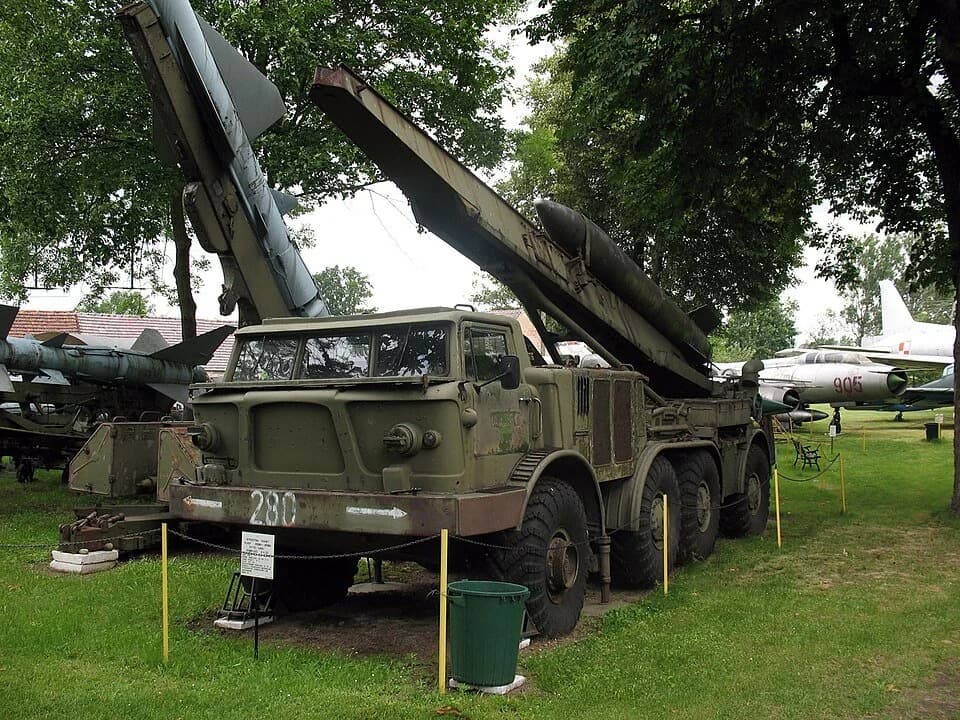
8×8 ZIL-135 missile launcher
Egypt
North Korea
Afghanistan − Frog-7A and Frog-7B
Algeria
Belarus − 36 in 2011
Bulgaria
Cuba − Between 65 and 70 launchers
Czechoslovakia − 36 in 1990
East Germany
Hungary − 18 in 1990
Iraq – entered service in 1975
Kuwait – bought in 1977. Captured by the Iraqi Army during the Gulf War
Libya − 40 in 2011
Poland – 49 launchers, operated between 1966 and 2001
Romania – operated between 1982 and 1998
Russia − Kept in reserve storage as late as of 2011
South Yemen – 12 launchers bought from the Soviet Union in 1979
Syria − 18 in 2011
Soviet Union
Ukraine − 50 in 2011
Yemen − 12 in 2011
Yugoslavia − 8 in 1990
Originally called the 3R-11 and 9R11 , the 9M21 is a solid fuel rocket, with four off-angle vernier chambers immediately behind the warhead section. When the main engine section ignites, the verniers activate to start spinning the rocket, to improve stability and accuracy. At range, the 9M21 has a nominal CEP ( circular error probable ) of 400 meters. Western intelligence estimated that its CEP at maximum range was 500 to 700 meters. Russian sources admit the likely impact point could fall anywhere within an area 2.8 kilometers in depth from range error, and 1.8 kilometers in width in azimuth error.
The initial 3R-11 rocket, known also by its military designation R-65 (NATO: Frog-7A ), measures 8,900 mm in length. It was replaced in 1968 with an improved R-70 (NATO: Frog-7B ) which measures 9,400 mm. This new variant allows for switching warhead sections and the addition of air brakes at the rear of the rocket, lowering the minimum range to 15 km (9.3 mi).
The headquarters battery numbered about 80 personnel and provided the battalion with command and logistical support. Vehicles included 4 9T29 transporter vehicles, a 9T31M1 crane vehicle ( Ural-375 D), an RM-1 maintenance complex (3 ZIL-157s ), an RVD-1 optical maintenance vehicle (Ural-375D) and a PKPP maintenance/check vehicle ( ZIL-131 ).
Preparing the launcher to fire could take anywhere from 15 to 30 minutes. Launch sites were generally located 20 to 25 kilometers behind the front line . It was the longest-ranged artillery system available to a division commander and typically reserved for special missions. Because the rocket's inaccuracy at long range made the use of conventional warheads insufficient, barring a large and vital target, the system was more useful deploying specialized warheads.
The Luna was later extensively deployed throughout some Warsaw Pact countries and other Soviet allies. The rocket has been widely exported, and is now in the possession of a large number of countries. North Korea may have produced a small number of the rockets domestically under the name Hwasong-3 in the 1970s.
Iraq made intensive use of Frog-7 rockets in the war with Iran (1980-1988) . After the war with Iran, Iraq modified its remaining stock of 9M21s by extending their range to 100 kilometres, improving their precision by installing a gyroscope , and fitting submunition-carrying warheads, under a project code-named al-Laith. On 21 February 1991, during operation Desert Storm , Senegalese troops were hit hard by a Laith-90. Eight Senegalese soldiers were wounded in action and one vehicle disabled as a result
During the 2003 invasion of Iraq, the Headquarters of the 2nd Brigade, US 3rd Infantry Division, Tactical Operations Center (TOC) of U.S Col. David Perkins , was targeted and struck by either an Iraqi Frog-7 rocket or an Ababil-100 SSM missile, killing three soldiers and two embedded journalists. Another 14 soldiers were injured, and 22 vehicles destroyed or seriously damaged, most of them Humvees .
Chemical weapon variant, the 436kg 9N18kh warhead is fitted with a VT fuze and carries 216kg of VX nerve agent .
Iraqi version with increased range (100 km), improved accuracy and submunition warhead suitable for attacking troop concentrations.
Iraqi version with increased range (100 km), improved accuracy and submunition warhead suitable for attacking vehicle or infantry columns.
Iraqi version with range increased to 150 km, improved accuracy and submunition warhead.
Diameter 544 mm (21.4 in)
Producer Soviet Union - SKB-385 Votkinsk machine-building plant
Transporter, erector and launcher of the 9K52 Luna-M system based on the ZIL-135LM 8x8 truck chassis. A single 9M21 series artillery rocket is carried on the launch rail. A crane stowed on the right hand side of the launch rail is used for reloading.
Warhead HE
Combat Weight 17,560 kg
Reference text from Wikipedia contributors, used under CC BY-SA 4.0.
9K52 Luna-M equipment records. Variants, orders and quantities are shown as reported in each inventory source; coverage is incomplete.
 Egypt
Army exact named equipment holdings: FROG-7. Active, operational-reserve and training units excluding equipment in store; November 2025 IISS assessment. Named service only; no parent-force or national total inferred. Source role: ARTILLERY / Conventional. Original estimates, ranges, reporting names, reserve, lease and employment scopes retained; nested included counts are not added. Missile-system quantities mean launchers, not rounds. No readiness, crew, carried weapon, payload, factory-production or future order count inherited.
Keep exploring
 Iran
 North Korea
 United Arab Emirates