FORCETALLY
Loading the evidence…
Preparing your view.


Preparing your view.
Rockets & launchersIn service
Rocket artillery
BMD-20 is a rocket artillery originating in Soviet Union.
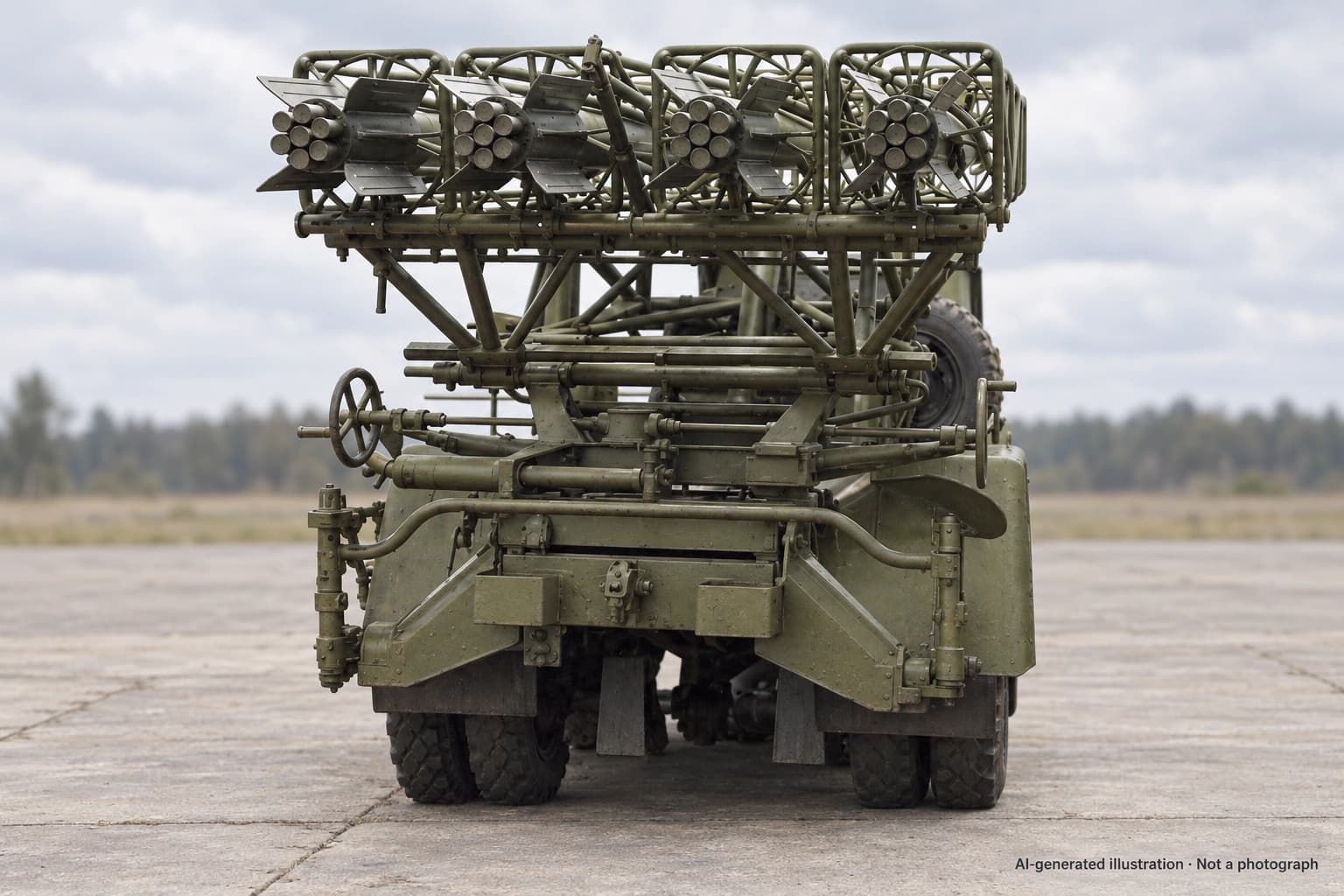
AI-generated illustration · Not a photograph — BMD-20 launcher/carrier in the pictured museum rear configuration. Fine detail is illustrative, not engineering-verified.
ForceTally · AI-generated illustration · Not a photograph · Based on BMD-20 from the rear.JPG by Ain92, CC BY-SA 3.0, https://commons.wikimedia.org/wiki/File:BMD-20_from_the_rear.JPG. Changes: pictured BMD-20 rear configuration isolated, museum/background vehicles removed, lighting clarified, disclosure added. Shared under CC BY-SA 3.0. Fine detail is illustrative. · CC BY-SA 3.0 · AI-generated illustration · Source ↗ · ModifiedRocket artillery
Soviet Union
1952–1970s
1947–1951
1952–late 1950s
4,000
8.7 t (9.6 short tons)
7.2 m (24 ft)
2.3 m (7 ft 7 in)
2.85 m (9 ft 4 in)
8
200 mm
4 in 4–6 sec
590 m/s (1,900 ft/s)
19 km (12 mi)
92 hp (69 kW)
10.6 hp/t
520 km (320 mi)
60 km (37 mi)
The BMD-20 ( GRAU designation 8U33 ) was a 200 mm multiple rocket launcher (MRL) created by the Soviet Union .
Following the success of rocket artillery systems like the Katyusha during World War II , the Soviet Union continued development on such weapons. Development of the BMD-20 began in 1947 and it was accepted into Soviet Army service in 1952. The system was based on a ZIS-151 6×6 truck chassis carrying four rockets in an open steel lattice resting at +9° elevation which could be raised to +60° and traverse 20° to the sides. The launcher is crewed by eight men, three of which are seated inside the cab with the rest seated externally. The windows of the cab are protected by folding metal sheet covers when firing. Once in position, the BMD-20 can be made ready to fire within two minutes.
Each MD-20F 200 mm fin stabilized rocket measured 3.05 m (10.0 ft) long and weighed 194 kg (428 lb) with a 30 kg (66 lb) high explosive warhead. They had a maximum range of 19 km (12 mi) and could all be fired in 4-6 seconds. Accompanied by a reloading vehicle, the launcher took five men 6-10 minutes to reload manually, which usually happened at another location away from the firing position to avoid counter battery fire . Although powerful, the rockets were not accurate, dispersing 90-210 meters from each other, so multiple launchers were intended to be used at once to bombard a large area.
Following the success of rocket artillery systems like the Katyusha during World War II , the Soviet Union continued development on such weapons. Development of the BMD-20 began in 1947 and it was accepted into Soviet Army service in 1952. The system was based on a ZIS-151 6×6 truck chassis carrying four rockets in an open steel lattice resting at +9° elevation which could be raised to +60° and traverse 20° to the sides. The launcher is crewed by eight men, three of which are seated inside the cab with the rest seated externally. The windows of the cab are protected by folding metal sheet covers when firing. Once in position, the BMD-20 can be made ready to fire within two minutes.
Hersteller GSKB Spetzmasch
Länge 3,04 m
Gewicht 194 kg
Reference text from Wikipedia contributors, used under CC BY-SA 4.0.
True scale
Sourced dimensions beside a 1.75 m human reference.
Points represent sourced observations, including revisions. Revisions on the same effective date are not separate inventory events. Ranges appear in the table and are not plotted as exact points.
| Observation / report period | Value | Source | Claim state |
|---|---|---|---|
| 28 Sept 2026 | 200 mm | Wikipedia contributors | superseded |
| 28 Sept 2026 | 200 mm | Wikipedia contributors | superseded |
| 28 Sept 2026 | 200 mm | Wikipedia contributors | superseded |
| 28 Sept 2026 | 200 mm | Wikipedia contributors | approved |
BMD-20 equipment records. Variants, orders and quantities are shown as reported in each inventory source; coverage is incomplete.
Keep exploring
 North Korea
 Iran
 United Arab Emirates