FORCETALLY
Loading the evidence…
Preparing your view.


Preparing your view.
Anti-tank weaponsIn service
Heavy anti-tank/landing-craft guided missile
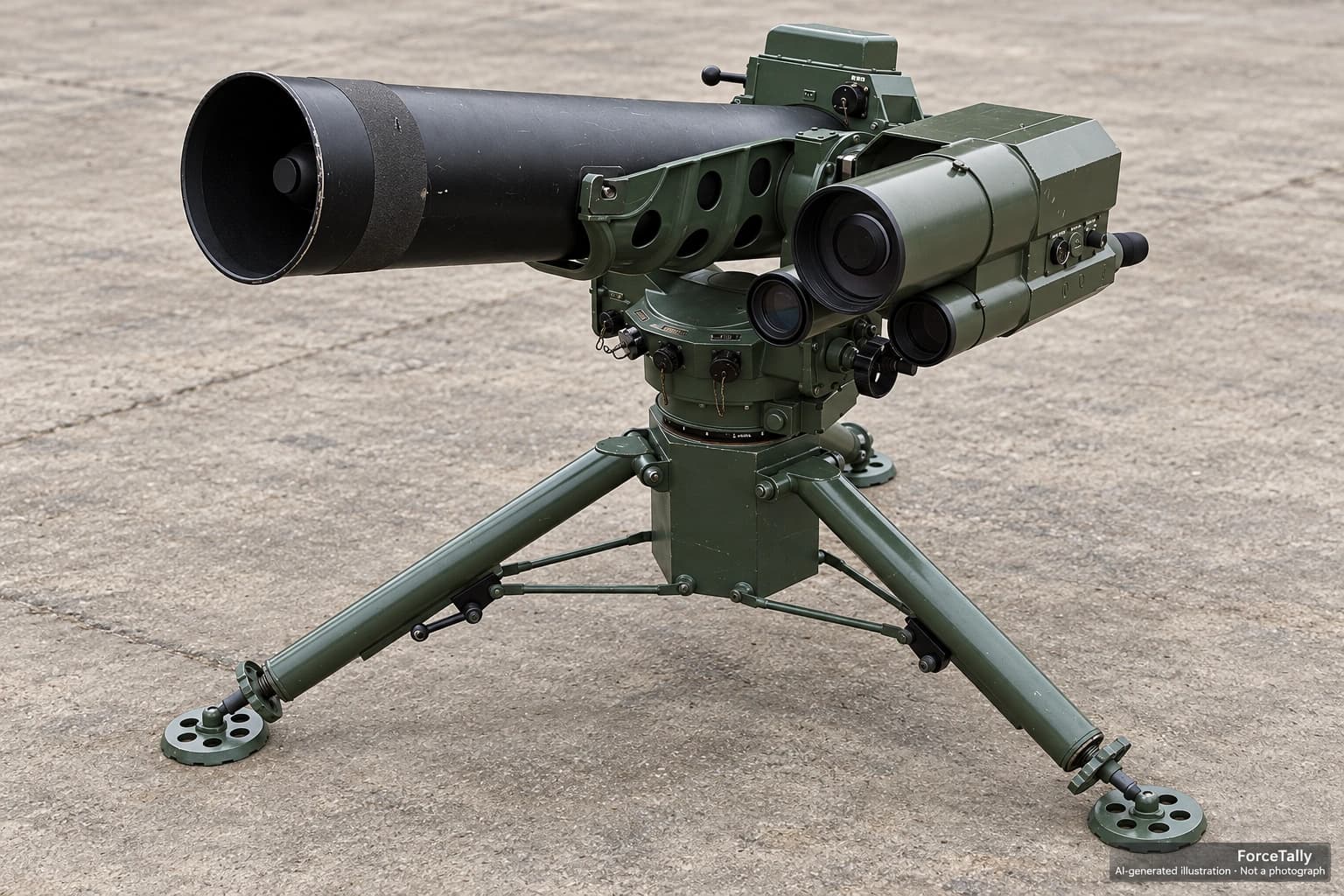
Type 79 Jyu-MAT is a heavy anti-tank/landing-craft guided missile originating in Japan. It was built by Kawasaki Heavy Industries. Reported operators include Japan.
 Japan
AI-generated illustration · Not a photograph · Type 79 system: the source-pictured tripod-mounted sighting/control assembly; the missile is not shown.
ForceTally · AI-generated illustration based on Max Smith · Public domain; reference attribution retained. · ForceTally · All rights reserved · Source ↗ · ModifiedHeavy anti-tank/landing-craft guided missile
Japan
1984 to present
Japan
Defense Agency Technical Research and Development Institute
Kawasaki Heavy Industries
1980 to present
33 kg missile
1.5 m
153 mm
1
Shaped charge on tanks/armored vehicles Fragmentation charged warhead for landing vessels and ships.
4.2 kg
Impact or delayed impact
200 m/s
Wire guided SACLOS
The Type 79 Jyu-MAT ( 79式対舟艇対戦車誘導弾 , 79-shiki tai-shūtei tai-sensha yūdō-dan ) is a Japanese SACLOS guided anti-tank missile that entered service with the JGSDF in 1984.
The missile is stored in a cylindrical transport container. On launch the missile is ejected from the tube by a solid rocket motor. After traveling a safe distance from the operator, the Daicel flight motor ignites and takes the missile to its cruising speed of approximately 200 meters per second.
Caliber 120-mm
Range 320 to 4,000 m
Guidance Wire-guided SACLOS
Reference text from Wikipedia contributors, used under CC BY-SA 4.0.
True scale
Sourced dimensions beside a 1.75 m human reference.
Points represent sourced observations, including revisions. Revisions on the same effective date are not separate inventory events. Ranges appear in the table and are not plotted as exact points.
| Observation / report period | Value | Source | Claim state |
|---|---|---|---|
| 10 Oct 2026 | 120 mm | US Marine Corps Intelligence Activity | approved |
Type 79 Jyu-MAT equipment records. Variants, orders and quantities are shown as reported in each inventory source; coverage is incomplete.
Keep exploring
 Russia
 South Korea