FORCETALLY
Loading the evidence…
Preparing your view.


Preparing your view.
Radar & sensorsIn service
Surveillance
Tethered Aerostat Radar System is a surveillance originating in United States. It was built by Lockheed Martin (prime contractor) ILC Dover (envelope). Reported operators include U.S. Customs and Border Protection Philippine Navy Historic users: United States Air Force United States Coast Guard United States Customs Service.
 United States
Tethered Aerostat Radar System
U.S. Customs and Border Protection · Public domain · Resized · Public domain · Source ↗ · ModifiedSurveillance
Lockheed Martin (prime contractor) ILC Dover (envelope)
In active service
U.S. Customs and Border Protection Philippine Navy Historic users: United States Air Force United States Coast Guard United States Customs Service
9 – Lockheed Martin 420K 2 – Lockheed Martin 275K
1980
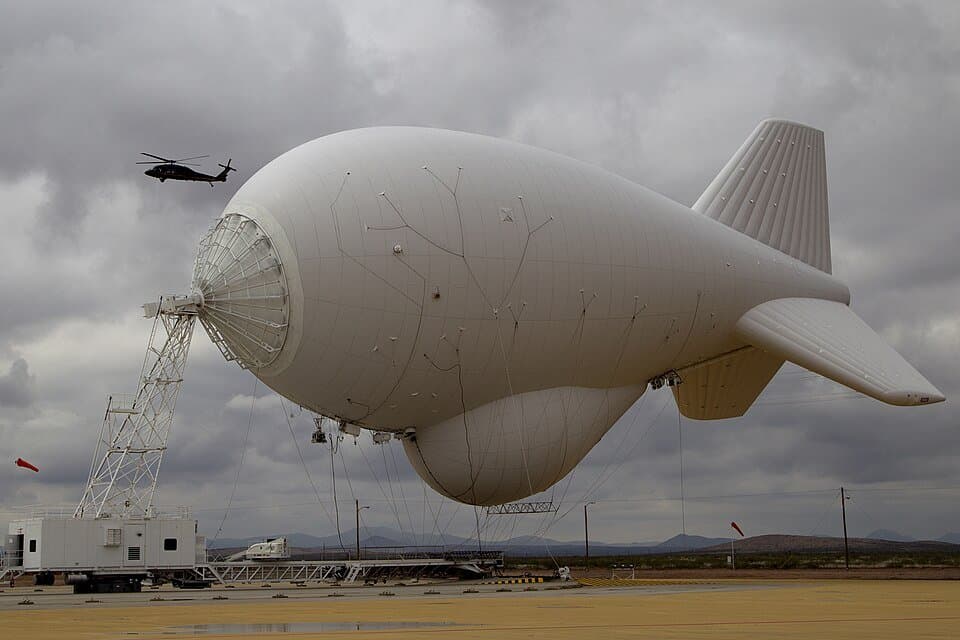
The Tethered Aerostat Radar System ( TARS ) is an American low-level airborne ground surveillance system that uses aerostats ( moored balloons ) as radar platforms.
The aerostats used in the TARS system are large fabric envelopes filled with helium that can rise to an altitude of 15,000 feet (4,600 m) while tethered by a single cable. The largest lifts a 1000 kg payload to an operating altitude providing low-level, downward-looking radar coverage. The aerostat consists of four major parts or assemblies: the hull and fin, windscreen and radar platform, airborne power generator, and rigging and tether; they are kite balloons obtaining aerodynamic lift from relative wind and buoyancy from being lighter than air .
The hull of the aerostat contains two parts separated by a gas-tight fabric partition. The upper chamber is filled with helium and provides the aerostat's lifting capability. The lower chamber of the hull is a pressurized air compartment. The hull is constructed of a lightweight polyurethane-coated Tedlar fabric. An airborne engine drives the generator, supplied by a 100-gallon diesel fuel tank.
Beginning in the late 1990s, the aerostat sites were equipped with Lockheed Martin 420K aerostats. This version carries the Lockheed Martin L-88, a surveillance radar with a range of 370 km (200 nm), as its primary payload. The 420K's envelope shape, fin design, and cable attachment points are further optimized for high aerodynamic stability and easy ground handling. While Lockheed Martin is the prime contractor for the 420K aerostats, the envelopes are built by ILC Dover .
The Philippine Navy (PN) formally received a 28M Class Tethered Aerostat Radar System (TARS) from the United States government in a turn-over ceremony on August 22, 2017 at the Naval Education and Training Command (NETC) inside Naval Station Leovigildo Gantioqui in San Antonio, Zambales.
Operators launch the aerostat from a large circular launch pad containing a mooring fixed or mobile system. The mooring systems contain a large winch with 25,000 feet (7,600 m) of tether cable. Operational availability is generally limited only by the weather (60 percent standard) and routine maintenance downtime. The aerostats are stable in winds below 65 knots (120 km/h). Aerostat and equipment availability averages more than 98 percent system-wide.
For security and safety reasons, air space around aerostat sites is restricted for a radius of at least two to three statute miles and an altitude up to 15,000 feet (4,600 m).
One unique capability of the aerostat is providing persistent long-range coastal surveillance for up to 128 nautical miles (237 kilometers) at 4,000 feet (1,200 meters) elevation based on actual flight done by the aerostat students.
Volume: 275,000 and 420,000 cubic feet (12,000 m 3 )
Tether length: 25,000 feet (7,600 m)
Payload weight: 1,200-2,200 pounds
Maximum detection range: 200 nautical miles (400 km)
Maximum detection range: 200 nautical miles (400 km)
Maximum detection range: 200 nautical miles (400 km)
Manufacturer: ILC Dover
1222.5-1223.5 TARS Pulsed radar AZ, Ft Huachuca, Pulsed & intermittent
1222.5-1223.5 TARS Pulsed radar AZ, Ft Huachuca, Pulsed & intermittent
1251.5-1252.5 TARS pulsed radar NM, Deming Pulsed & Intermittant plot
1251.5-1252.5 TARS pulsed radar NM, Deming Pulsed & Intermittant plot
1282.5-1283.5 TARS pulsed radar AZ, Ft Huachuca Pulsed & Intermittant
1282.5-1283.5 TARS pulsed radar AZ, Ft Huachuca Pulsed & Intermittant
1311.5-1312.5 TARS pulsed radar NM, Deming Pulsed & Intermittant plot
Reference text from Wikipedia contributors, used under CC BY-SA 4.0.
1311.5-1312.5 TARS pulsed radar NM, Deming Pulsed & Intermittant plot
Tethered Aerostat Radar System equipment records. Variants, orders and quantities are shown as reported in each inventory source; coverage is incomplete.
 Philippines
 Singapore
Reported count for Tethered Aerostat Radar System. Service scope: Republic of Singapore Air Force; does not replace a national total. 1 distinct quantity component(s) from the same source list; shared rowspan cells counted once. Explicit source inventory scope: active; no other stock status or total inferred. Count column(s): in service: 2. Origin: United States. The listed variants/roles are the scope, not an immediately deployable count. The components do not establish one inventory census date; the stored date is the retrieved source snapshot.
U.S. Customs and Border Protection Philippine Navy Historic users: United States Air Force United States Coast Guard United States Customs Service
Equipment reference ↗Keep exploring
Ground surveillance
 France
Primary surveillance radar
 India
Secondary surveillance radar
IndiaSurveillance/Target Acquisition
ground and coast surveillance radar
 Germany
three-dimensional main guidance and surveillance radar
 China