FORCETALLY
Loading the evidence…
Preparing your view.


Preparing your view.
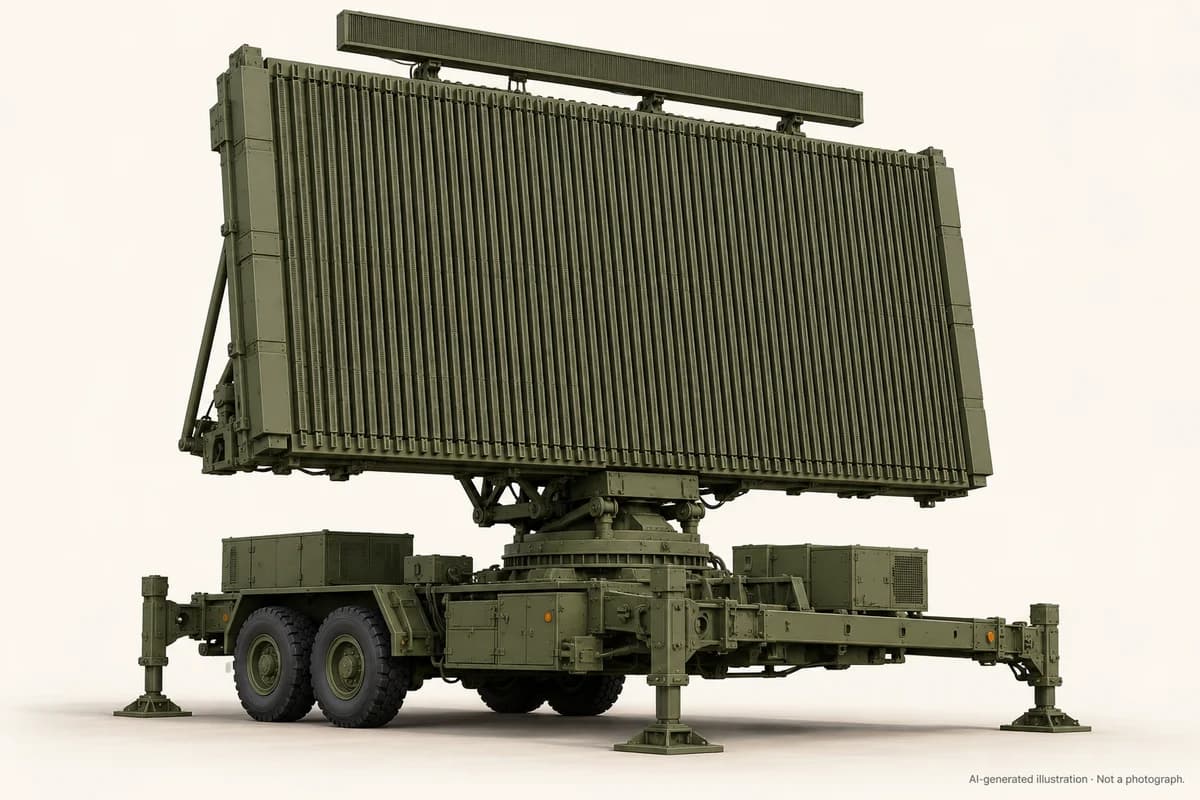
Radar & sensorsIn service
three-dimensional main guidance and surveillance radar
YLC-2 Radar is a three-dimensional main guidance and surveillance radar. Reported operators include China.
 China
AI-generated illustration · Not a photograph. Representative exterior illustration; details are illustrative and do not establish specifications. Radar exterior is representative; named configuration and source scopes remain separate.
ForceTally · AI-generated illustration · Not a photograph · AI-generated · OpenAI output terms · Source ↗ · Modified5.5 KW
<500 m(R: <200km); 750 m(R: 300km)
Myanmar : China sold unknown number of YLC-2V and YLC-18 radars to Myanmar in 2014.
is a three-dimensional main guidance and surveillance radar
radar developed by the Nanjing Research Institute of Electronics Technology
domestic designation: LLQ303 , formerly known as 385
Specifications L - band
Peak Power: 85 KW
Detection range: >500km
Accuracy: range 200m
Resolution range: <100m
Antenna aperture: 7m x 9m
Other features: Phased array system and pencil beam scan technology
<500 m(R: <200km); 750 m(R: 300km)
The YLC-2 radar (domestic designation: LLQ303 , formerly known as 385 ) is a three-dimensional main guidance and surveillance radar developed by the Nanjing Research Institute of Electronics Technology .
In the mid-2000s, an improved version labeled YLC-2A was deployed to the PLA. Equipped with a new Giga-flops digital signal processor , it is capable of Digital Moving Target Indication (DMTI) and Constant false alarm rate (CFAR) processing. An S-band variation called YLC-2U with similar capabilities was also developed for SAM guidance. Both of these advanced YLC-2 radars have been specifically designed to counter stealth fighters such as F-22 , with a claimed range of up to 200km even in heavy ECM environment.
Power Output: 5.5 KW
Peak Power: 85 KW
Detection range: >500km
Accuracy: range 200m
Height: <500 m(R: <200km); 750 m(R: 300km)
Resolution range: <100m
Antenna aperture: 7m x 9m
China Electronics Technology Group Corporation
frequency: 1 240 … 1 400 MHz ( L band ) S band
frequency: 1 240 … 1 400 MHz ( L band ) S band
pulse repetition frequency (PRF) : 275 Hz
peak power : 85 kW
average power : 5.5 kW
instrumented range : 330 km 500 km
instrumented range : 330 km 500 km
YLC-2 Radar China Air radar U/N [74] YLC-2V version with a range of 500 km, entered service in 2012
Reference text from Wikipedia contributors, used under CC BY-SA 4.0.
Points represent sourced observations, including revisions. Revisions on the same effective date are not separate inventory events. Ranges appear in the table and are not plotted as exact points.
| Observation / report period | Value | Source | Claim state |
|---|---|---|---|
| 1 Oct 2026 | 500 km | Wikipedia contributors | superseded |
| 1 Oct 2026 | 500 km | Wikipedia contributors | superseded |
range resolution : ≤ 300 m ≤ 200 m
range resolution : ≤ 300 m ≤ 200 m
accuracy : ≤ 100 m ; ≤ 0.3° ≤ 100 m ; ≤ 0.3°
accuracy : ≤ 100 m ; ≤ 0.3° ≤ 100 m ; ≤ 0.3°
YLC-2 radar is a 3-D air surveillance and acquisition radar that operates in L band . The radar uses a phased array with an aperture of 7 m · 9 m that scans electronically in elevation while rotating in azimuth. The original for this radar was possibly the AN/TPS-59 , an assumption supported by many similarities in the construction of the antenna. The antenna array of the YLC-2 consists of many low-power radiating elements using solid-state power-amplifier modules mounted in 54 vertical rows. The main antenna is topped by an IFF/MSSR array.
The YLC-2 radar has three display consoles and can track as many as 100 targets.
A total of 5 sets of YLC-2 radar systems were delivered to Pakistan from 2003 to 2004.
YLC-2V radar is a mobile surveillance and medium/long-range guidance S band (IEEE designation) or in the E/F band (NATO designation) radar that can be quickly deployed. It can provide comprehensive information including azimuth, range, altitude, IFF attribute, of large quantities of air targets. The antenna is smaller than the above origin, that results in lower resolution in elevation but higher mobility (assembly/disassembly time: 40 min with 6 persons).
YLC-2 Radar equipment records. Variants, orders and quantities are shown as reported in each inventory source; coverage is incomplete.
Keep exploring
ground and coast surveillance radar
 Germany
Primary surveillance radar
 India
Secondary surveillance radar
Indiatwo-dimensional radars
Chinatransportable 2-dimensional air search radar
 United States
Ground surveillance
 France
 Morocco
 Myanmar