Design and configuration
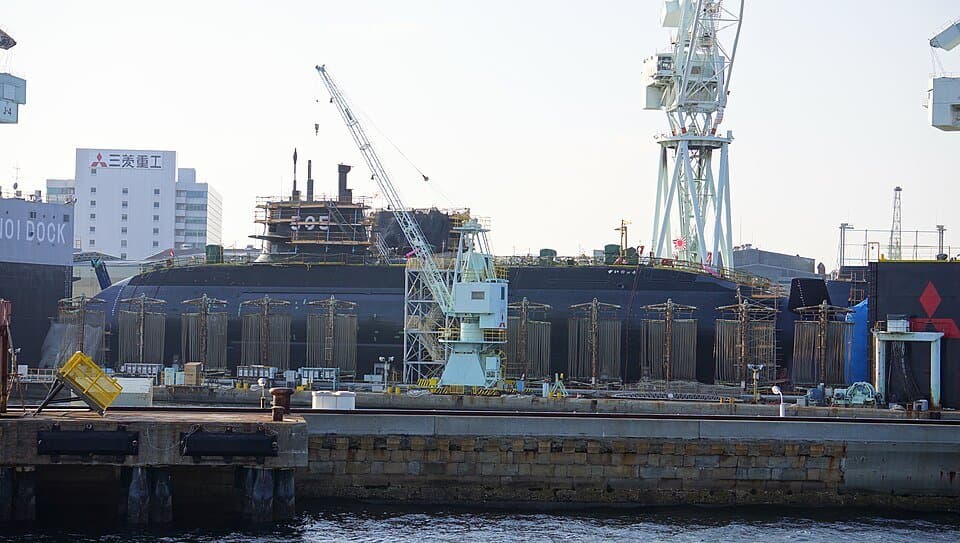
A large sail and X-arranged stern surfaces distinguish the external form. The official depth dimension is a hull measurement, not a diving-depth rating.1


Preparing your view.
SubmarinesIn service
Attack submarine
Sōryū-class submarine is a attack submarine. It was built by Mitsubishi Heavy Industries Kawasaki Shipbuilding Corporation.
 Japan
Sōryū
Mitsubishi Heavy Industries Kawasaki Shipbuilding Corporation
Japan Maritime Self-Defense Force
Oyashio -class submarine
Taigei -class submarine
2005 – 2019
2009 – Present
12
12
12
Attack submarine
Surfaced: 2,900 tonnes (2,854 long tons ) Submerged: 4,200 t (4,134 long tons)
84.0 m (275 ft 7 in )
9.1 m (29 ft 10 in)
8.5 m (27 ft 11 in)
1-shaft 2× Kawasaki 12V 25/25 SB-type diesel engines diesel-electric 4× Kawasaki Kockums V4-275R Stirling engines - up to Shōryū 3,900 hp (2,900 kW) surfaced 8,000 hp (6,000 kW) submerged
Surfaced: 13 kn (24 km/h; 15 mph) Submerged: 20 kn (37 km/h; 23 mph)
AIP endurance (est.): 6,100 nautical miles (11,300 km; 7,000 mi) at 6.5 knots (12.0 km/h; 7.5 mph)
65 (9 officers, 56 enlisted)
ZPS-6F surface/low-level air search radar Hughes/Oki ZQQ-7 Sonar suite: 1× bow-array, 4× LF flank arrays and 1× Towed array sonar
ZLR-3-6 ESM equipment 2× 3-inch underwater countermeasure launcher tubes for launching of Acoustic Device Countermeasures (ADCs)
6 × HU-606 21 in (533 mm) torpedo tubes with 30 reloads for: Type 89 torpedo Harpoon (missile) Mines
{"datatype": "wikibase-item", "datavalue": {"type": "wikibase-entityid", "value": {"entity-type": "item", "id": "Q17", "numeric-id": 17}}, "hash": "e9d62405b1bb9b7b979f00006a344891e4c4f072", "property": "P495", "snaktype": "value"}
Reference text from Wikipedia contributors, used under CC BY-SA 4.0.
True scale
Sourced dimensions beside a 1.75 m human reference.
The system in detail
A large sail and X-arranged stern surfaces distinguish the external form. The official depth dimension is a hull measurement, not a diving-depth rating.1
The JMSDF class page lists diesel engines, Stirling machinery and an electric propulsion motor. These apply to the AIP configuration identified here.1
Oryu and Toryu use a different lithium-ion battery arrangement. Their energy system must not be combined with the earlier boats’ Stirling machinery in one specification.1
Standard displacement differs from submerged displacement. The quoted speed and machinery count do not establish an unrestricted submerged endurance figure.1
Sōryū -class submarines equipment records. Variants, orders and quantities are shown as reported in each inventory source; coverage is incomplete.
JapanMaritime Self-Defense Force exact named equipment holdings: Soryu (of which 10 fitted with AIP and 2 fitted with lithium-ion fuel battery). Active, operational-reserve and training units excluding equipment in store; November 2025 IISS assessment. Named service only; no parent-force or national total inferred. Source role: SUBMARINES / SSK. Original estimates, ranges, reporting names, reserve, lease and employment scopes retained; nested included counts are not added. Missile-system quantities mean launchers, not rounds. No readiness, crew, carried weapon, payload, factory-production or future order count inherited.
Reported count for Sōryū -class. Service scope: Japan Maritime Self-Defense Force ships; does not replace a national total. 2 distinct quantity component(s) from the same source list; shared rowspan cells counted once. Explicit source inventory scope: active; no other stock status or total inferred. Count column(s): in service: 10 / in service: 2. Origin: unstated. The listed variants/roles are the scope, not an immediately deployable count. The components do not establish one inventory census date; the stored date is the retrieved source snapshot.
 Germany