Design and configuration
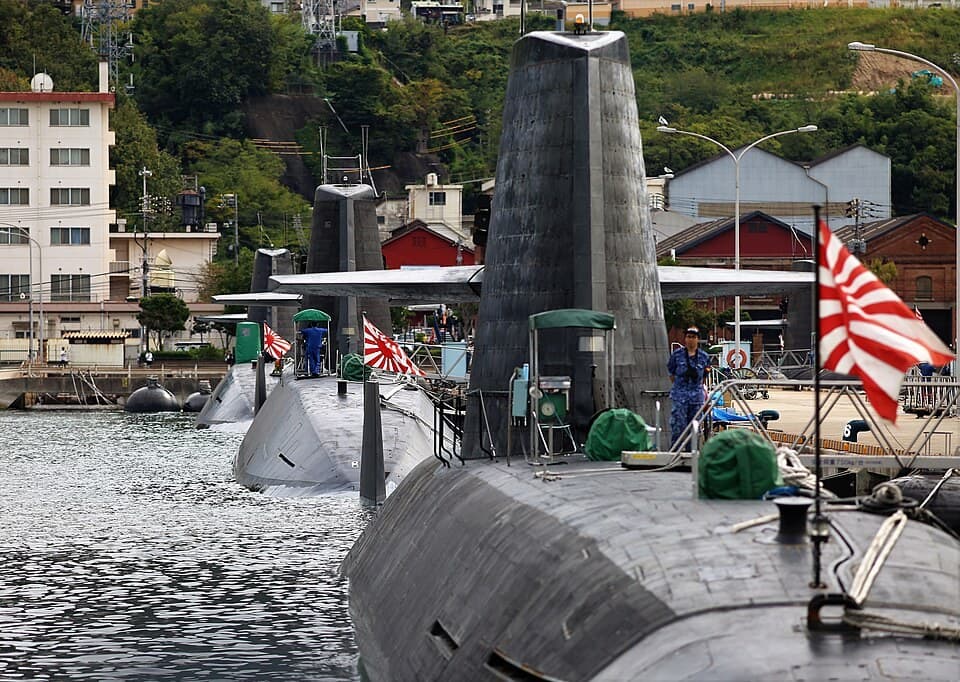
A large sail and X-arranged stern surfaces distinguish the external form. The official depth dimension is a hull measurement, not a diving-depth rating.1


Preparing your view.
Submarines2009 – PresentProfile in progress
The earlier Soryu-class submarines combine diesel-electric machinery with Stirling air-independent propulsion. Later boats changed their energy-storage arrangement, so the class is not one uniform technical configuration.
 Japan
Japan海上自衛隊呉基地に停泊する「そうりゅう」型潜水艦。2019年の撮影。奥は「おやしお」型潜水艦。艦名は不詳。左手のビルは、海上自衛隊 潜水艦教育訓練隊の建物。右手の赤レンガの建物は「アレイからすこじま」の旧日本海軍建築物群で「昭和町れんが倉庫群」と呼ばれる。現在は民間の倉庫や商店として使用されている。 Historical equipment reference photograph. It does not establish current availability or every detail of the named variant.
メルビル · CC BY-SA 4.0 · Wikimedia Commons · CC BY-SA 4.0 · Source ↗ · ModifiedSōryū
Mitsubishi Heavy Industries Kawasaki Shipbuilding Corporation
Japan Maritime Self-Defense Force
Oyashio -class submarine
Taigei -class submarine
2005 – 2019
2009 – Present
12
12
12
Attack submarine
Surfaced: 2,900 tonnes (2,854 long tons ) Submerged: 4,200 t (4,134 long tons)
84.0 m (275 ft 7 in )
9.1 m (29 ft 10 in)
8.5 m (27 ft 11 in)
1-shaft 2× Kawasaki 12V 25/25 SB-type diesel engines diesel-electric 4× Kawasaki Kockums V4-275R Stirling engines - up to Shōryū 3,900 hp (2,900 kW) surfaced 8,000 hp (6,000 kW) submerged
Surfaced: 13 kn (24 km/h; 15 mph) Submerged: 20 kn (37 km/h; 23 mph)
AIP endurance (est.): 6,100 nautical miles (11,300 km; 7,000 mi) at 6.5 knots (12.0 km/h; 7.5 mph)
65 (9 officers, 56 enlisted)
ZPS-6F surface/low-level air search radar Hughes/Oki ZQQ-7 Sonar suite: 1× bow-array, 4× LF flank arrays and 1× Towed array sonar
ZLR-3-6 ESM equipment 2× 3-inch underwater countermeasure launcher tubes for launching of Acoustic Device Countermeasures (ADCs)
6 × HU-606 21 in (533 mm) torpedo tubes with 30 reloads for: Type 89 torpedo Harpoon (missile) Mines
{"datatype": "wikibase-item", "datavalue": {"type": "wikibase-entityid", "value": {"entity-type": "item", "id": "Q17", "numeric-id": 17}}, "hash": "e9d62405b1bb9b7b979f00006a344891e4c4f072", "property": "P495", "snaktype": "value"}
Reference text from Wikipedia contributors, used under CC BY-SA 4.0.
The system in detail
A large sail and X-arranged stern surfaces distinguish the external form. The official depth dimension is a hull measurement, not a diving-depth rating.1
The JMSDF class page lists diesel engines, Stirling machinery and an electric propulsion motor. These apply to the AIP configuration identified here.1
Oryu and Toryu use a different lithium-ion battery arrangement. Their energy system must not be combined with the earlier boats’ Stirling machinery in one specification.1
Standard displacement differs from submerged displacement. The quoted speed and machinery count do not establish an unrestricted submerged endurance figure.1
Soryu class equipment records. Variants, orders and quantities are shown as reported in each inventory source; coverage is incomplete.
JapanMaritime Self-Defense Force exact named equipment holdings: Soryu (of which 10 fitted with AIP and 2 fitted with lithium-ion fuel battery). Active, operational-reserve and training units excluding equipment in store; November 2025 IISS assessment. Named service only; no parent-force or national total inferred. Source role: SUBMARINES / SSK. Original estimates, ranges, reporting names, reserve, lease and employment scopes retained; nested included counts are not added. Missile-system quantities mean launchers, not rounds. No readiness, crew, carried weapon, payload, factory-production or future order count inherited.
Maritime Self-Defense Force exact named equipment holdings of Soryu (of which 10 fitted with AIP and 2 fitted with lithium-ion fuel battery). Active, operational-reserve and training units excluding equipment in store; November 2025 IISS assessment. Named service only, not a national or parent-force total or combat-readiness measure. Source role(s): SUBMARINES / SSK. No heading aggregate, carried armament, crew, payload, factory production or future order count inherited. The leading printed inventory count is retained; separately stated extra reserve, nonoperational or repair quantities inside parentheses are not added to it and remain verbatim in the excerpt. Source parentheses retain employment, lease, reporting designation, alternate model, or included-subset scopes exactly. Own fetched primary and alternate/model identity declarations are retained. Numbers inside an included subset are part of the printed count and are never added again; no sibling or parent specification is copied.
Reported count for Sōryū -class. Service scope: Japan Maritime Self-Defense Force ships; does not replace a national total. 2 distinct quantity component(s) from the same source list; shared rowspan cells counted once. Explicit source inventory scope: active; no other stock status or total inferred. Count column(s): in service: 10 / in service: 2. Origin: unstated. The listed variants/roles are the scope, not an immediately deployable count. The components do not establish one inventory census date; the stored date is the retrieved source snapshot.