FORCETALLY
Loading the evidence…
Preparing your view.


Preparing your view.
Military transport & logisticsIn service
All-terrain transport vehicle
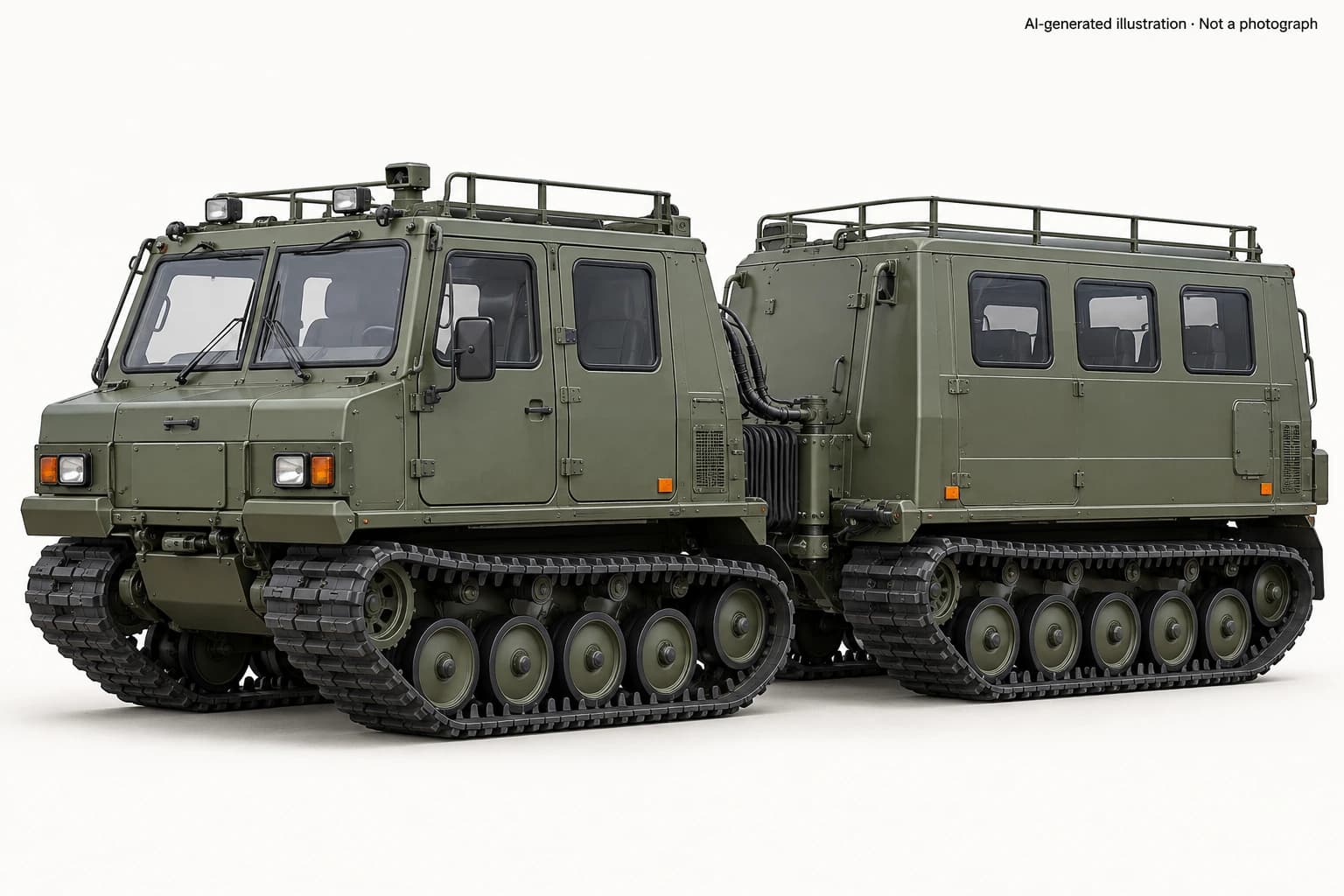
Sisu Nasu is a all-terrain transport vehicle originating in Finland.
 Finland
AI-generated illustration · Not a photograph — Representative exterior; geometry is illustrative. Not evidence for specifications.
ForceTally · AI-generated illustration · Not a photograph · AI-generated · OpenAI output terms · Source ↗ · ModifiedAll-terrain transport vehicle
Finland
5,250 kg (11,574 lb)
7.67 m (302 in)
1.91 m (75 in)
2.38 m (94 in)
1 (+16 passengers)
Kevlar lining
12.7 mm NSV machine gun
GM 6.2 L Heavy Duty V-8 diesel engine 113 kW (154 PS; 152 hp) 346 N⋅m (255 lb⋅ft)
21.5 kW/tonne
tracked and all four tracks are powered
280 km (170 mi)
65 km/h (40 mph), swim 6 km/h (4 mph)
The Nasu (acronym for Nauha-Sisu , English: Track Sisu ; also meaning " Piglet " in colloquial Finnish) is a tracked articulated, all-terrain transport vehicle developed by Sisu Auto for the Finnish Army .
The Nasu (acronym for Nauha-Sisu , English: Track Sisu ; also meaning " Piglet " in colloquial Finnish) is a tracked articulated, all-terrain transport vehicle developed by Sisu Auto for the Finnish Army . It consists of two units, with all four tracks powered. It can carry up to 17 people, although the trailer unit can be adapted for different applications (see Variants section). There are two main versions, the NA-140 BT and the NA-110 .
Although it looks externally like the Bandvagn 206 , which also is in Finnish Army use, it is an entirely new design, and almost 1 meter longer and 1,000 kg (2,205 lb) heavier. It has better payload-carrying capability than the Bv 206. The Nasu is designed to carry troops and equipment through snow and bog-lands in northern Finland. For this, it is equipped with four wide (62 cm) powered rubber tracks. The low ground pressure enables the Nasu to cope with a wide range of difficult conditions. It is also fully amphibious, with a speed in water of up to 6 km/h (4 mph) when driven by its tracks.
The total load capacity is 1,950 kg (4,299 lb) and a trailer with a weight of up to 2,500 kg (5,512 lb) can also be towed behind the second compartment.
More than 500 vehicles of this type have been manufactured and it is used as a personnel carrier and a weapons platform (for BGM-71 TOW anti-tank guided missiles, 120 mm mortars). In basic infantry versions, a roof-mounted 12.7 mm NSV anti-aircraft machine gun is used for close-range anti-aircraft protection. There are also command, signals and ambulance variants of the vehicle.
Manufactured between 1986 and 1991. Powered by a Rover 3,5 (3,9) V-8 gasoline engine (142 kW/280 Nm). Weight: 4,850 kg (10,692 lb), payload: 1,950 kg (4,299 lb), length: 7.55 m, width: 1.91 m (75 in), height: 2.30 m (91 in), complement: 5 (including driver) in frontal unit and up to 12 in tail unit.
Manufactured between 1992 and 1994. Powered by a GM 6.2 L Heavy Duty V-8 diesel engine (113 kW/346 Nm). Weight: 5,250 kg (11,574 lb), payload: 1,950 kg (4,299 lb), length: 7.67 m, width: 1.91 m (75 in), height: 2.38 m (94 in), complement: 5 (including driver) in frontal unit and up to 12 in tail unit.
A version that carries a 120 mm mortar 120 KRH 92 and 14 rounds on its tail unit. Called Krh-TeKa in Finnish Army service.
Valmistajat Oy Sisu-Auto Ab
Reference text from Wikipedia contributors, used under CC BY-SA 4.0.
True scale
Sourced dimensions beside a 1.75 m human reference.
Points represent sourced observations, including revisions. Revisions on the same effective date are not separate inventory events. Ranges appear in the table and are not plotted as exact points.
| Observation / report period | Value | Source | Claim state |
|---|---|---|---|
| 29 Sept 2026 | 1 people | Wikipedia contributors | superseded |
| 29 Sept 2026 | 1 people | Wikipedia contributors | superseded |
| 29 Sept 2026 | 1 people | Wikipedia contributors | superseded |
| 29 Sept 2026 | 1 people | Wikipedia contributors | superseded |
| 29 Sept 2026 | 1 people | Wikipedia contributors | approved |
Sisu Nasu equipment records. Variants, orders and quantities are shown as reported in each inventory source; coverage is incomplete.
FinlandNumber column of the Wikipedia list table under "Mortars", 3 rows summed. The list's own wording applies; it is a compiled secondary source, not an official census.
Keep exploring
 Sweden
 Italy
 United States