FORCETALLY
Loading the evidence…
Preparing your view.


Preparing your view.
Combat aircraftIn service
Multirole fighter
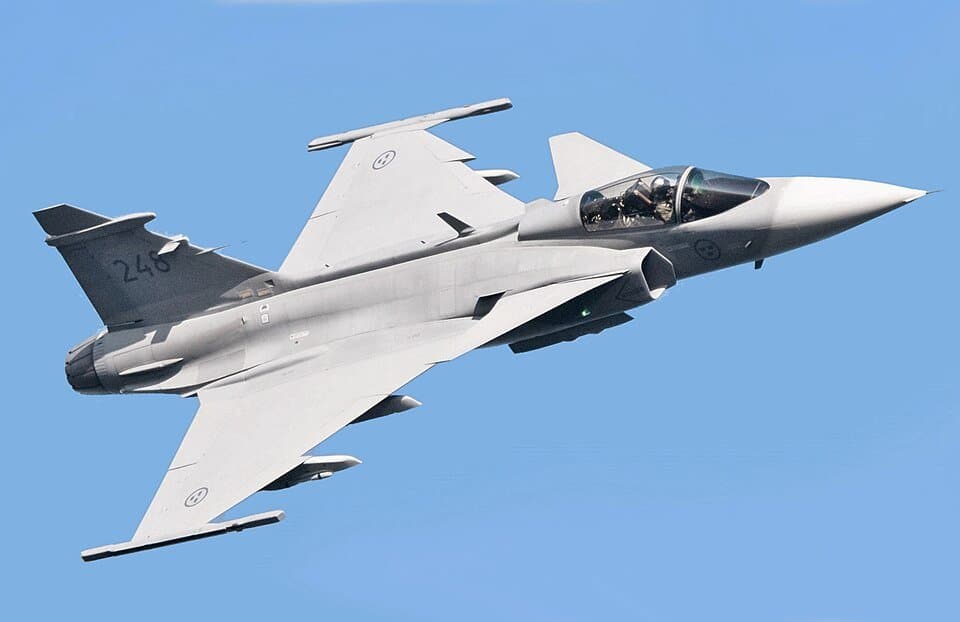
Saab JAS 39 Gripen is a multirole fighter originating in Sweden. It was built by Saab AB. Reported operators include Swedish Air Force Brazilian Air Force South African Air Force Hungarian Air Force.
 Sweden
Saab JAS 39 Gripen
Tuomo Salonen / SIM Finnish Aviation Museum · CC BY-SA 4.0 · Resized · CC BY-SA 4.0 · Source ↗ · ModifiedMultirole fighter
Sweden
Saab AB
Industrigruppen JAS , FMV
In service
Swedish Air Force Brazilian Air Force South African Air Force Hungarian Air Force
~300 (2023)
1987–present
9 June 1996
9 December 1988
1 JAS 39C / 2 JAS 39D
14.9 m (48 ft 11 in) JAS 39C
8.4 m (27 ft 7 in)
4.5 m (14 ft 9 in)
30 m 2 (320 sq ft)
6,800 kg (14,991 lb)
14,000 kg (30,865 lb)
3,000 L (790 US gal) (2340 kg) (internal); 3,500 L (920 US gal) (2730 kg) (external)
5,300 kg (11,700 lb)
1 × Volvo RM12 afterburning turbofan engine, 54 kN (12,000 lbf) thrust dry, 80.5 kN (18,100 lbf) with afterburner
Mach 2 (2,100 km/h; 1,300 mph; 1,100 kn) at 15 240 m (50,000 ft)
800 km (500 mi, 430 nmi)
3,200 km (2,000 mi, 1,700 nmi)
15,240 m (50,000 ft)
+9/−3 (+12 if needed)
283 kg/m 2 (58 lb/sq ft)
0.97
400 m (1,312 ft)
500 m (1,640 ft)
1 × 27 mm Mauser BK-27 revolver cannon with 120 rounds (single-seat models only)
8 (two hardpoints under fuselage, two under each wing, and one on each wing tip, with one of these for FLIR/ECM/LD/Recon pod) with a capacity of 5,300 kg (11,700 lb), with provisions to carry combinations of:
6 × IRIS-T (Rb.98) or AIM-9 Sidewinder (Rb.74) or A-Darter 4 × MBDA Meteor (Rb.101), AIM-120 AMRAAM (Rb.99) 4 × AGM-65 Maverick 2 × RBS-15 F anti-ship missile
4 × GBU-12 Paveway II laser-guided bomb 8 × Mark 82 bombs 16 × GBU-39 Small Diameter Bomb
1 × ALQ-TLS electronic countermeasures (ECM) pod 1 × Digital Joint Reconnaissance Pod BriteCloud Expendable Active Decoys (EADs)
In the late 1970s, Sweden sought to replace its aging Saab 35 Draken and Saab 37 Viggen . The Swedish Air Force required an affordable Mach 2 aircraft with good short-field performance for a defensive dispersed basing plan in the event of invasion; the plan included 800 m long by 17 m wide rudimentary runways that were part of the Bas 90 system. One goal was for the aircraft to be smaller than the Viggen while equalling or improving on its payload-range characteristics. Early proposals included the Saab 38 , also called B3LA, intended as an attack aircraft and trainer, and the A 20 , a development of the Viggen that would have capabilities as a fighter, attack and sea reconnaissance aircraft. Several foreign designs were also studied, including the General Dynamics F-16 Fighting Falcon , the McDonnell Douglas F/A-18 Hornet , the Northrop F-20 Tigershark and the Dassault Mirage 2000 . Ultimately, the Swedish government opted for a new fighter to be developed by Saab .
Saab rolled out the first Gripen on 26 April 1987, marking the company's 50th anniversary. Originally planned to fly in 1987, the first flight was delayed by 18 months due to issues with the flight control system. On 9 December 1988, the first prototype (serial number 39-1) took its 51-minute maiden flight with pilot Stig Holmström at the controls. During the test programme, concern surfaced about the aircraft's avionics, specifically the fly-by-wire flight control system (FCS), and the relaxed stability design. On 2 February 1989, this issue led to the crash of the prototype during an attempted landing at Linköping ; the test pilot Lars Rådeström walked away with a broken elbow. The cause of the crash was identified as pilot-induced oscillation , caused by problems with the FCS's pitch-control routine.
The first order included an option for another 110, which was exercised in June 1992. Batch II consisted of 96 one-seat JAS 39As and 14 two-seat JAS 39Bs. The JAS 39B variant is 66 cm (26 in) longer than the JAS 39A to accommodate a second seat, which also necessitated the deletion of the cannon and a reduced internal fuel capacity. By April 1994, five prototypes and two series-production Gripens had been completed; but a beyond-visual-range missile (BVR) had not yet been selected. A third batch was ordered in June 1997, composed of 50 upgraded single-seat JAS 39Cs and 14 JAS 39D two-seaters, known as 'Turbo Gripen', with NATO compatibility for exports. Batch III aircraft, delivered between 2002 and 2008, possess more powerful and updated avionics, in-flight refuelling capability via retractable probes on the aircraft's starboard side , and an on-board oxygen-generating system (OBOGS) for longer-duration missions. In-flight refuelling was tested via a specially equipped prototype (39‐4) used in successful trials with a VC10 from the Royal Air Force in 1998.
The Gripen NG's maximum takeoff weight was increased from 14 000 to 16 000 kg ( 30 900 –35 300 lb ), internal fuel capacity was increased by 40 per cent by relocating the undercarriage, which also allowed for two additional hardpoints be added on the fuselage underside.
Its combat radius was 1,300 kilometres (810 mi) when carrying six air-to-air missiles (4 RR + 2 IR) and external tanks.
On 21 January 2009, the Gripen Demo flew at Mach 1.2+ at 28 000 ft ( 8540 m ) without reheat to test its supercruise capability.
The Gripen is a multirole fighter aircraft, intended as a light-weight and agile aerial platform with advanced, highly adaptable avionics. It has canard control surfaces that contribute a positive lift force at all speeds, while the generous lift from the delta wing compensates for the rear stabiliser producing negative lift at high speeds, increasing induced drag . Being intentionally unstable and employing digital fly-by-wire flight controls to maintain stability removes many flight restrictions, improves manoeuvrability , and reduces drag. The Gripen also has good short takeoff performance, being able to maintain a high sink rate and strengthened to withstand the stresses of short landings. The aircraft is fitted with retractable tricycle landing gear, with a double-wheeled nose gear and single main wheels. A pair of air brakes are located on the sides of the rear fuselage; the canards also angle downward to act as air brakes and decrease landing distance. It is capable of flying at a 70–80 degrees angle of attack.
The Gripen entered service using the PS-05/A pulse-Doppler multi-mode X band radar, developed by Ericsson and GEC-Marconi , which is based on the latter's advanced Blue Vixen radar for the Sea Harrier that also served as the basis for the Eurofighter's CAPTOR radar. The all-weather radar is capable of locating and identifying targets 120 km (74 mi) away, and automatically tracking multiple targets in the upper and lower spheres, on the ground and sea or in the air. It can guide several beyond visual range air-to-air missiles to multiple targets simultaneously. Saab stated the PS-05/A is able to handle all types of air defence, air-to-surface, and reconnaissance missions, and is developing a Mark 4 upgrade to it. The Mark 4 version has a 150% increase in high-altitude air-to-air detection ranges, detection and tracking of smaller targets at current ranges, 140% improvement in air-to-air mode at low altitude, and full integration of modern weapons such as the AIM-120C-7 AMRAAM , AIM-9X Sidewinder , and MBDA Meteor missiles.
Like the Gripen, test models of the Dassault Rafale used F404 engines until replaced by the Snecma M88 -2 engine on production aircraft. A JAS 39C variant powered by a new 80–93 kN (8,200–9,500 kgf; 18,000–21,000 lbf) thrust SNECMA M88-3 engine was proposed. The M88-3 variant would have a new low pressure compressor (LPC) with a new variable stator vane stage and an increased mass flow of 73.4 kg/s (9,710 lb/min).
The Gripen is compatible with a number of different armaments, beyond the aircraft's single 27 mm Mauser BK-27 cannon (omitted on the two-seat variants), including air-to-air missiles such as the AIM-9 Sidewinder , air-to-ground missiles such as the AGM-65 Maverick , and anti-ship missiles such as the RBS-15 . In 2010, the Swedish Air Force's Gripen fleet completed the MS19 upgrade process, enabling compatibility with a range of weapons, including the long-range MBDA Meteor missile, the short-range IRIS-T missile and the GBU-49 laser-guided bomb. Speaking on the Gripen's selection of armaments, Saab's campaign director for India, Edvard de la Motte stated that: "If you buy Gripen, select where you want your weapons from: Israel, Sweden, Europe, US ... South America. It's up to the customer".
In flight, the Gripen is typically capable of carrying up to 6,500 kg (14,330 lb) of assorted armaments and equipment. Equipment includes external sensor pods for reconnaissance and target designation, such as Rafael 's LITENING targeting pod, Saab's Modular Reconnaissance Pod System, or Thales' Digital Joint Reconnaissance Pod. The Gripen has an advanced and integrated electronic warfare suite, capable of operating in an undetectable passive mode or to actively jam hostile radar; a missile approach warning system passively detects and tracks incoming missiles. In November 2013, it was announced that Saab will be the first to offer the BriteCloud expendable Active jammer developed by Selex ES. In June 2014, the Enhanced Survivability Technology Modular Self Protection Pod, a defensive missile countermeasure pod, performed its first flight on the Gripen.
During the Cold War , the Swedish Armed Forces were to be ready to defend against a possible invasion. This scenario required defensive force dispersal of combat aircraft in the Bas 90 system to maintain an air defence capacity. Thus, a key design goal during the Gripen's development was the ability to operate from snow-covered landing strips of only 500 metres (1,600 ft); furthermore, a short-turnaround time of just ten minutes, during which a team composed of a technician and five conscripts would be able to re-arm, refuel, and perform routine inspections and servicing inside that time window before returning to flight for air-to-air missions. For air-to-ground missions this turnaround time using the same resources is slightly longer at twenty minutes.
On 24 October 2014, Brazil and Sweden signed a 39.3 billion SEK (US$5.44 bn, R$13 bn) contract for 28 Gripen E (single-seat version) and eight Gripen F (dual-seat version) fighters for delivery from 2019 to 2024 and maintained until 2050; the Swedish government will provide a subsidized 25-year, 2.19% interest rate loan for the buy. At least 15 aircraft are to be assembled in Brazil, Brazilian companies shall be involved in its production; Gripen Fs are to be delivered later. An almost US$1 billion price increase since selection is due to developments requested by Brazil, such as the "Wide Area Display" (WAD), a panoramic 19 by 8 inches touchscreen display. The compensation package is set at US$9 billion, or 1.7 times the order value. The Brazilian Navy is interested in the Gripen Maritime to replace its Douglas A-4KU Skyhawk carrier-based fighters. In 2015, Brazil and Sweden finalised the deal to develop the Gripen F, designated F-39 by Brazil.
The first Brazilian F-39E Gripen flight took place on 26 August 2019, from Saab's facility in Linköping, Sweden. It was handed over to the Brazilian Air Force on 10 September 2019 for flight testing. The fighter arrived in Brazil on 20 September 2020, and then was transported by land to Navegantes International Airport . On 24 September, it took off to the Embraer unit in Gavião Peixoto , in São Paulo state, for the test program for flight control systems, weapon integration, communication systems and others. The fighters will be part of the 1st Air Defense Group (1º GDA), based at the Anápolis Air Force Base . The deliveries of operational fighters will begin in 2021. According to Saab executive Eddy De La Motte, the first F-39F will be delivered in 2023. In 2021, Brazil started F-39E supersonic flight tests at high altitude above 16 000 feet. According to Saab executive Mikael Franzén, Brazil will start receiving production aircraft with IRST from November 2021. The service has a requirement for 108 Gripens, to be delivered in three batches.
Saab and Embraer inaugurated the production line for Gripen E in Brazil on 9 May 2023. On 23 November 2023, the newspaper Folha de S. Paulo reported ongoing negotiations between the Brazilian and Swedish governments, for a deal involving 14 more Gripens for the Brazilian Air Force, in exchange of four Embraer C-390 Millennium transport aircraft for the Swedish Air Force, according to sources, the deal will be finalized in 2024. On 9 November 2024, the Brazilian Minister of Defence José Múcio signed a letter of intent, to increase the contract with Saab by 25%, increasing to 45 Gripens for the FAB. In exchange, the Swedish Air Force announced the selection and the beginning of negotiations to procure the Embraer C-390 Millenium airlifter. On 16 September 2025, the FAB commander Marcelo Kanitz Damasceno and the Swedish Minister of Defence Pål Jonson announced negotiations for six more Gripen Es and a batch of 12 second-hand Gripen C/Ds from the Swedish Air Force inventory.
This led the Trudeau Government to ultimately select the F-35 in 2023, despite campaigning in 2015 on a promise to not purchase the F-35.
Gripen B, or JAS 39B : two-seat version of the 39A for training, specialised missions and aircraft type conversion . To fit the second crew member and life support systems, the internal cannon and an internal fuel tank were removed and the airframe lengthened 0.66 m (2 ft 2 in).
Gripen NG : Follow-on to the Gripen Demo technology demonstrator. Changes from the JAS 39C include the more powerful F414G engine, Raven ES-05 AESA radar, increased fuel capacity and payload, and two additional hardpoints. These improvements reportedly increased operational costs to an estimated 24 000 Swiss francs ( US$27 000 ) per hour, and the flyaway cost to 100 million Swiss Francs (US$113M).
The following investigation by the Swedish Accident Investigation Authority led to the conclusion by DNA analysis of the engine that it collided with Great cormorant birds at a speed of 304 kn (563 km/h) and height 1,400 ft (430 m).
Length: 14.9 m (48 ft 11 in) JAS 39C
15.6 m (51 ft) JAS 39D
Wingspan: 8.4 m (27 ft 7 in)
Height: 4.5 m (14 ft 9 in)
Wing area: 30 m 2 (320 sq ft)
Empty weight: 6,800 kg (14,991 lb)
Max takeoff weight: 14,000 kg (30,865 lb)
Fuel capacity: 3,000 L (790 US gal) (2340 kg) (internal); 3,500 L (920 US gal) (2730 kg) (external)
Payload: 5,300 kg (11,700 lb)
Powerplant: 1 × Volvo RM12 afterburning turbofan engine, 54 kN (12,000 lbf) thrust dry, 80.5 kN (18,100 lbf) with afterburner
Maximum speed: Mach 2 (2,100 km/h; 1,300 mph; 1,100 kn) at 15 240 m (50,000 ft) Mach 1.2 (1,470 km/h; 913 mph; 794 kn) at sea level
Combat range: 800 km (500 mi, 430 nmi)
Ferry range: 3,200 km (2,000 mi, 1,700 nmi)
Service ceiling: 15,240 m (50,000 ft)
Takeoff distance: 400 m (1,312 ft)
Landing distance: 500 m (1,640 ft)
Guns: 1 × 27 mm Mauser BK-27 revolver cannon with 120 rounds (single-seat models only)
Hardpoints: 8 (two hardpoints under fuselage, two under each wing, and one on each wing tip, with one of these for FLIR/ECM/LD/Recon pod) with a capacity of 5,300 kg (11,700 lb), with provisions to carry combinations of: Missiles: 6 × IRIS-T (Rb.98) or AIM-9 Sidewinder (Rb.74) or A-Darter 4 × MBDA Meteor (Rb.101), AIM-120 AMRAAM (Rb.99) 4 × AGM-65 Maverick 2 × RBS-15 F anti-ship missile Bombs: 4 × GBU-12 Paveway II laser-guided bomb 8 × Mark 82 bombs 16 × GBU-39 Small Diameter Bomb Other: 1 × ALQ-TLS electronic countermeasures (ECM) pod 1 × Digital Joint Reconnaissance Pod BriteCloud Expendable Active Decoys (EADs)
Length: 15.2 m (49 ft 10 in) JAS 39E
15.9 m (52 ft) JAS 39F
Wingspan: 8.6 m (28 ft 3 in)
Wing area: 31 m 2 (330 sq ft)
Empty weight: 8,000 kg (17,637 lb)
Max takeoff weight: 16,500 kg (36,376 lb)
Fuel capacity: Internal: 4,360 L (1,150 US gal) (3,400 kg)
External: 4,535 L (3,537 kg) via 3 drop tanks: 2 × 1,700 L (450 US gal) + 1 × 1,135 L (300 US gal)
Payload: 7,200 kg (15,900 lb)
Powerplant: 1 × General Electric F414-GE-39E (RM16) afterburning turbofan engine, 64 kN (14,400 lbf) thrust dry, 98 kN (22,000 lbf) with afterburner
Maximum speed: 2,100 km/h (1,300 mph, 1,100 kn) at 15 240 m (50,000ft)
Combat range: 1,500 km (930 mi, 810 nmi) air-to-ground config
Combat endurance: >2 hours typical air-to-air config combat air patrol >1 hour at 926 km (500 nmi) radius of action 0.5 hours at 1300 km combat radius carrying 6 AAMs (4 RR + 2 IR) and external tank
Ferry range: 4,000 km (2,500 mi, 2,200 nmi)
Service ceiling: 16,000 m (52,000 ft)
Rate of climb: 254 m/s (50,000 ft/min)
Takeoff distance: 500 m (1,640 ft)
Landing distance: 600 m (1,969 ft)
JAS 39 Gripen Sweden Conversion trainer JAS 39D 23
Reference text from Wikipedia contributors, used under CC BY-SA 4.0.
True scale
Sourced dimensions beside a 1.75 m human reference.
See it in your room. Scan with your phone to open this model in 3D, then place it in your space.
Points represent sourced observations, including revisions. Revisions on the same effective date are not separate inventory events. Ranges appear in the table and are not plotted as exact points.
| Observation / report period | Value | Source | Claim state |
|---|---|---|---|
| 28 Sept 2026 | 800 km | Wikipedia contributors | superseded |
Saab JAS 39 Gripen equipment records. Variants, orders and quantities are shown as reported in each inventory source; coverage is incomplete.
 Brazil
Reported count for JAS 39 Gripen · F-39E F-39F. Service scope: Air Force; does not replace a national total. 1 distinct quantity component(s) from the same source list; shared rowspan cells counted once. Explicit source inventory scope: active; no other stock status or total inferred. Count column(s): in service: 13. Origin: Sweden Brazil. The listed variants/roles are the scope, not an immediately deployable count. Explicitly named source subset; this is not a whole-family total and does not cover other listed designs. Dates are the count-cell citations' stated source period (2026), not the article revision. Cited source 2026-05-03; Cited source 2026-03-25. Edition or publication years do not claim an exact inventory census day.
 Colombia
 Czechia
Number column of the Wikipedia list table under "Combat aircraft", 2 rows summed. The list's own wording applies; it is a compiled secondary source, not an official census.
 Hungary
Air Component exact named equipment holdings: Gripen C; Gripen D. Active, operational-reserve and training units excluding equipment in store; November 2025 IISS assessment. Named service only; no parent-force or national total inferred. Source role: AIRCRAFT / FGA. Original estimates, ranges, reporting names, reserve, lease and employment scopes retained; nested included counts are not added. Missile-system quantities mean launchers, not rounds. No readiness, crew, carried weapon, payload, factory-production or future order count inherited.
 South Africa
Air Force exact named equipment holdings: Gripen C (JAS-39C). Active, operational-reserve and training units excluding equipment in store; November 2025 IISS assessment. Named service only; no parent-force or national total inferred. Source role: AIRCRAFT / FGA. Original estimates, ranges, reporting names, reserve, lease and employment scopes retained; nested included counts are not added. Missile-system quantities mean launchers, not rounds. No readiness, crew, carried weapon, payload, factory-production or future order count inherited.
SwedenReported count for JAS 39 Gripen · JAS 39C / JAS 39 Gripen · JAS 39E / JAS 39 Gripen · JAS 39D. Service scope: Swedish Air Force; does not replace a national total. 3 distinct quantity component(s) from the same source list; shared rowspan cells counted once. Explicit source inventory scope: active; no other stock status or total inferred. Count column(s): in service: 71 / in service: 2 / in service: 23. Origin: Sweden. The listed variants/roles are the scope, not an immediately deployable count. Dates are the count-cell citations' stated source period (2026), not the article revision. 2026 cited source edition. Edition or publication years do not claim an exact inventory census day.
 Thailand
Air Force exact named equipment holdings: Gripen C; Gripen D. Active, operational-reserve and training units excluding equipment in store; November 2025 IISS assessment. Named service only; no parent-force or national total inferred. Source role: AIRCRAFT / FGA. Original estimates, ranges, reporting names, reserve, lease and employment scopes retained; nested included counts are not added. Missile-system quantities mean launchers, not rounds. No readiness, crew, carried weapon, payload, factory-production or future order count inherited.
Swedish Air Force Brazilian Air Force South African Air Force Hungarian Air Force
Equipment reference ↗Reported count for JAS 39 Gripen · JAS 39E. Service scope: Swedish Air Force; does not replace a national total. 1 distinct quantity component(s) from the same source list; shared rowspan cells counted once. Explicit source inventory scope: ordered; no other stock status or total inferred. Count column(s): in service: +58. Origin: Sweden. The listed variants/roles are the scope, not an immediately deployable count. The components do not establish one inventory census date; the stored date is the retrieved source snapshot.
Keep exploring
Multirole fighter
Compare with Saab JAS 39 GripenMultirole fighter
Compare with Saab JAS 39 GripenMultirole fighter
 TaiwanCompare with Saab JAS 39 Gripen
Multirole fighter
 United StatesCompare with Saab JAS 39 Gripen
Multirole fighter
 FranceCompare with Saab JAS 39 Gripen
Multirole fighter
United StatesCompare with Saab JAS 39 Gripen