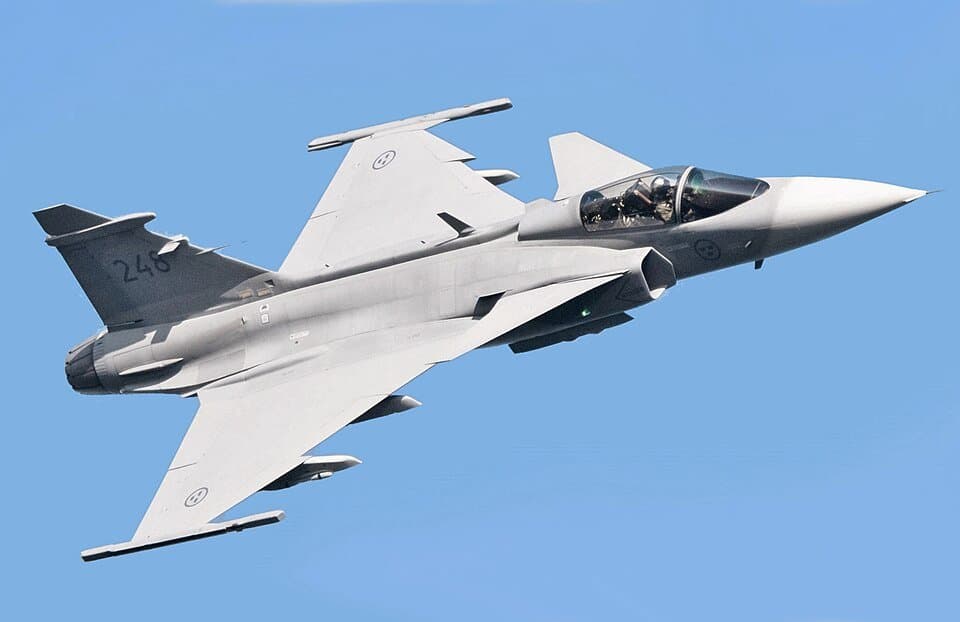

Credit
Tuomo Salonen / SIM Finnish Aviation Museum · CC BY-SA 4.0 · Resized · CC BY-SA 4.0 · Source ↗ · Modified


Preparing your view.
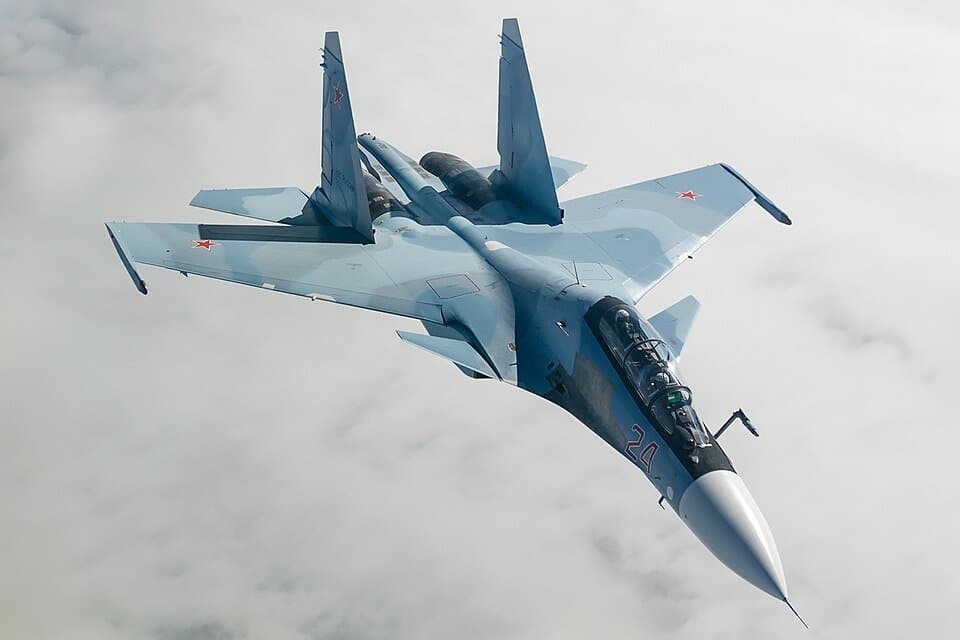
At a glance
Measured figures
JAS 39C
Single source14.9 m (48 ft 11 in) JAS 39C[source]
Su-27PU/Su-30 · Length
Single sourceConfiguration
| Specification | Saab JAS 39 Gripen | Sukhoi Su-30 |
|---|---|---|
| Type | Multirole fighter[source] | Multirole fighter[source] |
| National origin | Sweden[source] | Soviet Union Russia[source] |
| Manufacturer | Saab AB[source] | Sukhoi, Komsomolsk-on-Amur Aircraft Production Association, Yakovlev Corporation[source] |
| Designer | Industrigruppen JAS , FMV[source] |
21.935 m (72 ft 0 in)[source]
Maximum; ) at 15 240 m (50,000 ft
Single sourceMaximum; Mach 2 (
Single sourceMaximum; Maximum speed
Single sourceMach 2 (2,100 km/h; 1,300 mph; 1,100 kn) at 15 240 m (50,000 ft)[source]
Maximum; Su-27PU/Su-30 · at high altitude
Single source2,120 km/h (1,320 mph, 1,140 kn) at high altitude[source]
Combat range
Single source800 km (500 mi, 430 nmi)[source]
1 × Volvo RM12 afterburning turbofan engine thrust dry
Single sourcewith afterburner
Single source1 × Volvo RM12 afterburning turbofan engine, 54 kN (12,000 lbf) thrust dry, 80.5 kN (18,100 lbf) with afterburner[source]
Su-27PU/Su-30 · 2 × Saturn AL-31FL /FP Afterburning turbofan engines thrust each dry
Single sourceSu-27PU/Su-30 · with afterburner
Single sourceSu-27PU/Su-30 · 45,000 ft/min
Single source230 m/s (45,000 ft/min)[source]
Bars compare reported quantities only. A larger figure does not make a system better; configurations and test conditions differ.
Sukhoi[source] |
| Status | In service[source] | In service[source] |
|---|
| Primary users | Swedish Air Force Brazilian Air Force South African Air Force Hungarian Air Force[source] | Russian Aerospace Forces Indian Air Force People's Liberation Army Air Force Algerian Air Force[source] |
|---|
| Number built | ~300 (2023)[source] | 630+ (as of 2019 )[source] |
|---|
| Manufactured | 1987–present[source] | 1992–present[source] |
|---|
| Introduction date | 9 June 1996[source] | 1992 (Su-30) 2013 (Su-30SM)[source] |
|---|
| First flight | 9 December 1988[source] | 31 December 1989 ( 1989-12-31 )[source] |
|---|
| Fuel capacity | 3,000 L (790 US gal) (2340 kg) (internal); 3,500 L (920 US gal) (2730 kg) (external)[source] | 9,400 kg (20,723 lb) internal[source] |
|---|
| g limits | +9/−3 (+12 if needed)[source] | + 9[source] |
|---|
| Wing loading | 283 kg/m 2 (58 lb/sq ft)[source] | 401 kg/m 2 (82 lb/sq ft) with 56% fuel[source] |
|---|
| Thrust/weight | 0.97[source] | 1 with 56% fuel[source] |
|---|
| Takeoff distance | 400 m (1,312 ft)[source] | — |
|---|
| Landing distance | 500 m (1,640 ft)[source] | — |
|---|
| Guns | 1 × 27 mm Mauser BK-27 revolver cannon with 120 rounds (single-seat models only)[source] | 1 × 30 mm Gryazev-Shipunov GSh-30-1 autocannon with 150 rounds[source] |
|---|
| Hardpoints | 8 (two hardpoints under fuselage, two under each wing, and one on each wing tip, with one of these for FLIR/ECM/LD/Recon pod) with a capacity of 5,300 kg (11,700 lb), with provisions to carry combinations of:[source] | 12 hardpoints with a capacity of up to 8,000 kg (18,000 lb), with provisions to carry combinations of: Rockets: S-8 KOM/BM/OM S-13 T/OF S-25 OFM-PU Missiles: Air-to-air missiles : R-27 R/ER/T/ET/P/EA R-73 E/M RVV-AE (R-77)-1/M R-37M (on the SM2 variant) Air-to-surface missiles : Kh-29 TE/L Kh-59 M/ME Anti-ship missiles : Kh-31 A Anti-radiation missiles : Kh-31 P Bombs: KAB-500KR general-purpose bomb KAB-500OD bomb KAB-1500KR GP bomb KAB-1500L laser-guided bomb FAB-500T GP bomb BETAB-500 SHP bomb ODAB-500PM bomb OFAB-250-270 bomb OFAB-100-120 bomb P-50T bomb RBK-500 cluster bombs SPBE-D bomb[source] |
|---|
| Missiles | 6 × IRIS-T (Rb.98) or AIM-9 Sidewinder (Rb.74) or A-Darter 4 × MBDA Meteor (Rb.101), AIM-120 AMRAAM (Rb.99) 4 × AGM-65 Maverick 2 × RBS-15 F anti-ship missile[source] | Air-to-air missiles : R-27 R/ER/T/ET/P/EA R-73 E/M RVV-AE (R-77)-1/M R-37M (on the SM2 variant) Air-to-surface missiles : Kh-29 TE/L Kh-59 M/ME Anti-ship missiles : Kh-31 A Anti-radiation missiles : Kh-31 P[source] |
|---|
| Bombs | 4 × GBU-12 Paveway II laser-guided bomb 8 × Mark 82 bombs 16 × GBU-39 Small Diameter Bomb[source] | KAB-500KR general-purpose bomb KAB-500OD bomb KAB-1500KR GP bomb KAB-1500L laser-guided bomb FAB-500T GP bomb BETAB-500 SHP bomb ODAB-500PM bomb OFAB-250-270 bomb OFAB-100-120 bomb P-50T bomb RBK-500 cluster bombs SPBE-D bomb[source] |
|---|
| Other | 1 × ALQ-TLS electronic countermeasures (ECM) pod 1 × Digital Joint Reconnaissance Pod BriteCloud Expendable Active Decoys (EADs)[source] | — |
|---|
| Source measurement | In the late 1970s, Sweden sought to replace its aging Saab 35 Draken and Saab 37 Viggen . The Swedish Air Force required an affordable Mach 2 aircraft with good short-field performance for a defensive dispersed basing plan in the event of invasion; the plan included 800 m long by 17 m wide rudimentary runways that were part of the Bas 90 system. One goal was for the aircraft to be smaller than the Viggen while equalling or improving on its payload-range characteristics. Early proposals included the Saab 38 , also called B3LA, intended as an attack aircraft and trainer, and the A 20 , a development of the Viggen that would have capabilities as a fighter, attack and sea reconnaissance aircraft. Several foreign designs were also studied, including the General Dynamics F-16 Fighting Falcon , the McDonnell Douglas F/A-18 Hornet , the Northrop F-20 Tigershark and the Dassault Mirage 2000 . Ultimately, the Swedish government opted for a new fighter to be developed by Saab .[source]Saab JAS 39 Gripen · Development / Origins; only the objects and conditions stated in this passage Saab rolled out the first Gripen on 26 April 1987, marking the company's 50th anniversary. Originally planned to fly in 1987, the first flight was delayed by 18 months due to issues with the flight control system. On 9 December 1988, the first prototype (serial number 39-1) took its 51-minute maiden flight with pilot Stig Holmström at the controls. During the test programme, concern surfaced about the aircraft's avionics, specifically the fly-by-wire flight control system (FCS), and the relaxed stability design. On 2 February 1989, this issue led to the crash of the prototype during an attempted landing at Linköping ; the test pilot Lars Rådeström walked away with a broken elbow. The cause of the crash was identified as pilot-induced oscillation , caused by problems with the FCS's pitch-control routine.[source]Saab JAS 39 Gripen · Development / Testing, production, and improvements; only the objects and conditions stated in this passage The first order included an option for another 110, which was exercised in June 1992. Batch II consisted of 96 one-seat JAS 39As and 14 two-seat JAS 39Bs. The JAS 39B variant is 66 cm (26 in) longer than the JAS 39A to accommodate a second seat, which also necessitated the deletion of the cannon and a reduced internal fuel capacity. By April 1994, five prototypes and two series-production Gripens had been completed; but a beyond-visual-range missile (BVR) had not yet been selected. A third batch was ordered in June 1997, composed of 50 upgraded single-seat JAS 39Cs and 14 JAS 39D two-seaters, known as 'Turbo Gripen', with NATO compatibility for exports. Batch III aircraft, delivered between 2002 and 2008, possess more powerful and updated avionics, in-flight refuelling capability via retractable probes on the aircraft's starboard side , and an on-board oxygen-generating system (OBOGS) for longer-duration missions. In-flight refuelling was tested via a specially equipped prototype (39‐4) used in successful trials with a VC10 from the Royal Air Force in 1998.[source]Saab JAS 39 Gripen · Development / Testing, production, and improvements; only the objects and conditions stated in this passage The Gripen NG's maximum takeoff weight was increased from 14 000 to 16 000 kg ( 30 900 –35 300 lb ), internal fuel capacity was increased by 40 per cent by relocating the undercarriage, which also allowed for two additional hardpoints be added on the fuselage underside.[source]Saab JAS 39 Gripen · Development / JAS 39E/F and other developments; only the objects and conditions stated in this passage Its combat radius was 1,300 kilometres (810 mi) when carrying six air-to-air missiles (4 RR + 2 IR) and external tanks.[source]Saab JAS 39 Gripen · Development / JAS 39E/F and other developments; only the objects and conditions stated in this passage On 21 January 2009, the Gripen Demo flew at Mach 1.2+ at 28 000 ft ( 8540 m ) without reheat to test its supercruise capability.[source]Saab JAS 39 Gripen · Development / JAS 39E/F and other developments; only the objects and conditions stated in this passage The Gripen is a multirole fighter aircraft, intended as a light-weight and agile aerial platform with advanced, highly adaptable avionics. It has canard control surfaces that contribute a positive lift force at all speeds, while the generous lift from the delta wing compensates for the rear stabiliser producing negative lift at high speeds, increasing induced drag . Being intentionally unstable and employing digital fly-by-wire flight controls to maintain stability removes many flight restrictions, improves manoeuvrability , and reduces drag. The Gripen also has good short takeoff performance, being able to maintain a high sink rate and strengthened to withstand the stresses of short landings. The aircraft is fitted with retractable tricycle landing gear, with a double-wheeled nose gear and single main wheels. A pair of air brakes are located on the sides of the rear fuselage; the canards also angle downward to act as air brakes and decrease landing distance. It is capable of flying at a 70–80 degrees angle of attack.[source]Saab JAS 39 Gripen · Design / Overview; only the objects and conditions stated in this passage The Gripen entered service using the PS-05/A pulse-Doppler multi-mode X band radar, developed by Ericsson and GEC-Marconi , which is based on the latter's advanced Blue Vixen radar for the Sea Harrier that also served as the basis for the Eurofighter's CAPTOR radar. The all-weather radar is capable of locating and identifying targets 120 km (74 mi) away, and automatically tracking multiple targets in the upper and lower spheres, on the ground and sea or in the air. It can guide several beyond visual range air-to-air missiles to multiple targets simultaneously. Saab stated the PS-05/A is able to handle all types of air defence, air-to-surface, and reconnaissance missions, and is developing a Mark 4 upgrade to it. The Mark 4 version has a 150% increase in high-altitude air-to-air detection ranges, detection and tracking of smaller targets at current ranges, 140% improvement in air-to-air mode at low altitude, and full integration of modern weapons such as the AIM-120C-7 AMRAAM , AIM-9X Sidewinder , and MBDA Meteor missiles.[source]Saab JAS 39 Gripen · Design / Avionics and sensors; only the objects and conditions stated in this passage Like the Gripen, test models of the Dassault Rafale used F404 engines until replaced by the Snecma M88 -2 engine on production aircraft. A JAS 39C variant powered by a new 80–93 kN (8,200–9,500 kgf; 18,000–21,000 lbf) thrust SNECMA M88-3 engine was proposed. The M88-3 variant would have a new low pressure compressor (LPC) with a new variable stator vane stage and an increased mass flow of 73.4 kg/s (9,710 lb/min).[source]Saab JAS 39 Gripen · Design / Engine; only the objects and conditions stated in this passage The Gripen is compatible with a number of different armaments, beyond the aircraft's single 27 mm Mauser BK-27 cannon (omitted on the two-seat variants), including air-to-air missiles such as the AIM-9 Sidewinder , air-to-ground missiles such as the AGM-65 Maverick , and anti-ship missiles such as the RBS-15 . In 2010, the Swedish Air Force's Gripen fleet completed the MS19 upgrade process, enabling compatibility with a range of weapons, including the long-range MBDA Meteor missile, the short-range IRIS-T missile and the GBU-49 laser-guided bomb. Speaking on the Gripen's selection of armaments, Saab's campaign director for India, Edvard de la Motte stated that: "If you buy Gripen, select where you want your weapons from: Israel, Sweden, Europe, US ... South America. It's up to the customer".[source]Saab JAS 39 Gripen · Design / Equipment and armaments; only the objects and conditions stated in this passage In flight, the Gripen is typically capable of carrying up to 6,500 kg (14,330 lb) of assorted armaments and equipment. Equipment includes external sensor pods for reconnaissance and target designation, such as Rafael 's LITENING targeting pod, Saab's Modular Reconnaissance Pod System, or Thales' Digital Joint Reconnaissance Pod. The Gripen has an advanced and integrated electronic warfare suite, capable of operating in an undetectable passive mode or to actively jam hostile radar; a missile approach warning system passively detects and tracks incoming missiles. In November 2013, it was announced that Saab will be the first to offer the BriteCloud expendable Active jammer developed by Selex ES. In June 2014, the Enhanced Survivability Technology Modular Self Protection Pod, a defensive missile countermeasure pod, performed its first flight on the Gripen.[source]Saab JAS 39 Gripen · Design / Equipment and armaments; only the objects and conditions stated in this passage During the Cold War , the Swedish Armed Forces were to be ready to defend against a possible invasion. This scenario required defensive force dispersal of combat aircraft in the Bas 90 system to maintain an air defence capacity. Thus, a key design goal during the Gripen's development was the ability to operate from snow-covered landing strips of only 500 metres (1,600 ft); furthermore, a short-turnaround time of just ten minutes, during which a team composed of a technician and five conscripts would be able to re-arm, refuel, and perform routine inspections and servicing inside that time window before returning to flight for air-to-air missions. For air-to-ground missions this turnaround time using the same resources is slightly longer at twenty minutes.[source]Saab JAS 39 Gripen · Design / Usability and maintenance; only the objects and conditions stated in this passage On 24 October 2014, Brazil and Sweden signed a 39.3 billion SEK (US$5.44 bn, R$13 bn) contract for 28 Gripen E (single-seat version) and eight Gripen F (dual-seat version) fighters for delivery from 2019 to 2024 and maintained until 2050; the Swedish government will provide a subsidized 25-year, 2.19% interest rate loan for the buy. At least 15 aircraft are to be assembled in Brazil, Brazilian companies shall be involved in its production; Gripen Fs are to be delivered later. An almost US$1 billion price increase since selection is due to developments requested by Brazil, such as the "Wide Area Display" (WAD), a panoramic 19 by 8 inches touchscreen display. The compensation package is set at US$9 billion, or 1.7 times the order value. The Brazilian Navy is interested in the Gripen Maritime to replace its Douglas A-4KU Skyhawk carrier-based fighters. In 2015, Brazil and Sweden finalised the deal to develop the Gripen F, designated F-39 by Brazil.[source]Saab JAS 39 Gripen · Operational history / Current users / Brazil; only the objects and conditions stated in this passage The first Brazilian F-39E Gripen flight took place on 26 August 2019, from Saab's facility in Linköping, Sweden. It was handed over to the Brazilian Air Force on 10 September 2019 for flight testing. The fighter arrived in Brazil on 20 September 2020, and then was transported by land to Navegantes International Airport . On 24 September, it took off to the Embraer unit in Gavião Peixoto , in São Paulo state, for the test program for flight control systems, weapon integration, communication systems and others. The fighters will be part of the 1st Air Defense Group (1º GDA), based at the Anápolis Air Force Base . The deliveries of operational fighters will begin in 2021. According to Saab executive Eddy De La Motte, the first F-39F will be delivered in 2023. In 2021, Brazil started F-39E supersonic flight tests at high altitude above 16 000 feet. According to Saab executive Mikael Franzén, Brazil will start receiving production aircraft with IRST from November 2021. The service has a requirement for 108 Gripens, to be delivered in three batches.[source]Saab JAS 39 Gripen · Operational history / Current users / Brazil; only the objects and conditions stated in this passage Saab and Embraer inaugurated the production line for Gripen E in Brazil on 9 May 2023. On 23 November 2023, the newspaper Folha de S. Paulo reported ongoing negotiations between the Brazilian and Swedish governments, for a deal involving 14 more Gripens for the Brazilian Air Force, in exchange of four Embraer C-390 Millennium transport aircraft for the Swedish Air Force, according to sources, the deal will be finalized in 2024. On 9 November 2024, the Brazilian Minister of Defence José Múcio signed a letter of intent, to increase the contract with Saab by 25%, increasing to 45 Gripens for the FAB. In exchange, the Swedish Air Force announced the selection and the beginning of negotiations to procure the Embraer C-390 Millenium airlifter. On 16 September 2025, the FAB commander Marcelo Kanitz Damasceno and the Swedish Minister of Defence Pål Jonson announced negotiations for six more Gripen Es and a batch of 12 second-hand Gripen C/Ds from the Swedish Air Force inventory.[source]Saab JAS 39 Gripen · Operational history / Current users / Brazil; only the objects and conditions stated in this passage This led the Trudeau Government to ultimately select the F-35 in 2023, despite campaigning in 2015 on a promise to not purchase the F-35.[source]Saab JAS 39 Gripen · Operational history / Potential sales / Canada; only the objects and conditions stated in this passage Gripen B, or JAS 39B : two-seat version of the 39A for training, specialised missions and aircraft type conversion . To fit the second crew member and life support systems, the internal cannon and an internal fuel tank were removed and the airframe lengthened 0.66 m (2 ft 2 in).[source]Saab JAS 39 Gripen · Variants; only the objects and conditions stated in this passage Gripen NG : Follow-on to the Gripen Demo technology demonstrator. Changes from the JAS 39C include the more powerful F414G engine, Raven ES-05 AESA radar, increased fuel capacity and payload, and two additional hardpoints. These improvements reportedly increased operational costs to an estimated 24 000 Swiss francs ( US$27 000 ) per hour, and the flyaway cost to 100 million Swiss Francs (US$113M).[source]Saab JAS 39 Gripen · Variants; only the objects and conditions stated in this passage The following investigation by the Swedish Accident Investigation Authority led to the conclusion by DNA analysis of the engine that it collided with Great cormorant birds at a speed of 304 kn (563 km/h) and height 1,400 ft (430 m).[source]Saab JAS 39 Gripen · Accidents and incidents; only the objects and conditions stated in this passage Length: 14.9 m (48 ft 11 in) JAS 39C[source]Saab JAS 39 Gripen · Specifications / JAS 39C/D; only the objects and conditions stated in this passage 15.6 m (51 ft) JAS 39D[source]Saab JAS 39 Gripen · Specifications / JAS 39C/D; only the objects and conditions stated in this passage Wingspan: 8.4 m (27 ft 7 in)[source]Saab JAS 39 Gripen · Specifications / JAS 39C/D; only the objects and conditions stated in this passage Height: 4.5 m (14 ft 9 in)[source]Saab JAS 39 Gripen · Specifications / JAS 39C/D; only the objects and conditions stated in this passage Wing area: 30 m 2 (320 sq ft)[source]Saab JAS 39 Gripen · Specifications / JAS 39C/D; only the objects and conditions stated in this passage Empty weight: 6,800 kg (14,991 lb)[source]Saab JAS 39 Gripen · Specifications / JAS 39C/D; only the objects and conditions stated in this passage Max takeoff weight: 14,000 kg (30,865 lb)[source]Saab JAS 39 Gripen · Specifications / JAS 39C/D; only the objects and conditions stated in this passage Fuel capacity: 3,000 L (790 US gal) (2340 kg) (internal); 3,500 L (920 US gal) (2730 kg) (external)[source]Saab JAS 39 Gripen · Specifications / JAS 39C/D; only the objects and conditions stated in this passage Payload: 5,300 kg (11,700 lb)[source]Saab JAS 39 Gripen · Specifications / JAS 39C/D; only the objects and conditions stated in this passage Powerplant: 1 × Volvo RM12 afterburning turbofan engine, 54 kN (12,000 lbf) thrust dry, 80.5 kN (18,100 lbf) with afterburner[source]Saab JAS 39 Gripen · Specifications / JAS 39C/D; only the objects and conditions stated in this passage Maximum speed: Mach 2 (2,100 km/h; 1,300 mph; 1,100 kn) at 15 240 m (50,000 ft) Mach 1.2 (1,470 km/h; 913 mph; 794 kn) at sea level[source]Saab JAS 39 Gripen · Specifications / JAS 39C/D; only the objects and conditions stated in this passage Combat range: 800 km (500 mi, 430 nmi)[source]Saab JAS 39 Gripen · Specifications / JAS 39C/D; only the objects and conditions stated in this passage Ferry range: 3,200 km (2,000 mi, 1,700 nmi)[source]Saab JAS 39 Gripen · Specifications / JAS 39C/D; only the objects and conditions stated in this passage Service ceiling: 15,240 m (50,000 ft)[source]Saab JAS 39 Gripen · Specifications / JAS 39C/D; only the objects and conditions stated in this passage Takeoff distance: 400 m (1,312 ft)[source]Saab JAS 39 Gripen · Specifications / JAS 39C/D; only the objects and conditions stated in this passage Landing distance: 500 m (1,640 ft)[source]Saab JAS 39 Gripen · Specifications / JAS 39C/D; only the objects and conditions stated in this passage Guns: 1 × 27 mm Mauser BK-27 revolver cannon with 120 rounds (single-seat models only)[source]Saab JAS 39 Gripen · Specifications / JAS 39C/D; only the objects and conditions stated in this passage Hardpoints: 8 (two hardpoints under fuselage, two under each wing, and one on each wing tip, with one of these for FLIR/ECM/LD/Recon pod) with a capacity of 5,300 kg (11,700 lb), with provisions to carry combinations of: Missiles: 6 × IRIS-T (Rb.98) or AIM-9 Sidewinder (Rb.74) or A-Darter 4 × MBDA Meteor (Rb.101), AIM-120 AMRAAM (Rb.99) 4 × AGM-65 Maverick 2 × RBS-15 F anti-ship missile Bombs: 4 × GBU-12 Paveway II laser-guided bomb 8 × Mark 82 bombs 16 × GBU-39 Small Diameter Bomb Other: 1 × ALQ-TLS electronic countermeasures (ECM) pod 1 × Digital Joint Reconnaissance Pod BriteCloud Expendable Active Decoys (EADs)[source]Saab JAS 39 Gripen · Specifications / JAS 39C/D; only the objects and conditions stated in this passage Length: 15.2 m (49 ft 10 in) JAS 39E[source]Saab JAS 39 Gripen · Specifications / JAS 39E/F; only the objects and conditions stated in this passage 15.9 m (52 ft) JAS 39F[source]Saab JAS 39 Gripen · Specifications / JAS 39E/F; only the objects and conditions stated in this passage Wingspan: 8.6 m (28 ft 3 in)[source]Saab JAS 39 Gripen · Specifications / JAS 39E/F; only the objects and conditions stated in this passage Wing area: 31 m 2 (330 sq ft)[source]Saab JAS 39 Gripen · Specifications / JAS 39E/F; only the objects and conditions stated in this passage Empty weight: 8,000 kg (17,637 lb)[source]Saab JAS 39 Gripen · Specifications / JAS 39E/F; only the objects and conditions stated in this passage Max takeoff weight: 16,500 kg (36,376 lb)[source]Saab JAS 39 Gripen · Specifications / JAS 39E/F; only the objects and conditions stated in this passage Fuel capacity: Internal: 4,360 L (1,150 US gal) (3,400 kg)[source]Saab JAS 39 Gripen · Specifications / JAS 39E/F; only the objects and conditions stated in this passage External: 4,535 L (3,537 kg) via 3 drop tanks: 2 × 1,700 L (450 US gal) + 1 × 1,135 L (300 US gal)[source]Saab JAS 39 Gripen · Specifications / JAS 39E/F; only the objects and conditions stated in this passage Payload: 7,200 kg (15,900 lb)[source]Saab JAS 39 Gripen · Specifications / JAS 39E/F; only the objects and conditions stated in this passage Powerplant: 1 × General Electric F414-GE-39E (RM16) afterburning turbofan engine, 64 kN (14,400 lbf) thrust dry, 98 kN (22,000 lbf) with afterburner[source]Saab JAS 39 Gripen · Specifications / JAS 39E/F; only the objects and conditions stated in this passage Maximum speed: 2,100 km/h (1,300 mph, 1,100 kn) at 15 240 m (50,000ft)[source]Saab JAS 39 Gripen · Specifications / JAS 39E/F; only the objects and conditions stated in this passage Combat range: 1,500 km (930 mi, 810 nmi) air-to-ground config[source]Saab JAS 39 Gripen · Specifications / JAS 39E/F; only the objects and conditions stated in this passage Combat endurance: >2 hours typical air-to-air config combat air patrol >1 hour at 926 km (500 nmi) radius of action 0.5 hours at 1300 km combat radius carrying 6 AAMs (4 RR + 2 IR) and external tank[source]Saab JAS 39 Gripen · Specifications / JAS 39E/F; only the objects and conditions stated in this passage Ferry range: 4,000 km (2,500 mi, 2,200 nmi)[source]Saab JAS 39 Gripen · Specifications / JAS 39E/F; only the objects and conditions stated in this passage Service ceiling: 16,000 m (52,000 ft)[source]Saab JAS 39 Gripen · Specifications / JAS 39E/F; only the objects and conditions stated in this passage Rate of climb: 254 m/s (50,000 ft/min)[source]Saab JAS 39 Gripen · Specifications / JAS 39E/F; only the objects and conditions stated in this passage Takeoff distance: 500 m (1,640 ft)[source]Saab JAS 39 Gripen · Specifications / JAS 39E/F; only the objects and conditions stated in this passage Landing distance: 600 m (1,969 ft)[source]Saab JAS 39 Gripen · Specifications / JAS 39E/F; only the objects and conditions stated in this passage | — |
|---|
| Country of origin | Sweden[source]Inventory Origin column; table 1, row 24, cell 2; revision 1377321936; retrieved 2026-10-01 | — |
|---|
| Built by | — | KnAAPO Irkut Corporation Hindustan Aeronautics Limited (built by HAL in India under license)[source] |
|---|
| Developed from | — | Sukhoi Su-27[source] |
|---|
| Variants | — | Sukhoi Su-30MKI Sukhoi Su-30MKK Sukhoi Su-30MKM Sukhoi Su-30MKA[source] |
|---|
| Rockets | — | S-8 KOM/BM/OM S-13 T/OF S-25 OFM-PU[source] |
|---|
Maximum take-off; Su-27PU/Su-30 · Max takeoff weight
Single source2 × Saturn AL-31FL /FP Afterburning turbofan engines, 74.5 kN (16,700 lbf) thrust each dry, 122.58 kN (27,560 lbf) with afterburner[source]