FORCETALLY
Loading the evidence…
Preparing your view.


Preparing your view.
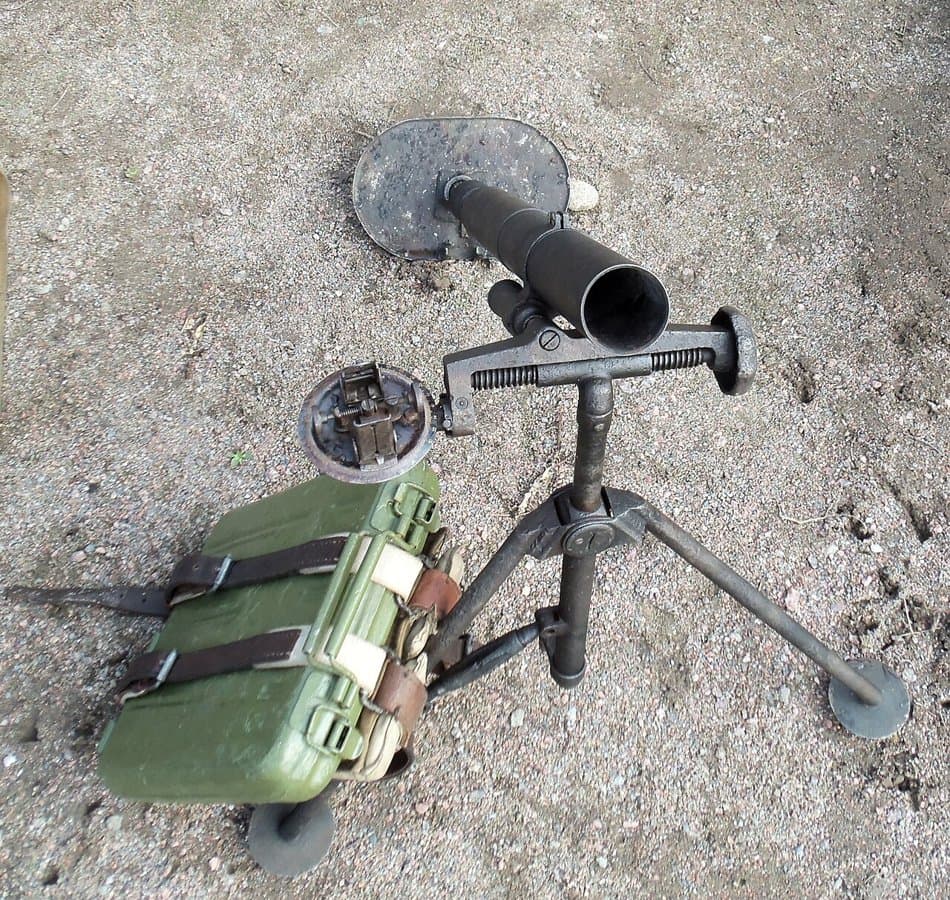
MortarsIn service
Infantry mortar
RM-38 is a infantry mortar originating in Soviet Union. Reported operators include Soviet Union.
Technical data
Points represent sourced observations, including revisions. Revisions on the same effective date are not separate inventory events. Ranges appear in the table and are not plotted as exact points.
| Observation / report period | Value | Source | Claim state |
|---|---|---|---|
| 14 Oct 2026 | 0.78 m | Wikipedia contributors | approved |
Infantry mortar
Soviet Union
Soviet Union
World War II
combat: 12.1 kg (27 lb)
bore: 50 mm (2 in) overall: 78 cm (2 ft 7 in)
0.85 kg (1 lb 14 oz)
50 mm (1.97 in)
muzzle loaded
45° or 75°. 82° on some models
6°
96 m/s (310 ft/s)
45°: 800 m (870 yd) 75°: 402 m (440 yd) 82°: 100 m (110 yd)
The RM-38 was a Soviet 50 mm light infantry mortar .
The RM-38 was a Soviet 50 mm light infantry mortar . The barrel was clamped at two elevation angles only - 45 and 75 degrees. Range variations were made by altering a sleeve round the base of the barrel. This sleeve opened a series of gas ports which bled off exhaust gases and so determined the range.
The project was deemed overly complex and expensive, and was only produced for a short time, before being replaced by the Model 1939. Despite the small number produced, some fell into German hands in 1941, who introduced them as the 5 cm Granatwerfer 205/1(r) .
The RM-38 or 50-RM 38 (50-mm company mortar model 1938) was based on the British Stokes mortar . It was further developed as the RM-39 and RM40.
The Red Army of the USSR divided mortars into company (RM Rotnyy Minomet ) battalion (BM Batalonnyy Minomet ) and regimental (PM Polkovoy Minomet ) mortars. Development of a light 50mm company mortar started in 1937. The RM-38 was approved for use in 1938 and entered production in 1939. In the space of just over a year RM-39, RM-40 and RM-41 replaced each other in succession. RM-41 remained in production until 1943, when the USSR decided to cease making 50mm mortars. Only the RM-41 was a new design with the others being incremental improvements of the original RM-38.
The problem of having only two fixed elevations and thus needing to adjust the range with the complex adjustment of gas escape made for inaccurate ranging and was dangerous to the mortar crew as well. The minimum shooting range of 200 m was felt to be impractical in Red Army use as well.
RM39 Barrel Length: 77.5 cm Weight: 14 or 17 kg
RM40 Barrel Length: 63 cm Weight: 12.1 kg
Essentially a new design, influenced by German 50mm mortars, which was continued in use until 50mm mortars were removed from Soviet Army service. This mortar was without a tripod but instead relied on its barrel yoke which contained traverse and elevation adjustments. The gases now vented under the muzzle via a tube.
The Finns were apparently not impressed with these Russian 50mm mortars, giving them mildly derogatory nicknames - "Naku" and "Tiltu", and not being over-zealous about re-issuing them.
The Finns found the RM-39 relatively accurate in use and getting the mortar ready to fire took only about one minute. The mortar was no substitute for the 80-82mm mortars however, perhaps due to only having 100g of TNT in the shell, less than some hand grenades.
Contractor(s): State Arsenals - Soviet Union
780 mm 30.71 in O/A Length
780 mm 30.71 in Barrel Length
26.68 lb 12.10 kg Weight
Manual Operation; Reusable Tube Action
50mm Caliber(s)
Included Sighting Device Sights
1,320 ft 402.3 m | 440.0 yds Max.Eff.Range
15 Rounds-Per-Minute Rate-of-Fire
Масса, кг в бою: 12.1 кг
Длина ствола , мм 553
Экипаж (расчёт), чел. 2
Скорострельность , выстрелов/мин 30 - 32
Максимальная дальность, м 45 градусов: 800 м 75 градусов: 402 м 82 градуса: 100 м
Масса, кг в бою: 12.1 кг
Длина ствола , мм 553
Экипаж (расчёт), чел. 2
Rohrlänge 78 cm (RM-38) 63 cm (RM-40)
Kaliber 5 cm
Kadenz 30 Schuss/min
Reference text from Wikipedia contributors, used under CC BY-SA 4.0.
RM-38 equipment records. Variants, orders and quantities are shown as reported in each inventory source; coverage is incomplete.
 Azerbaijan
Reported count for RM-38. Service scope: Azerbaijani Land Forces; does not replace a national total. 1 distinct count cell(s) from the same source list; shared rowspan cells counted once. Retired, wholly reserve and on-order rows are excluded; the reported count retains any explicitly mixed stock scope in the quoted row. Count column(s): number: 107. Origin: Soviet Union. The listed variants/roles are the scope, not an immediately deployable count. Dates are the count-cell citations' stated source period (2017), not the article revision. 2017 cited source edition; Cited source 2017-08-04. Edition or publication years do not claim an exact inventory census day.
310 ft/sec 94 m/sec Muzzle Velocity
There proved several types in circulation by then, ranging from limited small caliber offerings in the 50mm range to the larger siege-type 160mm variants.
In 1937, a new indigenous design was being developed as a 50mm light infantry mortar and adopted in 1938 as the 50-RM 38 ("50mm caliber, company level mortar, Model 1938"), also designated the RM-38 in some sources.
The overall unit weighed 27lbs and featured a near-two foot length launch tube.
The 50mm projectile also proved limiting in its reach and overall shock value to the point that the RM-38 line was consistently evolved throughout the early war years in the 50-RM 39, 50-RM 40 and 50-RM 41 models.
While minor improvements were witnessed in the RM-39 and RM-40, it was only the RM-41 model that was a true departure from the original offering of 1938 and this was mainly due to careful study of captured German 50mm types.
By and large, the 50mm light mortar was eventually given up by the Soviet Army as thought now shifted to larger, more destructive mortar designs that included 82mm and 120mm types.
780 mm 30.71 in O/A Length
780 mm 30.71 in Barrel Length
26.68 lb 12.10 kg Weight
Manual Operation; Reusable Tube Action
50mm Caliber(s)
Included Sighting Device Sights
1,320 ft 402.3 m | 440.0 yds Max.Eff.Range
15 Rounds-Per-Minute Rate-of-Fire
310 ft/sec 94 m/sec Muzzle Velocity
Скорострельность , выстрелов/мин 30 - 32
Максимальная дальность, м 45 градусов: 800 м 75 градусов: 402 м 82 градуса: 100 м
Экипаж (расчёт), чел. 2
Масса, кг в бою: 12.1 кг
Длина ствола , мм 553
Экипаж (расчёт), чел. 2
Скорострельность , выстрелов/мин 30 - 32
Максимальная дальность, м 45 градусов: 800 м 75 градусов: 402 м 82 градуса: 100 м
Масса, кг в бою: 12.1 кг
Длина ствола , мм 553
Экипаж (расчёт), чел. 2
Скорострельность , выстрелов/мин 30 - 32
Максимальная дальность, м 45 градусов: 800 м 75 градусов: 402 м 82 градуса: 100 м
Масса, кг в бою: 12.1 кг
Длина ствола , мм 553
Экипаж (расчёт), чел. 2
Скорострельность , выстрелов/мин 30 - 32
Максимальная дальность, м 45 градусов: 800 м 75 градусов: 402 м 82 градуса: 100 м
Масса, кг в бою: 12.1 кг
Длина ствола , мм 553
Экипаж (расчёт), чел. 2
Скорострельность , выстрелов/мин 30 - 32
Максимальная дальность, м 45 градусов: 800 м 75 градусов: 402 м 82 градуса: 100 м
Масса, кг в бою: 12.1 кг
Длина ствола , мм 553
Экипаж (расчёт), чел. 2
Скорострельность , выстрелов/мин 30 - 32
Максимальная дальность, м 45 градусов: 800 м 75 градусов: 402 м 82 градуса: 100 м
Масса, кг в бою: 12.1 кг
Длина ствола , мм 553
Экипаж (расчёт), чел. 2
Скорострельность , выстрелов/мин 30 - 32
Максимальная дальность, м 45 градусов: 800 м 75 градусов: 402 м 82 градуса: 100 м
 Moldova
Army exact named equipment holdings: PM-38. Active, operational-reserve and training units excluding equipment in store; November 2025 IISS assessment. Named service only; no parent-force or national total inferred. Source role: ARTILLERY / 120mm. Original estimates, ranges, reporting names, reserve, lease and employment scopes retained; nested included counts are not added. Missile-system quantities mean launchers, not rounds. No readiness, crew, carried weapon, payload, factory-production or future order count inherited.
 United States