FORCETALLY
Loading the evidence…
Preparing your view.


Preparing your view.
MortarsIn service
Infantry mortar
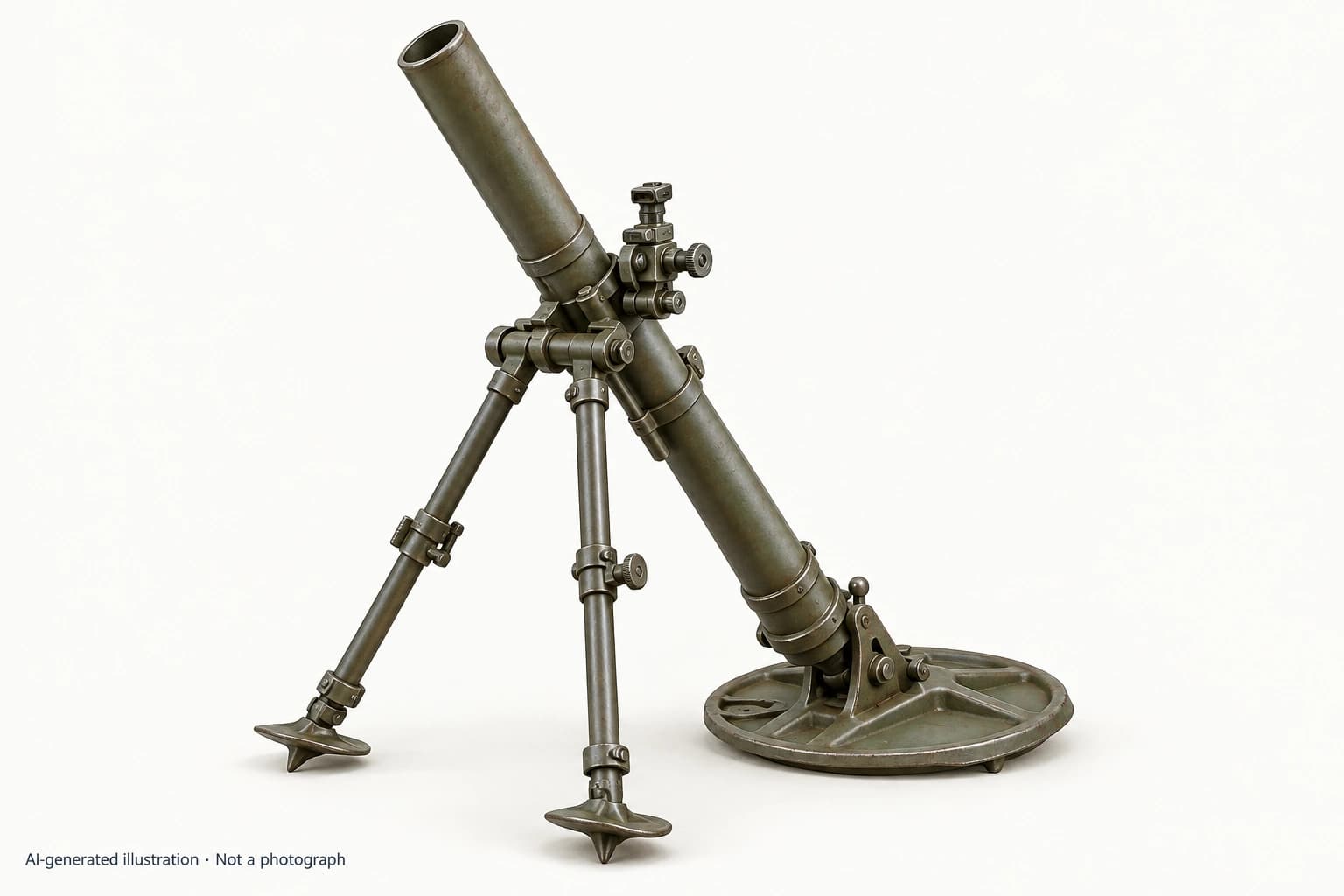
M19 mortar is a infantry mortar originating in United States. It was built by Watervliet Arsenal. Reported operators include Belgium, Cambodia, Canada, Chile, Colombia, El Salvador, Ethiopia, Greece, Iran, Japan, Lithuania, Luxembourg, Mexico, Myanmar, Panama, Philippines, South Korea, Thailand, Türkiye, United States, South Vietnam, Vietnam.
 United States
AI-generated illustration · Not a photograph. Representative rendering based on the page’s sourced specifications; exterior details are illustrative.
ForceTally · AI-generated illustration · Not a photograph · AI-generated · OpenAI output terms · Source ↗ · ModifiedInfantry mortar
United States
See Users
Korean War Vietnam War Laotian Civil War Cambodian Civil War Salvadoran Civil War
Watervliet Arsenal
23.4 kilograms (52 lb) (M5 mount) 9.3 kilograms (21 lb) (M1 mount)
81.9 cm (2 ft 8.2 in)
72.6 cm (2 ft 4.6 in)
1.36 kg (3 lb 0 oz)
60 mm (2.4 in)
+40° to +85° on M5 mount free on M1 mount
14° on M5 mount free on M1 mount
89 m/s (290 ft/s)
68 m (74 yd)
747 m (817 yd)
manual
Belgium
Cambodia
Canada
Chile
Colombia
El Salvador
Ethiopia
Greece
Iran
Japan
Lithuania
Luxembourg
Mexico
Myanmar
Panama
Philippines
South Korea
Thailand
Turkey
United States
South Vietnam
Vietnam
The M19 mortar is a light, smoothbore , muzzle-loading , high-angle-of-fire weapon for light infantry support developed and produced in the United States. It has been replaced in service by the more modern 60 mm M224 mortar , which has a much longer range and improved ammunition.
The development of the M19 began in 1942 as the T18E6, a light weapon weighing only 19.5 pounds (8.8 kg) and intended to be man-carried troops in rough terrain and quickly brought into action against enemy positions. The primary differences between the M2 and T18E6 was that the M2 was drop-fire only (the bomb being fired by a fixed firing pin at the base of the tube), while the T18E6 could be either drop-fired or a round loaded into the barrel and then fired by a lever-like trigger at the base of the tube. In addition, the original T18E6 only had a simple spade -like M1 baseplate , leaving the elevation and traverse free for the firer like the Japanese Type 89 grenade discharger or British Two-inch mortar .
A 7th Infantry Division operations report from the Battle of Leyte stated that "During this operation, the 60mm Mortar with T18E6 tube and M2 base plate, bipod, and sight, were employed.
This weapon has not proved as efficient as the M2 Mortar, since it is less accurate." Conversely, War Department observers in early 1944 found that after demonstrations of the weapon in the European and Mediterranean Theaters , "The lightness and versatility of the new 60-mm mortar firing mechanism and baseplate were appreciated, and this mortar is preferred to the present standard weapon." Postwar, the T18E6 was standardized as the M19, and saw action during the Korean War and Vietnam War alongside the M2 before being replaced by the M224 mortar in the late 1970s.
819 mm 32.24 in O/A Length
819 mm 32.24 in Barrel Length
65.70 lb 29.80 kg Weight
Muzzle Loading; Primer Impact Action
60mm Caliber(s)
None. Sights
5,872 ft 1,789.8 m | 1,957.3 yds Max.Eff.Range
18 Rounds-Per-Minute Rate-of-Fire
Origin United States
Type Mortar
Crew 2
Weight 23.4 kg
Length 819 mm with baseplate
Type 60mm smoothbore mortar
Barrel length 726 mm
Muzzle velocity 89 m/s
Elevation +40 to +85°
Traverse 7° left and right
Reference text from Wikipedia contributors, used under CC BY-SA 4.0.
True scale
Sourced dimensions beside a 1.75 m human reference.
Points represent sourced observations, including revisions. Revisions on the same effective date are not separate inventory events. Ranges appear in the table and are not plotted as exact points.
| Observation / report period | Value | Source | Claim state |
|---|---|---|---|
| 28 Sept 2026 | 0.726 m | Wikipedia contributors | superseded |
| 28 Sept 2026 | 0.726 m | Wikipedia contributors | superseded |
| 28 Sept 2026 | 0.726 m | Wikipedia contributors | superseded |
| 28 Sept 2026 | 0.726 m | Wikipedia contributors | superseded |
| 28 Sept 2026 | 0.726 m | Wikipedia contributors | superseded |
| 28 Sept 2026 | 0.726 m | Wikipedia contributors | superseded |
| 28 Sept 2026 | 0.726 m | Wikipedia contributors | superseded |
| 28 Sept 2026 | 0.726 m | Wikipedia contributors | superseded |
| 28 Sept 2026 | 0.726 m | Wikipedia contributors | superseded |
| 28 Sept 2026 | 0.726 m | Wikipedia contributors | superseded |
| 28 Sept 2026 | 0.726 m | Wikipedia contributors | superseded |
| 28 Sept 2026 | 0.726 m | Wikipedia contributors | superseded |
| 28 Sept 2026 | 0.726 m | Wikipedia contributors | superseded |
| 28 Sept 2026 | 0.726 m | Wikipedia contributors | approved |
550 ft/sec 168 m/sec Muzzle Velocity
Sights Indirect fire sight
Rate of fire 30 rpm maximum
Rate of fire 30 rpm maximum 18 rpm for 4 minutes
Rate of fire 30 rpm maximum 18 rpm for 4 minutes 8 rpm sustained
Range 1.8 km
Model M5
Type Square baseplate with bipod and indirect fire sight
Origin United States
Type Mortar
Crew 1 or 2
Weight 9.3 kg
Length 0.8 m with baseplate
Type 60mm smoothbore mortar
Barrel length 726 mm
Muzzle velocity 89 m/s
Elevation 0 to +85°
Traverse 360°
Sights Inclination gauge on base plate
Rate of fire 30 rpm maximum
Rate of fire 30 rpm maximum 18 rpm for 4 minutes
Rate of fire 30 rpm maximum 18 rpm for 4 minutes 8 rpm sustained
Range 1.8 km
Model M1
Type Bar shaped baseplate with inclination gauge
M19 mortar equipment records. Variants, orders and quantities are shown as reported in each inventory source; coverage is incomplete.
 Belgium
 Cambodia
 Canada
 Chile
 Colombia
 El Salvador
Number column of the Wikipedia list table under "Mortars". The list's own wording applies; it is a compiled secondary source, not an official census.
 Ethiopia
 Greece
Reported count for M19. Service scope: Hellenic Army; does not replace a national total. 1 distinct count cell(s) from the same source list; shared rowspan cells counted once. Retired, wholly reserve and on-order rows are excluded; the reported count retains any explicitly mixed stock scope in the quoted row. Count column(s): quantity: 150. Origin: United States. The listed variants/roles are the scope, not an immediately deployable count. The components do not establish one inventory census date; the stored date is the retrieved source snapshot.
 Iran
 Japan
 Lithuania
 Luxembourg
 Mexico
 Myanmar
 Panama
 Philippines
 South Korea
 Thailand
 Türkiye
Reported count for M19 · M19T. Service scope: Turkish Land Forces; does not replace a national total. 1 distinct count cell(s) from the same source list; shared rowspan cells counted once. Excludes retired/reserve/on-order rows. Count column(s): number: 3500. Origin: United States Turkey. The listed variants/roles are the scope, not an immediately deployable count. The components do not establish one inventory census date; the stored date is the retrieved source snapshot.
United States Vietnam
Belgium, Cambodia, Canada, Chile, Colombia, El Salvador, Ethiopia, Greece, Iran, Japan, Lithuania, Luxembourg, Mexico, Myanmar, Panama, Philippines, South Korea, Thailand, Türkiye, United States, South Vietnam, Vietnam
Equipment reference ↗