FORCETALLY
Loading the evidence…
Preparing your view.


Preparing your view.
Ballistic missilesIn service
Short-range ballistic missile
R-17 Elbrus is a short-range ballistic missile originating in Soviet Union. It was built by Votkinsk Machine Building Plant. Reported operators include Armenia, Egypt, North Korea, Syria, Turkmenistan, Vietnam, United States.
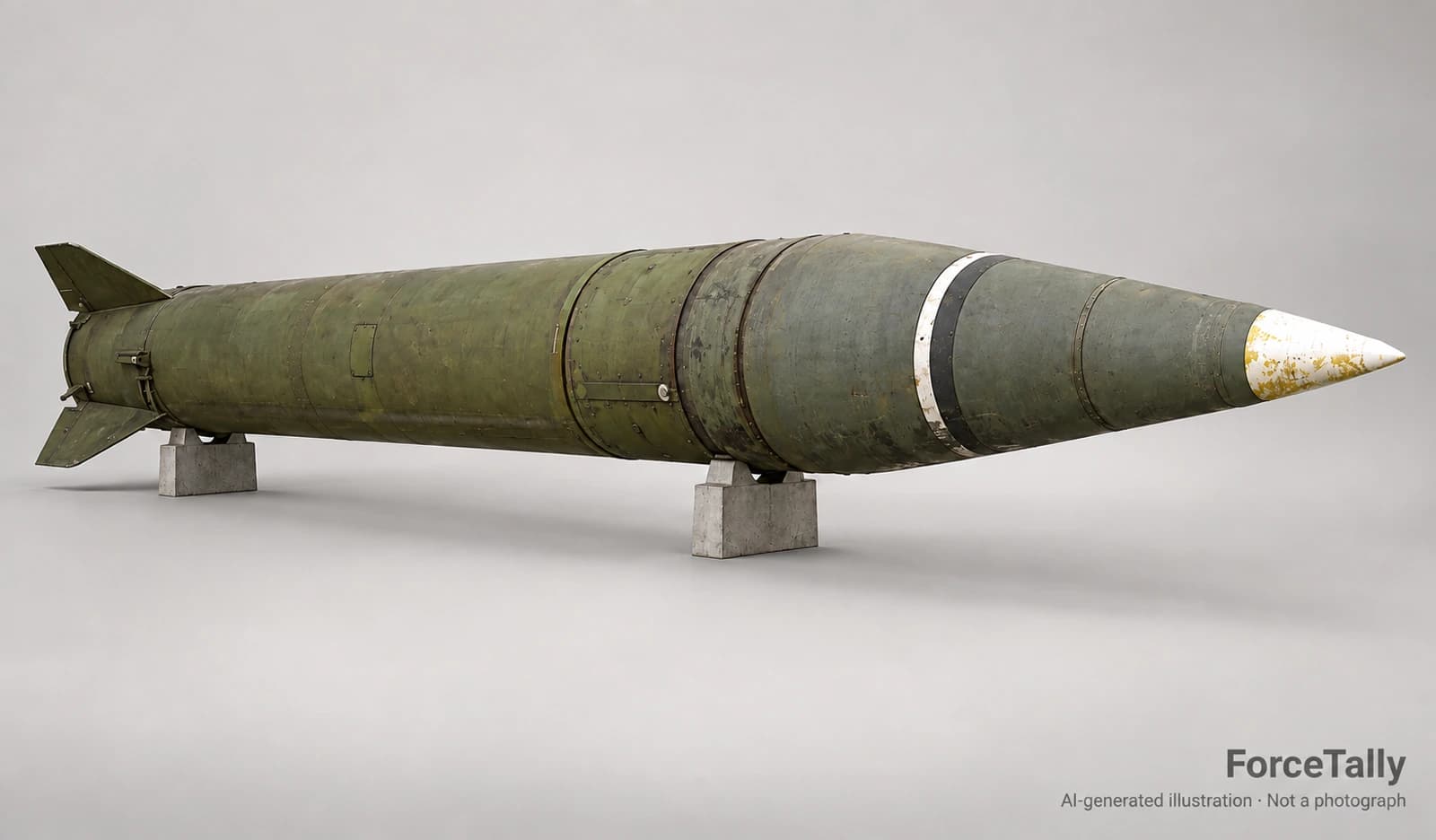
AI-generated illustration · Not a photograph · R-300 (8K14/R-17 Scud-B) museum missile at Drzonów, photographed 1 July 2007; transport carriage and painted display markings omitted. Exterior details are illustrative, not specification evidence.
ForceTally · AI-generated illustration · Not a photograph; adapted from Wisnia6522 · Public domain · https://commons.wikimedia.org/wiki/File:8K14_w_Drzonowie.jpg · ForceTally · All rights reserved · Source ↗ · ModifiedShort-range ballistic missile
Soviet Union
1962−present
See operators
Yom Kippur War Iran-Iraq War Soviet-Afghan War Gulf war Yemeni civil war (1994) Libyan civil war Syrian civil war Yemeni civil war (2014–present) 2020 Nagorno-Karabakh conflict
Viktor Makeyev
1958−1961
Votkinsk Machine Building Plant
US$1,000,000 (equivalent to US$ 2,722,285 in 2025)
1959 −1987
7,000−10,000 (est.)
See variants
5,682–5,950 kg (12,527–13,118 lb)
11.2−11.4 m (37 ft)
885 mm (34.8 in)
1,800 mm (71 in)
7
300 km (190 mi)
HE , cluster , chemical , nuclear
Isayev/KBKhM 9D21 liquid (missile) D-12-525A diesel (TEL)
440 mm (17 in)
TM-185 ( kerosene derivative) / AK-27I (27% N 2 O 4 73% HNO 3 )
450 km (280 mi) (full load)
45 km/h (28 mph)
450–900 m (490–980 yd) CEP
9P117M TEL
Armenia – 7+ launchers as of 2024
Egypt − 9 launchers as of 2024
North Korea − Produced locally as the Hwasong-5
Syria − Status unknown following the fall of the Assad regime
Turkmenistan − 16 launchers as of 2024
Vietnam
Afghanistan − The last 4 operational launchers were scrapped in 2005
Azerbaijan
Belarus − Scrapped
Czechoslovakia − Passed on to successor states
Czech Republic − Scrapped
Georgia
East Germany
Hungary − Scrapped
Iran − 20 missiles and 2 TELs supplied by Libya in 1982, Syrian R-17 and North Korean Hwasong-5 missiles were also used
Iraq − Includes local modifications: Al-Husayn , Al-Abbas , and Al Hijarah missiles
Kazakhstan
Libya
Poland − Scrapped
Romania
Russia
Slovakia
Soviet Union − Passed on to successor states
Ukraine
Yemen − Pre-war stocks depleted during the Yemeni civil war (2014–present) . Most were converted into Burkan missiles by the Houthis
United States − 30 missiles and 4 TELs purchased in 1995, these missiles were converted into targets by Lockheed Martin
The R-17 Elbrus ( Russian : Р-17, 9К72 «Эльбрус» , named for Mount Elbrus ), GRAU index 9K72 is a tactical ballistic missile , initially developed by the Soviet Union.
According to a 1988 CIA report, Egypt have probably assembled Hwasong-5 missiles locally from knock-down kits, though its unknown if their efforts to build them locally were successful. Iran have also locally assembled Hwasong-5s, giving them the local designation of Shahab-1 . Syria have also locally produced R-17 and R-17M with North Korean and Iranian assistance. Prior to the Syrian civil war , it was estimated that Syria was capable of building 30 R-17 missiles per year, under the designation Golan-1 and Golan-2 .
The R-17 featured important improvements over the R-11. The Isayev RD-21 engine used a combination of inhibited red fuming nitric acid (IRFNA) oxidiser and unsymmetrical dimethylhydrazine (UDMH) fuel, fed into the combustion chamber by fuel pumps that ensured a more consistent thrust. The guidance system, active only during the boosted phase, uses three gyroscopes , that give it a Circular Error Probable (CEP) of 450 m (490 yd) (900 m (980 yd) according to western sources ). A nuclear warhead was designed for the R-17, with a selectable yield, from 5 to 70 kilotons. However it could also carry a chemical warhead, containing 555 kg (1,224 lb) of viscous VX ; a conventional weapon, with a single high explosive warhead; or a series of fragmentation payloads, using either high explosive, anti-tank or anti-runway munitions.
The eight-wheeled MAZ-543 has a loaded weight of 37,400 kg, a road speed of 55 km/h and a range of 650 km.
The missile is raised to a vertical position by means of hydraulically powered cranes, which usually takes four minutes, while the total sequence lasts about one hour.
R-17 − Original version with a 270 km (170 mi) effective range, it used the AK-20I oxidant and TG-02 Tonka fuel.
R-17M − Improved version, it uses a more energetic fuel (a combination of the AK-27I oxidant with TM-185 fuel) and other changes increasing maximum range to 300 km (190 mi). In the 1970s, the R-17M was further improved with specially lined fuel tanks, allowing the missiles to be stored, fully fueled for up to 90 days.
Extended range R-17M − First tested in Kapustin Yar test range in 1965, it could reach 500–600 km (310–370 mi), but with poorer accuracy. Additionally, the missile performance was similar to the 9M76 Temp already in service, apparently preventing it from entering service with the Soviet Army. US intelligence initially designated it as the KY-3 , but later called the SS-1D Scud-C .
R-17E − Export version, it carries the 8F44F high-explosive warhead. When launched at the maximum 300 km range, it impacts at a speed of 1.4 km/s (0.87 mi/s), while the explosion usually leaves a crater 1.5–4 m (4 ft 11 in – 13 ft 1 in) deep and 12 m (39 ft) wide.
Hwasong-6 − Improved version of the Hwasong-5 with range extended from 330 km (210 mi) to 500 km (310 mi)
Al-Husayn − Named after Husayn ibn Ali , it was a modified R-17E with a smaller warhead and enlarged fuel tanks increasing maximum range to 650 km (400 mi).
Al-Abbas − Extended range variant with a maximum range of 860 km (530 mi).
Lacking the ability of striking targets more than 150 km (93 mi) beyond its border during the early stages of the Iran-Iraq war , the Iranians entered negotiations with the Libyans, who agreed to send two TELs and around 20 R-17E missiles to Iran, alongside instructors to train Iranian personnel. In 12 March, 1985 the Islamic Revolutionary Guard Corps launched a R-17 against Kirkuk , prompting the Iraqis to retaliate with missile launches against Dezful and Bakhtaran .
The Iraqis continued the development of extended range R-17 missiles after the war ended, including the Al-Abbas with a range of 860 km (530 mi), and the Al Hijarah with a concrete warhead for penetrating hardened targets such as Iranian or Israeli nuclear facilities. They were less successful at manufacturing R-17 copies, due to the difficulty in producing some of the more complex components such as engine turbo-pumps and guidance gyroscopes. Iraqi engineers also worked on locally building TELs (based on commercial trucks) and some static launchers (to be used against Israel).
During the Gulf War , the Brigade 224 carried missile strikes against Israel and Saudi Arabia, with at least 42 against the former and 46 against the latter. The Coalition forces employed MIM-104 Patriots to intercept Iraqi Al Husayn missiles. A problem faced by the Patriot was the Al Husayn poor design: due to the stretched fuselage, the missile became unstable upon descent, disintegrating upon atmospheric re-entry, forcing Patriots to choose which trail of debris to intercept, with critics pointing out that 1.8 tons of missile debris hitting the ground at high speed could still cause significant damage regardless of whether the R-17 warhead detonated. Regardless of the controversy, Zaloga argues that the use of Patriots did serve the political purpose of restraining the Israeli response to the Iraqi missile strikes which could have severely affected the cohesion of the Coalition.
It has been rumoured that R-17s were fired by loyalist forces against rebels in the 2011 Libyan civil war during the first phase of the war. On 14 August 2011 a confirmed R-17 launch was detected by a US Aegis destroyer, with the missile fired from Sirte and heading toward rebel positions in Ajdabiya . The missile fell 80 km off target in the middle of the desert, inflicting no damage. Eight days later, on August 22, three more R-17 launches were detected by NATO.
Range – 300 km,
CEP – 500–900 m
Preparation time – 1 hour
Flight time – 15 minutes
The guidance system, active only during the boosted phase, uses three gyroscopes , that give it a Circular Error Probable (CEP) of 450 m (490 yd) (900 m (980 yd) according to western sources ).
Reference text from Wikipedia contributors, used under CC BY-SA 4.0.
True scale
Sourced dimensions beside a 1.75 m human reference.
See it in your room. Scan with your phone to open this model in 3D, then place it in your space.
R-17 Elbrus equipment records. Variants, orders and quantities are shown as reported in each inventory source; coverage is incomplete.
 Armenia
Army exact named equipment holdings: 9K72 Elbrus (RS-SS-1C Scud B). Active, operational-reserve and training units excluding equipment in store; November 2025 IISS assessment. Named service only; no parent-force or national total inferred. Source role: GROUND-LAUNCHED MISSILES / Conventional. Original estimates, ranges, reporting names, reserve, lease and employment scopes retained; nested included counts are not added. Missile-system quantities mean launchers, not rounds. No readiness, crew, carried weapon, payload, factory-production or future order count inherited.
 Egypt
Army exact named equipment holdings: 9K72 Elbrus (RS-SS-1C Scud-B). Active, operational-reserve and training units excluding equipment in store; November 2025 IISS assessment. Named service only; no parent-force or national total inferred. Source role: GROUND-LAUNCHED MISSILES / Conventional. Original estimates, ranges, reporting names, reserve, lease and employment scopes retained; nested included counts are not added. Missile-system quantities mean launchers, not rounds. No readiness, crew, carried weapon, payload, factory-production or future order count inherited.
 Libya
 North Korea
 Syria
 Turkmenistan
Army exact named equipment holdings: 9K72 Elbrus (RS-SS-1C Scud B). Active, operational-reserve and training units excluding equipment in store; November 2025 IISS assessment. Named service only; no parent-force or national total inferred. Source role: GROUND-LAUNCHED MISSILES / Conventional. Original estimates, ranges, reporting names, reserve, lease and employment scopes retained; nested included counts are not added. Missile-system quantities mean launchers, not rounds. No readiness, crew, carried weapon, payload, factory-production or future order count inherited.
 United States
 Vietnam
Armenia, Egypt, North Korea, Syria, Turkmenistan, Vietnam, United States
Equipment reference ↗Keep exploring
Short-range ballistic missile
 India
Short-range ballistic missile
 Russia
Short-range ballistic missile
 Pakistan
Short-range ballistic missile
North KoreaShort-range ballistic missile
North KoreaShort-range ballistic missile
India